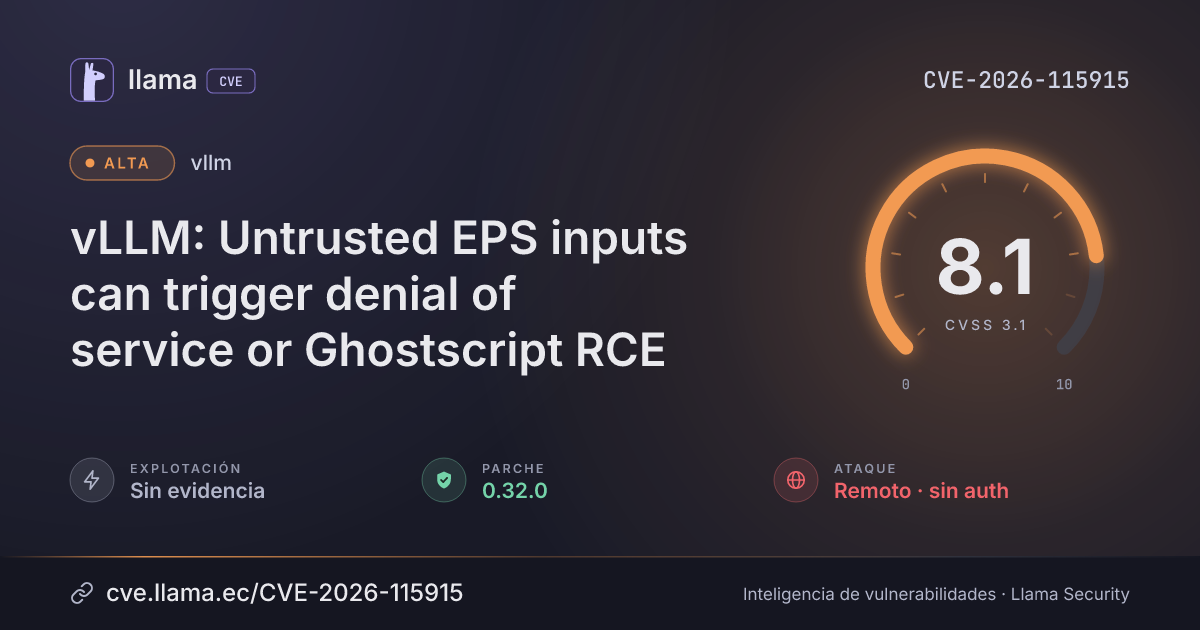
CVE-2026-115915
vLLM: Untrusted EPS inputs can trigger denial of service or Ghostscript RCE
CVSS:3.1/AV:N/AC:H/PR:N/UI:N/S:U/C:H/I:H/A:H
Fuente: CNA
CVSS:3.1/AV:N/AC:L/PR:N/UI:N/S:U/C:H/I:H/A:HCiclo de vida de la vulnerabilidad
| Fecha | Fase | Evento | Detalle |
|---|---|---|---|
| Remediación | Parche 0.32.0 | vllm · -8 d desde divulgación | |
| Divulgación | Publicada | CVE-2026-115915 divulgada · CVSS 8.1 (CNA) | |
| Monitoreo | Detectada | Ingresó al índice | |
| Monitoreo | Fuente: NIST NVD | Registro visto por primera vez en NIST NVD | |
| Monitoreo | Fuente: ENISA EUVD | Registro visto por primera vez en ENISA EUVD | |
| Divulgación | Evaluación SSVC | CISA-ADP · explotación ninguna | |
| Divulgación | Modificada | Última actualización del registro | |
| Monitoreo | Fuente: OSV | Registro visto por primera vez en OSV | |
| Monitoreo | Verificada | Última verificación contra las fuentes |
vLLM, an open-source engine for serving large language models, is affected through its image-loading code, which can be tricked into processing malicious EPS image data. This can let an attacker crash the service or, on hosts with a vulnerable Ghostscript installation, run commands with the privileges of the vLLM process.
Descripción original del registro (GitHub_M)
vLLM is an inference and serving engine for large language models. Prior to 0.32.0, ImageMediaIO passes attacker-controlled image bytes to Pillow through Image.open(BytesIO(data)) without restricting decoder selection, and the MIME label does not constrain the selected format. Image-capable request paths through parse_image() and fetch_image() can therefore dispatch an EPS payload to host components. A host with Ghostscript affected by CVE-2024-29510 can execute commands with the vLLM process's privileges, while environments using Pillow 12.0.0 through 12.2.0 can trigger CVE-2026-59203 and exhaust media-loading workers. Deployments without the applicable vulnerable dependency are not affected by that corresponding impact. This issue is fixed in version 0.32.0.
Desglose de métricas
Rangos afectados
Estado del parche por paquete
| Paquete / producto | Estado | Corregida en | Desde divulgación | Última versión |
|---|---|---|---|---|
pypivllm |
Corregida | 0.32.0 | -8 d | 0.33.0 no afectada |
0.32.0Arsenal público
Sin exploits, módulos ni PoC públicos conocidos a la fecha de verificación.
https://github.com/vllm-project/vllm/security/advisories/GHSA-h3rc-j82p-2c3hhttps://github.com/vllm-project/vllm/pull/60022https://github.com/vllm-project/vllm/commit/710ac56e691d4713feca50a43e6c440f07d373fdhttps://github.com/vllm-project/vllm/releases/tag/v0.32.0Las referencias externas se muestran para copiar: cve.llama.ec no lo redirige a otros sitios.