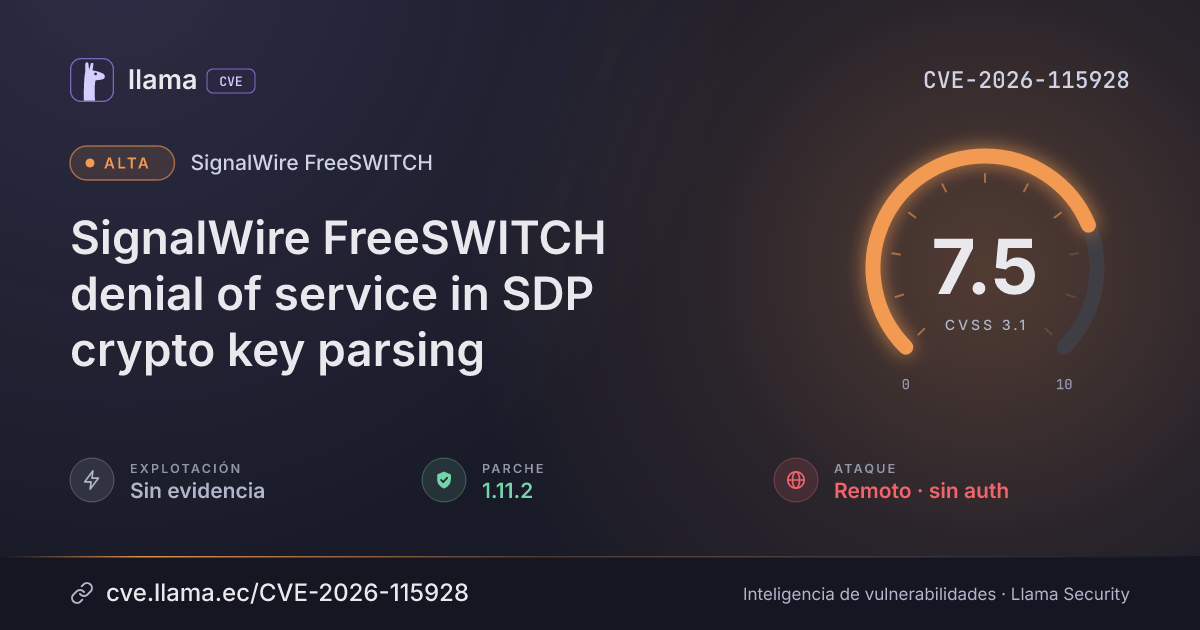
CVE-2026-115928
SignalWire FreeSWITCH denial of service in SDP crypto key parsing
A remote attacker without credentials can send a crafted call setup to crash the service and drop all active calls.
CVSS:3.1/AV:N/AC:L/PR:N/UI:N/S:U/C:N/I:N/A:H
Fuente: CNA
Ciclo de vida de la vulnerabilidad
| Fecha | Fase | Evento | Detalle |
|---|---|---|---|
| Divulgación | Publicada | CVE-2026-115928 divulgada · CVSS 7.5 (CNA) | |
| Monitoreo | Detectada | Ingresó al índice | |
| Monitoreo | Fuente: NIST NVD | Registro visto por primera vez en NIST NVD | |
| Monitoreo | Fuente: ENISA EUVD | Registro visto por primera vez en ENISA EUVD | |
| Divulgación | Evaluación SSVC | CISA-ADP · explotación ninguna | |
| Divulgación | Modificada | Última actualización del registro | |
| Monitoreo | Fuente: OSV | Registro visto por primera vez en OSV | |
| Monitoreo | Verificada | Última verificación contra las fuentes |
FreeSWITCH, an open-source telecom switching platform, has a stack buffer overflow in how it parses SDP a=crypto key material on inbound calls. A remote, unauthenticated attacker can send a crafted call setup to crash the FreeSWITCH process, dropping all active calls, though remote code execution has not been demonstrated.
Affects FreeSWITCH versions before 1.11.2 on SIP profiles that accept inbound calls and parse SDES a=crypto offers. Fixed in 1.11.2.
Descripción original del registro (GitHub_M)
FreeSWITCH is a Software Defined Telecom Stack enabling the digital transformation from proprietary telecom switches to a software implementation that runs on any commodity hardware. Prior to 1.11.2, switch_core_media_add_crypto() passed the encoded key and salt length from an inbound SDP a=crypto attribute to switch_b64_decode() as the destination capacity. A zero-length key and salt made that capacity underflow, allowing the decoded attribute to overflow a fixed stack buffer with sender-chosen bytes before the call was answered. On the shipped external profile, an unauthenticated caller can reach the SDES-SRTP parser, while profiles that challenge inbound calls remain affected for senders who can authenticate; setting rtp_secure_media_inbound to false removes the path, and WebRTC DTLS-SRTP legs are unaffected. The overflow corrupts memory and can crash the FreeSWITCH process, dropping every active call, although remote code execution has not been demonstrated. This issue is fixed in version 1.11.2.
Condiciones y alcance
Desglose de métricas
Rangos afectados
Estado del parche por paquete
| Paquete / producto | Estado | Corregida en | Desde divulgación | Última versión |
|---|---|---|---|---|
freeswitch |
Corregida | 1.11.2 | — | — |
1.11.2Arsenal público
Sin exploits, módulos ni PoC públicos conocidos a la fecha de verificación.
https://github.com/signalwire/freeswitch/security/advisories/GHSA-fvjx-g9x8-3xqhhttps://github.com/signalwire/freeswitch/commit/86b10358e2a191e2daff33d97c32757d43c8f92fhttps://github.com/signalwire/freeswitch/releases/tag/v1.11.2Las referencias externas se muestran para copiar: cve.llama.ec no lo redirige a otros sitios.