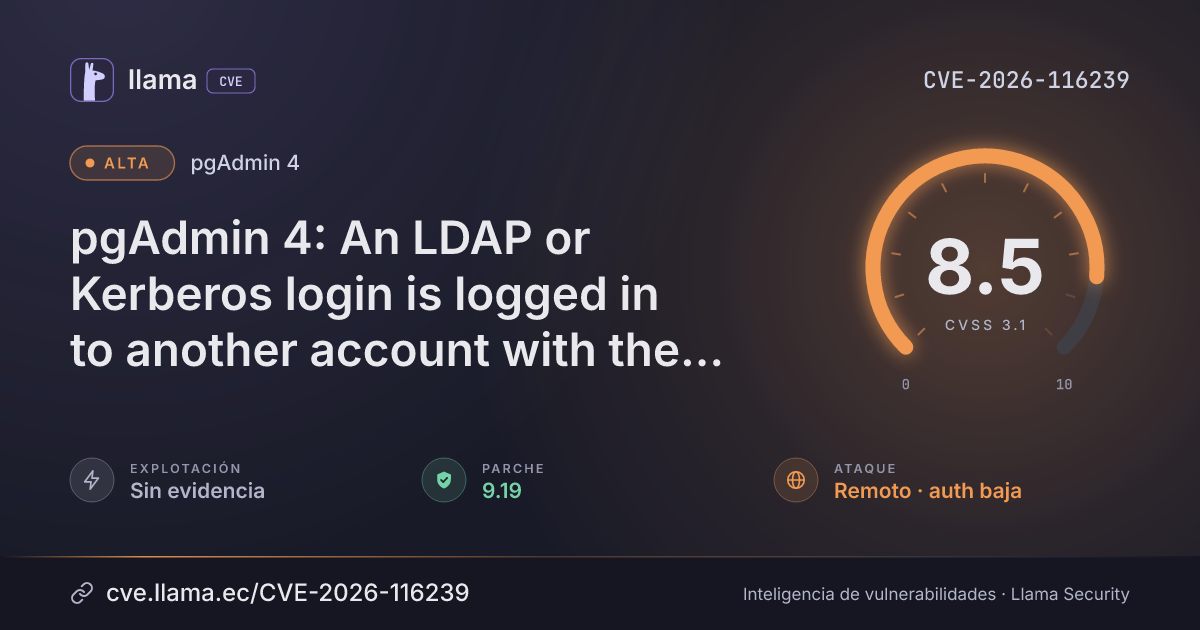
CVE-2026-116239
pgAdmin 4: An LDAP or Kerberos login is logged in to another account with the same username
CVSS:3.1/AV:N/AC:H/PR:L/UI:N/S:C/C:H/I:H/A:H
Fuente: CNA
Ciclo de vida de la vulnerabilidad
| Fecha | Fase | Evento | Detalle |
|---|---|---|---|
| Divulgación | Publicada | CVE-2026-116239 divulgada · CVSS 8.5 (CNA) | |
| Monitoreo | Detectada | Ingresó al índice | |
| Monitoreo | Fuente: NIST NVD | Registro visto por primera vez en NIST NVD | |
| Monitoreo | Fuente: OSV | Registro visto por primera vez en OSV | |
| Divulgación | Evaluación SSVC | CISA-ADP · explotación ninguna | |
| Divulgación | Modificada | Última actualización del registro | |
| Monitoreo | Verificada | Última verificación contra las fuentes |
pgAdmin 4 in server mode is affected when users sign in through LDAP or Kerberos, where a valid external login can open a session belonging to a different pgAdmin account with the same username, such as an internal account or the administrator account. That account's role, servers, and saved database passwords would then be exposed to the attacker.
Descripción original del registro (PostgreSQL)
In server mode pgAdmin 4 keeps an account per authentication source, so the same username can exist as, for example, an internal account and an LDAP account. After LDAP or Kerberos authenticated a user, pgAdmin chose the account to log in by username alone, or took the account Flask-Security's login form had looked up, without checking that it came from the source that authenticated the user. The session therefore belonged to another account, with its role, its servers and its saved database passwords: - An LDAP or Kerberos user whose username matched an internal account was logged in as that internal account, including the administrator account created when pgAdmin is first set up. - With internal authentication listed before LDAP or Kerberos in AUTHENTICATION_SOURCES, the login form's internal validation looks up the account whose email was typed and keeps it even though its password does not match. A Kerberos user could type another Kerberos user's principal and be logged in as that user, and an LDAP user could do the same with an LDAP account whose email is their username. Exploitation requires valid credentials for an LDAP directory or Kerberos realm that pgAdmin is configured to use. The fix looks the account up by the authenticated username and the source that authenticated it, and no longer uses the account the login form found for any source but internal authentication. Internal authentication logs in that account only if it is an internal account. Desktop mode is not affected. This issue affects pgAdmin 4: before 9.19.
Desglose de métricas
Rangos afectados
Estado del parche por paquete
| Paquete / producto | Estado | Corregida en | Desde divulgación | Última versión |
|---|---|---|---|---|
pgAdmin |
Corregida | 9.19 | — | — |
9.19Arsenal público
Sin exploits, módulos ni PoC públicos conocidos a la fecha de verificación.
https://github.com/pgadmin-org/pgadmin4/commit/7378060e5c8f7c3279b8138d371e13fd8b45a729https://github.com/pgadmin-org/pgadmin4/commit/269e32d5ee01f2eb5de36e464d44487a831f2424https://github.com/pgadmin-org/pgadmin4/issues/10675Las referencias externas se muestran para copiar: cve.llama.ec no lo redirige a otros sitios.