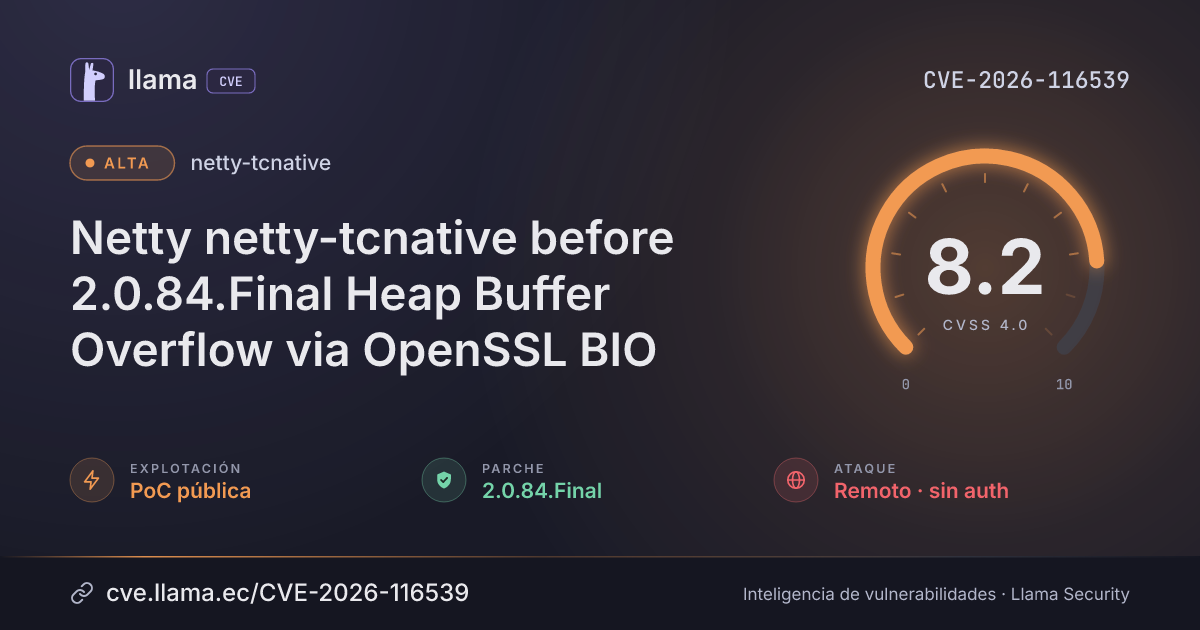
CVE-2026-116539
Netty netty-tcnative before 2.0.84.Final Heap Buffer Overflow via OpenSSL BIO
CVSS:4.0/AV:N/AC:L/AT:P/PR:N/UI:N/VC:N/VI:N/VA:H/SC:N/SI:N/SA:N
Fuente: CNA
Ciclo de vida de la vulnerabilidad
| Fecha | Fase | Evento | Detalle |
|---|---|---|---|
| Remediación | Parche 2.0.84.Final | io.netty:netty-tcnative · -49 d desde divulgación | |
| Divulgación | Publicada | CVE-2026-116539 divulgada · CVSS 8.2 (CNA) | |
| Monitoreo | Detectada | Ingresó al índice | |
| Monitoreo | Fuente: NIST NVD | Registro visto por primera vez en NIST NVD | |
| Monitoreo | Fuente: ENISA EUVD | Registro visto por primera vez en ENISA EUVD | |
| Divulgación | Evaluación SSVC | CISA-ADP · explotación PoC pública | |
| Divulgación | Modificada | Última actualización del registro | |
| Monitoreo | Fuente: OSV | Registro visto por primera vez en OSV | |
| Monitoreo | Verificada | Última verificación contra las fuentes |
Netty's netty-tcnative library, a Java wrapper for OpenSSL used in TLS-enabled network applications, is affected by this flaw. A remote attacker can send crafted TLS traffic during the handshake, renegotiation, or afterward to trigger a memory overflow that crashes the Java process.
netty-tcnative and netty-tcnative-boringssl-static before 2.0.84.Final are affected when the application sets a comparatively small nonApplicationBufferSize via bioNewByteBuffer. Fixed in 2.0.84.Final.
Descripción original del registro (VulnCheck)
Netty netty-tcnative before 2.0.84.Final contains a heap buffer overflow vulnerability in the tcn_write_to_bytebuffer BIO callback caused by failing to wrap the non-application ring buffer write index. Remote TLS peers can drive handshake, renegotiation, or post-handshake messages into this buffer, triggering an out-of-bounds memcpy that crashes the JVM process.
Condiciones y alcance
Desglose de métricas
Rangos afectados
Estado del parche por paquete
| Paquete / producto | Estado | Corregida en | Desde divulgación | Última versión |
|---|---|---|---|---|
mavenio.netty:netty-tcnative |
Corregida | 2.0.84.Final | -49 d | 2.0.86.Final no afectada |
mavenio.netty:netty-tcnative-boringssl-static |
Corregida | 2.0.84.Final | -49 d | 2.0.86.Final no afectada |
2.0.84.FinalArsenal público
Sin exploits, módulos ni PoC públicos conocidos a la fecha de verificación.
https://github.com/netty/netty-tcnative/security/advisories/GHSA-gf9q-9mg7-g5qhhttps://github.com/netty/netty-tcnative/commit/92dd66fd1243d85c05a61288f96367a70260b6b8https://github.com/netty/netty-tcnative/blob/netty-tcnative-parent-2.0.83.Final/openssl-dynamic/src/main/c/ssl.c#L199https://github.com/netty/netty-tcnative/releases/tag/netty-tcnative-parent-2.0.84.Finalhttps://github.com/netty/netty-tcnativehttps://www.vulncheck.com/advisories/netty-netty-tcnative-before-2.0.84-final-heap-buffer-overflow-via-openssl-bioLas referencias externas se muestran para copiar: cve.llama.ec no lo redirige a otros sitios.