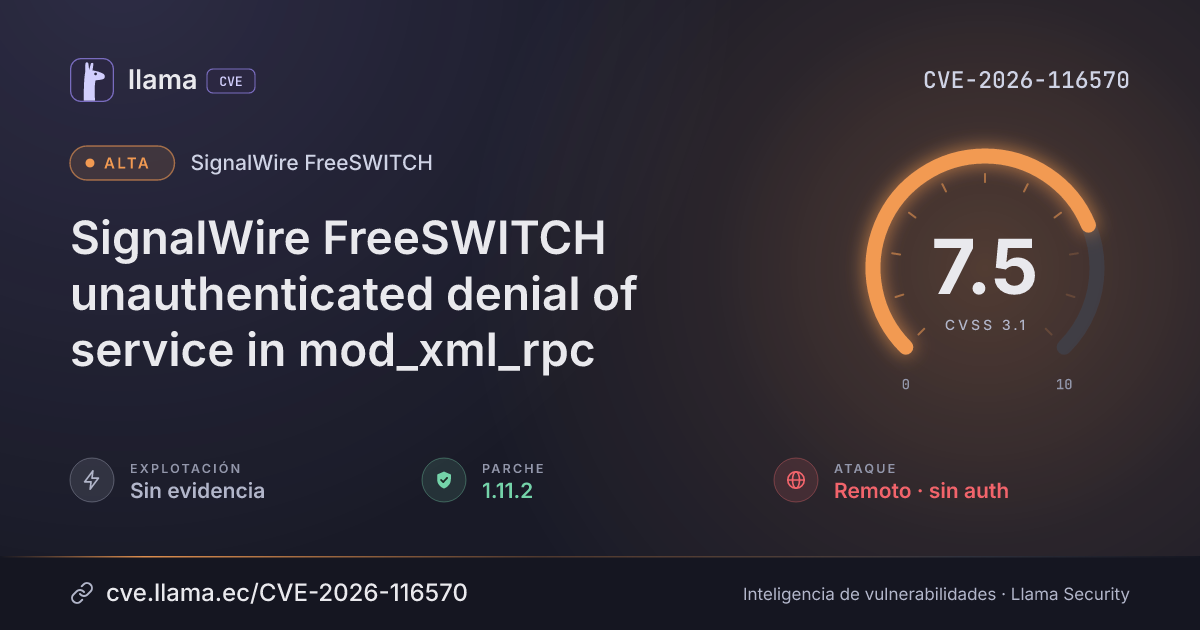
CVE-2026-116570
SignalWire FreeSWITCH unauthenticated denial of service in mod_xml_rpc
A remote attacker without logging in can crash the service and end all active calls.
CVSS:3.1/AV:N/AC:L/PR:N/UI:N/S:U/C:N/I:N/A:H
Fuente: CNA
Ciclo de vida de la vulnerabilidad
| Fecha | Fase | Evento | Detalle |
|---|---|---|---|
| Divulgación | Publicada | CVE-2026-116570 divulgada · CVSS 7.5 (CNA) | |
| Monitoreo | Detectada | Ingresó al índice | |
| Monitoreo | Fuente: NIST NVD | Registro visto por primera vez en NIST NVD | |
| Monitoreo | Fuente: ENISA EUVD | Registro visto por primera vez en ENISA EUVD | |
| Divulgación | Evaluación SSVC | CISA-ADP · explotación ninguna | |
| Divulgación | Modificada | Última actualización del registro | |
| Monitoreo | Fuente: OSV | Registro visto por primera vez en OSV | |
| Monitoreo | Verificada | Última verificación contra las fuentes |
FreeSWITCH, a software telecom switching stack, is affected by a stack buffer overflow in its mod_xml_rpc HTTP directory authentication that can be reached remotely, without logging in, on an exposed listener where the module is loaded and the configured credential is long enough to overflow the buffer. An attacker can crash FreeSWITCH, which ends all active calls, though remote code execution has not been demonstrated.
Affects FreeSWITCH builds before 1.11.2 that load mod_xml_rpc with its HTTP listener exposed and a directory entry of 58+ characters. Fixed in 1.11.2.
Descripción original del registro (GitHub_M)
FreeSWITCH is a Software Defined Telecom Stack enabling the digital transformation from proprietary telecom switches to a software implementation that runs on any commodity hardware. Prior to 1.11.2, http_directory_auth() rebuilt an expected user@domain:password credential and base64-encoded it into an 80-byte buffer using an encoder without an output-length argument. A configured credential longer than 57 characters overflowed the stack before the supplied HTTP Basic password was compared. An unauthenticated client only needed to name an existing directory user on an exposed mod_xml_rpc HTTP listener; the module is built but not loaded by the stock configuration. The overflow can corrupt the stack and crash FreeSWITCH, ending every active call, although the overrun bytes come from the configured credential and remote code execution has not been demonstrated. This issue is fixed in version 1.11.2.
Condiciones y alcance
Desglose de métricas
Rangos afectados
Estado del parche por paquete
| Paquete / producto | Estado | Corregida en | Desde divulgación | Última versión |
|---|---|---|---|---|
freeswitch |
Corregida | 1.11.2 | — | — |
1.11.2Arsenal público
Sin exploits, módulos ni PoC públicos conocidos a la fecha de verificación.
https://github.com/signalwire/freeswitch/security/advisories/GHSA-294g-hq4w-c275https://github.com/signalwire/freeswitch/commit/0246a16beb416aaaa59edbaf131d80c9d7989aeahttps://github.com/signalwire/freeswitch/releases/tag/v1.11.2Las referencias externas se muestran para copiar: cve.llama.ec no lo redirige a otros sitios.