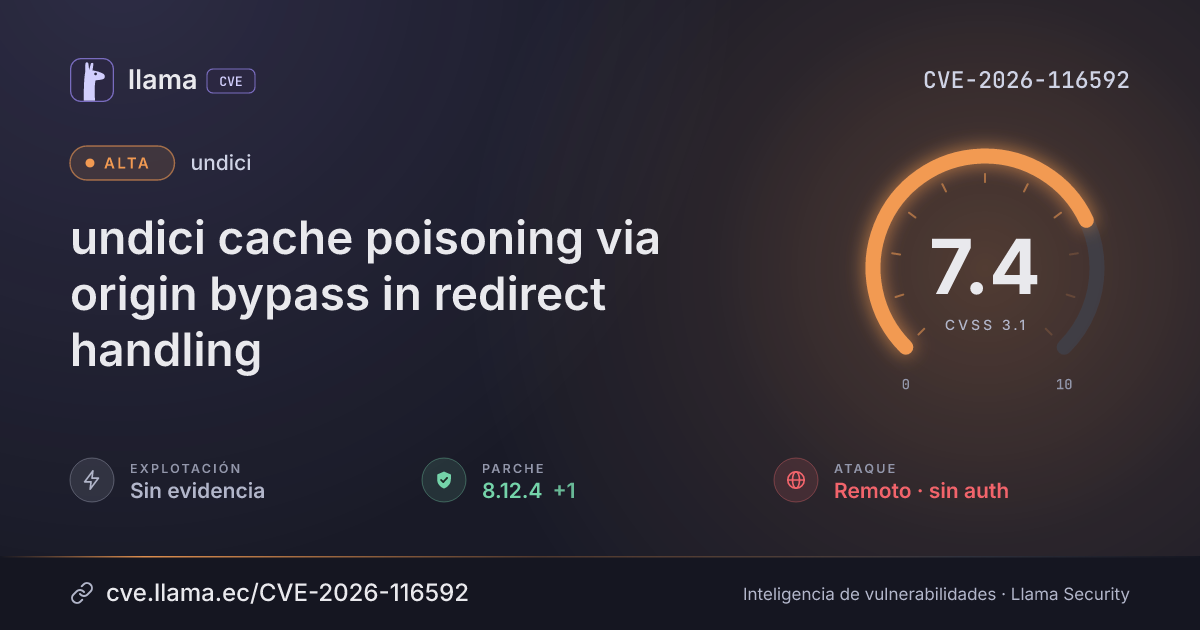
CVE-2026-116592
undici cache poisoning via origin bypass in redirect handling
A remote attacker controlling a redirect target can poison cached responses or read other users' private responses.
CVSS:3.1/AV:N/AC:H/PR:N/UI:N/S:U/C:H/I:H/A:N
Fuente: CNA
Ciclo de vida de la vulnerabilidad
| Fecha | Fase | Evento | Detalle |
|---|---|---|---|
| Remediación | Parche 7.30.2 | undici · -1 d desde divulgación | |
| Remediación | Parche 8.12.4 | undici · -1 d desde divulgación | |
| Divulgación | Publicada | CVE-2026-116592 divulgada · CVSS 7.4 (CNA) | |
| Monitoreo | Detectada | Ingresó al índice | |
| Monitoreo | Fuente: NIST NVD | Registro visto por primera vez en NIST NVD | |
| Monitoreo | Fuente: ENISA EUVD | Registro visto por primera vez en ENISA EUVD | |
| Divulgación | Evaluación SSVC | CISA-ADP · explotación ninguna | |
| Divulgación | Modificada | Última actualización del registro | |
| Monitoreo | Fuente: OSV | Registro visto por primera vez en OSV | |
| Monitoreo | Verificada | Última verificación contra las fuentes |
undici, an HTTP client for Node.js, can cache a redirected response under a trusted URL or serve one user's private response to another caller when a redirect passes through an untrusted origin. An attacker who controls a redirect target can do this remotely, without logging in and without any user action.
Only affects undici 7.30.1 to before 7.30.2 and 8.12.2 to before 8.12.4 when an originless Agent uses a shared cache store with compose(redirect(), cache()). Fixed in 7.30.2 and 8.12.4.
Descripción original del registro (openjs)
undici is an HTTP client for Node.js. In versions 7.30.1 and 8.12.2 through 8.12.3, when an originless Agent composes the redirect and shared cache interceptors, undici decides whether to store the final response under the original request key by inspecting only the final redirect hop, which bypasses the earlier fix for CVE-2026-109829 that compared only the initial and final origins. A redirect that bounces through an untrusted origin and returns to the trusted origin is still cached under the trusted key, an intermediate hop's Vary is dropped so a response that varies on Authorization or Cookie can be served to a different user, and an intermediate hop's no-cache or default-uncacheable status is ignored so a non-storable redirect is laundered into a cacheable entry. An attacker who controls a redirect target from a trusted URL can poison the cached entry for that URL or have a private, per-user response served to a later caller. The issue is fixed in undici 7.30.2 and 8.12.4, and users should upgrade to one of those versions or later. As a workaround, compose the interceptors as cache then redirect, use per-origin dispatchers and cache stores, or disable shared caching on redirect-capable requests.
Condiciones y alcance
Desglose de métricas
Rangos afectados
Estado del parche por paquete
| Paquete / producto | Estado | Corregida en | Desde divulgación | Última versión |
|---|---|---|---|---|
npmundici |
Corregida | 7.30.2, 8.12.4 | -1 d · -1 d | 8.12.4 no afectada |
7.30.28.12.4Arsenal público
Sin exploits, módulos ni PoC públicos conocidos a la fecha de verificación.
https://github.com/nodejs/undici/security/advisories/GHSA-mqg3-3v4r-cm32https://cna.openjsf.org/security-advisories.htmlLas referencias externas se muestran para copiar: cve.llama.ec no lo redirige a otros sitios.