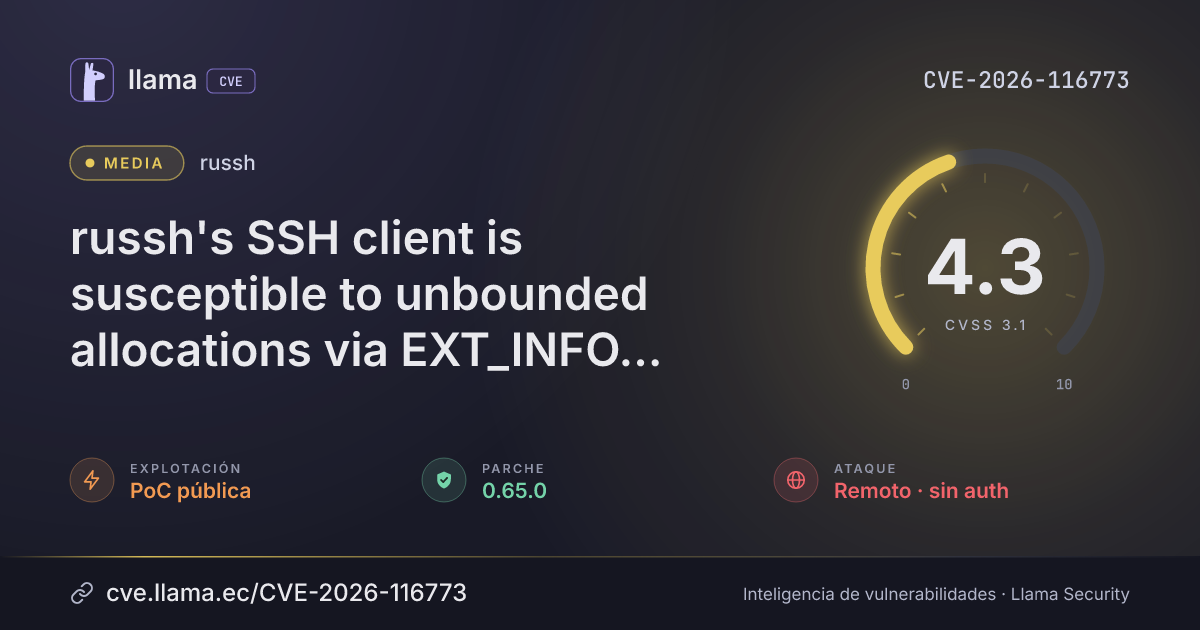
CVE-2026-116773
russh's SSH client is susceptible to unbounded allocations via EXT_INFO packets
CVSS:3.1/AV:N/AC:L/PR:N/UI:R/S:U/C:N/I:N/A:L
Fuente: CNA
Ciclo de vida de la vulnerabilidad
| Fecha | Fase | Evento | Detalle |
|---|---|---|---|
| Divulgación | Publicada | CVE-2026-116773 divulgada · CVSS 4.3 (CNA) | |
| Monitoreo | Detectada | Ingresó al índice | |
| Monitoreo | Fuente: NIST NVD | Registro visto por primera vez en NIST NVD | |
| Monitoreo | Fuente: ENISA EUVD | Registro visto por primera vez en ENISA EUVD | |
| Divulgación | Evaluación SSVC | CISA-ADP · explotación PoC pública | |
| Divulgación | Modificada | Última actualización del registro | |
| Monitoreo | Fuente: OSV | Registro visto por primera vez en OSV | |
| Monitoreo | Verificada | Última verificación contra las fuentes |
russh, a Rust SSH client and server library, has a flaw in its client that lets a malicious SSH server make the client store an ever-growing list of extension names during the connection, which can gradually exhaust the client's memory. The problem is fixed in a newer release of the library.
Descripción original del registro (GitHub_M)
russh is a Rust SSH client and server library that includes an SSH agent protocol implementation. Prior to 0.65.0, the client Session::process_packet path in russh/src/client/encrypted.rs accepts repeated packets encoded with russh's private msg::EXT_INFO = 7 before authentication, while the standards-compliant EXT_INFO message number 82 does not reach the affected handler. The handle_ext_info function appends every parsed extension name to received_extensions without clearing, deduplicating, or bounding the vector. A malicious SSH server that deliberately sends private message number 7 can therefore retain an unbounded number of attacker-controlled extension names for the session lifetime, causing progressive client memory exhaustion. This issue is fixed in version 0.65.0.
Desglose de métricas
Rangos afectados
Estado del parche por paquete
| Paquete / producto | Estado | Corregida en | Desde divulgación | Última versión |
|---|---|---|---|---|
russh |
Corregida | 0.65.0 | — | — |
0.65.0Arsenal público
Sin exploits, módulos ni PoC públicos conocidos a la fecha de verificación.
https://github.com/Eugeny/russh/security/advisories/GHSA-4p9f-7p9m-5vfghttps://github.com/Eugeny/russh/commit/b33e93beec393e6d29eee69c1b8831736724ee75https://github.com/Eugeny/russh/releases/tag/v0.65.0Las referencias externas se muestran para copiar: cve.llama.ec no lo redirige a otros sitios.