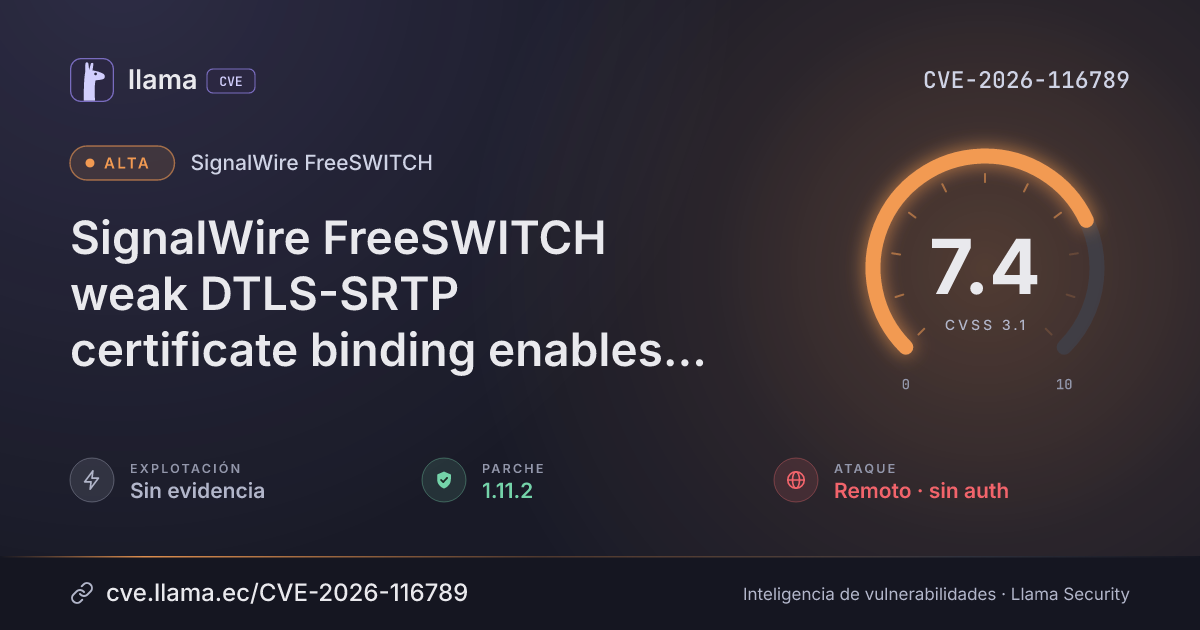
CVE-2026-116789
SignalWire FreeSWITCH weak DTLS-SRTP certificate binding enables media takeover
A remote attacker who can reach the media port may decrypt and inject media in some sessions.
CVSS:3.1/AV:N/AC:H/PR:N/UI:N/S:U/C:H/I:H/A:N
Fuente: CNA
Ciclo de vida de la vulnerabilidad
| Fecha | Fase | Evento | Detalle |
|---|---|---|---|
| Divulgación | Publicada | CVE-2026-116789 divulgada · CVSS 7.4 (CNA) | |
| Monitoreo | Detectada | Ingresó al índice | |
| Monitoreo | Fuente: NIST NVD | Registro visto por primera vez en NIST NVD | |
| Monitoreo | Fuente: ENISA EUVD | Registro visto por primera vez en ENISA EUVD | |
| Divulgación | Evaluación SSVC | CISA-ADP · explotación ninguna | |
| Divulgación | Modificada | Última actualización del registro | |
| Monitoreo | Fuente: OSV | Registro visto por primera vez en OSV | |
| Monitoreo | Verificada | Última verificación contra las fuentes |
FreeSWITCH, the open-source telecom switching platform, can be attacked remotely over the network without logging in when it acts as the DTLS server in WebRTC or SIP DTLS-SRTP media sessions. An attacker who can reach the negotiated media port may be able to obtain the session's SRTP keys, decrypt and inject media, and take over the legitimate endpoint's stream, though on ICE-enabled sessions they also need the connectivity-check credentials from the SDP, which usually requires signaling visibility or a position on the network path.
Affects FreeSWITCH legs that negotiate DTLS-SRTP, such as WebRTC via mod_verto or mod_sofia over WS/WSS and SIP peers using DTLS-SRTP, where FreeSWITCH is the DTLS server. Fixed in 1.11.2.
Descripción original del registro (GitHub_M)
FreeSWITCH is a Software Defined Telecom Stack enabling the digital transformation from proprietary telecom switches to a software implementation that runs on any commodity hardware. Prior to 1.11.2, dtls_state_setup() compared a peer certificate with the SDP a=fingerprint only when FreeSWITCH was the DTLS client, not when it held the DTLS server role. An unauthenticated peer able to reach the negotiated media port could complete the DTLS-SRTP handshake with an unrelated certificate, obtain the leg's SRTP keys, decrypt and inject media, and displace the legitimate endpoint; on ICE-enabled legs the peer also needs the connectivity-check credentials from SDP, which generally requires signaling visibility or a position on its path. WebRTC and SIP DTLS-SRTP legs are affected whenever the peer selects the active role, while FreeSWITCH client-role handshakes already perform fingerprint validation. Version 1.11.2 introduces the remediation, which requires rtp_dtls_client_cert_verify_mode=fingerprint.
Condiciones y alcance
Desglose de métricas
Rangos afectados
Estado del parche por paquete
| Paquete / producto | Estado | Corregida en | Desde divulgación | Última versión |
|---|---|---|---|---|
freeswitch |
Corregida | 1.11.2 | — | — |
1.11.2Arsenal público
Sin exploits, módulos ni PoC públicos conocidos a la fecha de verificación.
https://github.com/signalwire/freeswitch/security/advisories/GHSA-8ghv-ccjr-4cx9https://github.com/signalwire/freeswitch/commit/ea74c0acb8b85c5fc50158cd592a1b80c4edf6a6https://github.com/signalwire/freeswitch/releases/tag/v1.11.2Las referencias externas se muestran para copiar: cve.llama.ec no lo redirige a otros sitios.