llamaCVEVulnerability Intelligence
/
Eclipse Vert.x

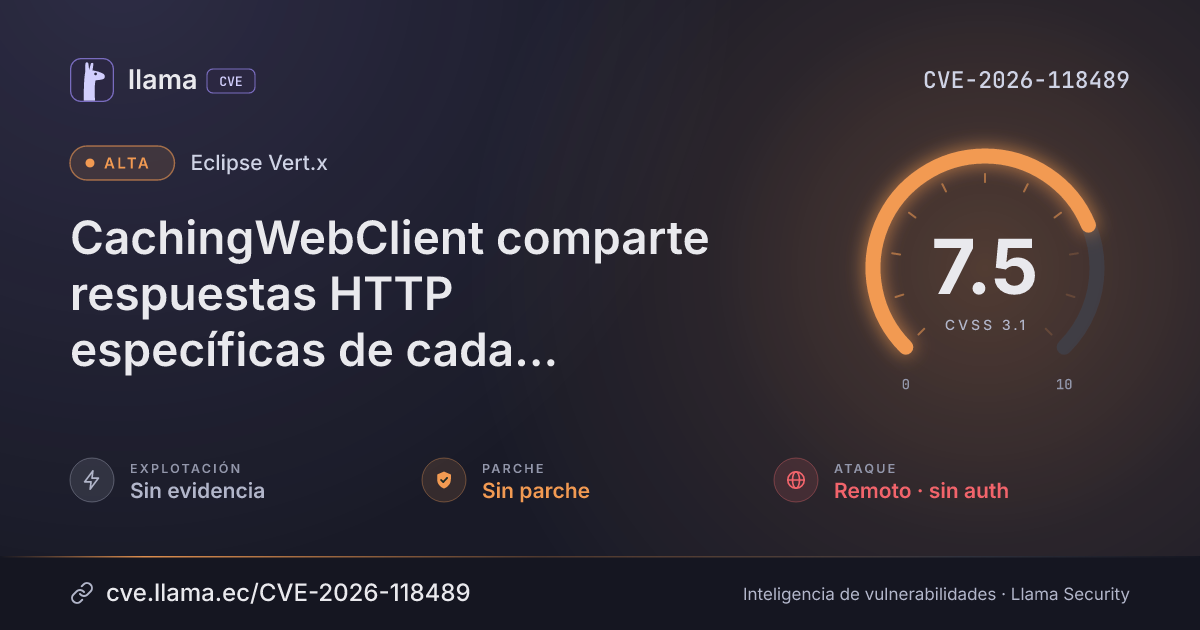
CVE-2026-118489

CachingWebClient shares user-specific HTTP responses across users via the shared cache tier

UnclearParche disponibleinformation disclosure
Descargar PNG JSON
CVSS 3.1
7.5
Alta
CVSS:3.1/AV:N/AC:L/PR:N/UI:N/S:U/C:H/I:N/A:N Fuente: CNA
ExplotaciónSin evidenciaSSVC: ninguna · no figura en CISA KEV
Exploits públicos0Ninguno conocido
Parche2 versiones4.5.36 · 5.2.3
Exposición17 dDesde la divulgación, 3 nov 2026, 9:55 a. m.
Detección6 minDesde la divulgación hasta su ingreso al índice
Decisión SSVCSeguir
Remediar en la ventana regular de mantenimiento
Sin explotación conocida, automatizable e impacto técnico parcial. Hay versiones corregidas disponibles.
Timeline

Ciclo de vida de la vulnerabilidad

Hoy
Divulgación
Publicada +2
Explotación
Remediación
Monitoreo
Detectada +2
Verificada
3 nov 26
16 nov 26
21 nov 26
3 nov 26
8 nov 26
12 nov 26
16 nov 26
21 nov 26
FechaFaseEventoDetalle
Divulgación Publicada CVE-2026-118489 divulgada · CVSS 7.5 (CNA)
Monitoreo Detectada Ingresó al índice
Monitoreo Fuente: NIST NVD Registro visto por primera vez en NIST NVD
Monitoreo Fuente: ENISA EUVD Registro visto por primera vez en ENISA EUVD
Divulgación Evaluación SSVC CISA-ADP · explotación ninguna
Divulgación Modificada Última actualización del registro
Monitoreo Verificada Última verificación contra las fuentes
Resumen
Resumen generado por IA · CC-BY 4.0

Eclipse Vert.x, specifically its CachingWebClient component, is affected when a single caching client is shared among multiple users. A user's personal web responses can be stored in a shared cache and returned to other users or anonymous callers requesting the same address, potentially exposing private content or session cookies to unauthorized people.

Affects Eclipse Vert.x 4.0.0 through 4.5.35 and 5.0.0 through 5.2.2 when one CachingWebClient is shared across users. The advisory gives no separate vendor rating. Fixed in 4.5.36 and 5.2.3.

¿Qué significa?CachingWebClient can store a user-specific HTTP response in a shared cache and then serve it to other users. This can disclose response bodies belonging to one user, and through Set-Cookie headers it can expose session credentials.
¿Quién está afectado?Eclipse Vert.x 4.0.0 through 4.5.35 and 5.0.0 through 5.2.2 are in the affected ranges. The issue needs a single CachingWebClient shared across user principals, an origin response that is user-specific but cacheable and not marked private or no-store, and a missing restrictive origin directive as a contributing condition. Check the Vert.x version in the project's dependency file.
¿Qué hacer?Upgrade to Eclipse Vert.x 4.5.36 or 5.2.3, the patched versions for each branch.
Descripción original del registro (eclipse)

In Eclipse Vert.x versions [4.0.0,4.5.35] or [5.0.0,5.2.2], when one `CachingWebClient` is shared across users — the documented pattern of a per-user `WebClientSession` over a shared caching client — a response that is specific to one user but is cacheable and not marked `private`/`no-store` is stored in the client-level shared cache tier and served to other users requesting the same URL. A later user's session, or an anonymous caller through the same client, can receive an earlier user's response. Depending on the response this discloses authenticated content or a session cookie, the latter enabling session fixation or hijacking.

Contexto

Condiciones y alcance

Condiciones necesarias para que el fallo sea explotable
01
A single CachingWebClient is shared across user principals“When one CachingWebClient is shared across users”
02
The origin response is user-specific but cacheable and not marked private or no-store“a response that is specific to one user but is cacheable and not marked private / no-store”
03
A missing restrictive origin directive is a contributing condition“a missing restrictive origin directive is a contributing condition”
Vector CVSS 3.1

Desglose de métricas

Opción resaltada = valor del vector · izquierda = peor caso · CNA
Vector de ataqueAV:N
RedAdyacenteLocalFísica
ComplejidadAC:L
BajaAlta
PrivilegiosPR:N
NingunoBajosAltos
InteracciónUI:N
NingunaRequerida
AlcanceS:U
CambiadoSin cambio
ConfidencialidadC:H
AltoBajoNinguno
IntegridadI:N
AltoBajoNinguno
DisponibilidadA:N
AltoBajoNinguno
Score de explotaciónQué tan fácil y probable es que la exploten
10.0/ 10Muy alto
Vector 10.0 (muy fácil) · sin evidencia de explotación.
Versiones

Rangos afectados

Afectada Corregida
Eclipse Vert.x≥ 4.0.0 ≤ 4.5.35
Eclipse Vert.x≥ 5.0.0 ≤ 5.2.2
4.0.0
4.5.35
5.0.0
5.2.2
Remediación

Estado del parche por paquete

Paquete / productoEstadoCorregida enDesde divulgaciónÚltima versión
Eclipse Vert.x
Corregida 4.5.36, 5.2.3 — —
Versiones corregidas4.5.365.2.3
Explotación

Arsenal público

Sin exploits, módulos ni PoC públicos conocidos a la fecha de verificación.

Registro
EscenarioGENERALeclipse
Referencias
Fabricantehttps://github.com/vert-x3/vertx-web/security/advisories/GHSA-xh2g-9hw9-mvp3
Fabricantehttps://gitlab.eclipse.org/security/cve-assignment/-/work_items/523

Las referencias externas se muestran para copiar: cve.llama.ec no lo redirige a otros sitios.