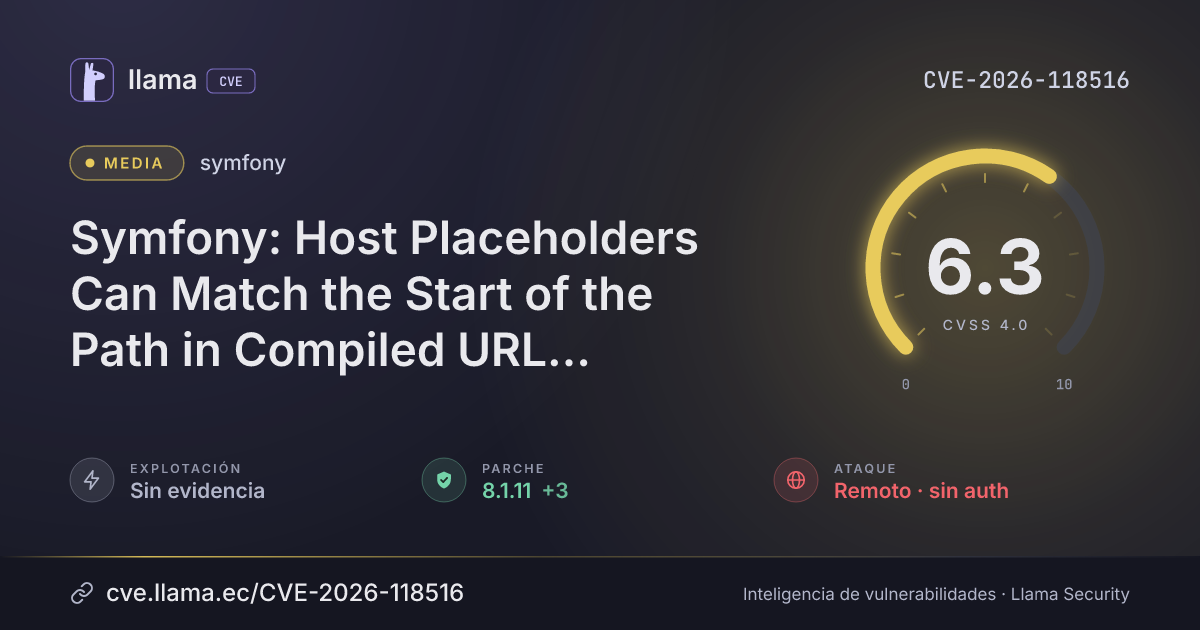
CVE-2026-118516
Symfony: Host Placeholders Can Match the Start of the Path in Compiled URL Matchers, Bypassing Path-Based Access Control
CVSS:4.0/AV:N/AC:L/AT:P/PR:N/UI:N/VC:L/VI:L/VA:N/SC:N/SI:N/SA:N
Fuente: CNA
Ciclo de vida de la vulnerabilidad
| Fecha | Fase | Evento | Detalle |
|---|---|---|---|
| Divulgación | Publicada | CVE-2026-118516 divulgada · CVSS 6.3 (CNA) | |
| Monitoreo | Detectada | Ingresó al índice | |
| Monitoreo | Fuente: NIST NVD | Registro visto por primera vez en NIST NVD | |
| Monitoreo | Fuente: ENISA EUVD | Registro visto por primera vez en ENISA EUVD | |
| Monitoreo | Fuente: OSV | Registro visto por primera vez en OSV | |
| Divulgación | Evaluación SSVC | CISA-ADP · explotación ninguna | |
| Divulgación | Modificada | Última actualización del registro | |
| Monitoreo | Verificada | Última verificación contra las fuentes |
Symfony's routing components can be tricked by crafted Host headers on routes with host placeholders, so path-based access control rules such as access_control or firewall patterns are not applied when the controller runs. A remote attacker without logging in can reach protected controllers this way, but only if the application has routes with host placeholders protected by path-based rules.
Descripción original del registro (Checkmarx)
The Symfony Routing components CompiledUrlMatcher and UrlMatcher interpret the host and path information differently, allowing path-based authorization rules to be bypassed in Symfony versions prior to 5.4.56, 6.x prior to 6.4.50, 7.x prior to 7.4.23, and 8.x prior to 8.1.11. For routes that define a host, CompiledUrlMatcher matches the string $host.'.'.$pathinfo against the host regular expression followed by the path regular expression, while UrlMatcher matches the host and the path separately. A host placeholder can therefore match /, and consume the beginning of the path, so the request is routed to a controller, while UrlMatcher would find no route. Rules that look at the path, such as access_control entries and firewall patterns, are evaluated against the actual request path, so they do not apply while the controller of the route runs, potentially allowing an unauthenticated request to reach a protected controller. For example, with the route /admin/report/{id}, the host app.{domain} and the rule access_control: [{ path: ^/admin, roles: ROLE_ADMIN }], an anonymous request for /admin/report/1 is sent to the login page. A request with the Host header app and path /x./admin/report/1 instead reaches the controller, with domain="/x". With the required domain: .+, the real hostname works: app.example.com and /x./admin/report/1 match with domain="example.com./x". Applications are affected if they have routes with host placeholders protected by path-based rules. With the default requirement, the Host header must be the host of the route without its last labels, such as app: framework.trusted_hosts blocks that, while a web server that only serves known names may not, for instance, Nginx passing the raw Host header to FastCGI for a request line that carries an absolute URI. If the requirement accepts /, such as .+, a real hostname works, and trusted_hosts does not help.
Desglose de métricas
Rangos afectados
Estado del parche por paquete
| Paquete / producto | Estado | Corregida en | Desde divulgación | Última versión |
|---|---|---|---|---|
symfony/routing |
Corregida | 5.4.56, 6.4.50, 7.4.23, 8.1.11 | — | — |
5.4.566.4.507.4.238.1.11Arsenal público
Sin exploits, módulos ni PoC públicos conocidos a la fecha de verificación.
https://github.com/symfony/symfony/security/advisories/GHSA-xqw3-x93m-887xhttps://github.com/symfony/symfony/commit/067cde51e29f6d605de4de53322a02c6e23b5416Las referencias externas se muestran para copiar: cve.llama.ec no lo redirige a otros sitios.