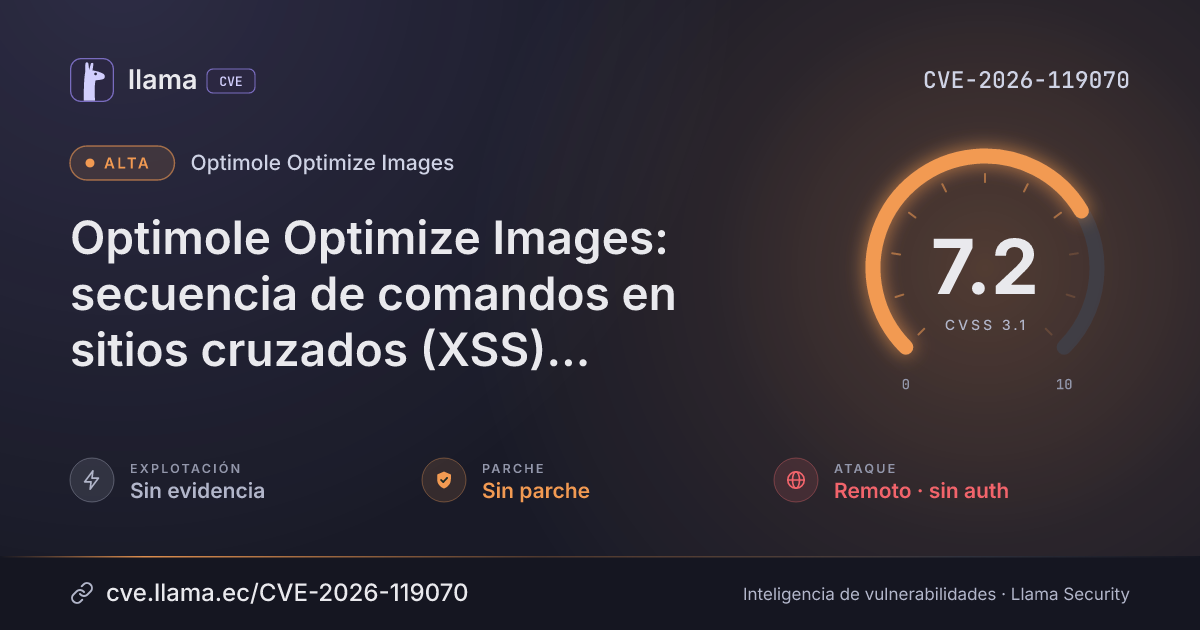
CVE-2026-119070
Optimole Optimize Images unauthenticated stored XSS in comment handling
An unauthenticated attacker can inject scripts via comment content that run whenever a user loads an affected page.
Texto original en inglés · Ver en español
CVSS:3.1/AV:N/AC:L/PR:N/UI:N/S:C/C:L/I:L/A:N
Fuente: CNA
Ciclo de vida de la vulnerabilidad
| Fecha | Fase | Evento | Detalle |
|---|---|---|---|
| Divulgación | Publicada | CVE-2026-119070 divulgada · CVSS 7.2 (CNA) | |
| Monitoreo | Detectada | Ingresó al índice | |
| Monitoreo | Fuente: NIST NVD | Registro visto por primera vez en NIST NVD | |
| Monitoreo | Fuente: ENISA EUVD | Registro visto por primera vez en ENISA EUVD | |
| Divulgación | Evaluación SSVC | CISA-ADP · explotación ninguna | |
| Divulgación | Modificada | Última actualización del registro | |
| Monitoreo | Verificada | Última verificación contra las fuentes |
The Optimole WordPress image optimization plugin has a stored cross-site scripting flaw in its comment handling, which lets an attacker remotely, without logging in, inject scripts that run whenever a user accesses an affected page. No user interaction beyond loading that page is needed to trigger the injected scripts.
Descripción original del registro (Wordfence)
The Optimole – Optimize Images | Convert WebP & AVIF | CDN & Lazy Load | Image Optimization plugin for WordPress is vulnerable to Stored Cross-Site Scripting via the 'comment' parameter in all versions up to, and including, 4.2.17 due to insufficient input sanitization and output escaping. This makes it possible for unauthenticated attackers to inject arbitrary web scripts in pages that will execute whenever a user accesses an injected page. The exploit requires the plugin to be in its normal connected state (cdn_key and cdn_secret configured) with the image replacer enabled, which is the default post-setup configuration; the stored payload bypasses all WordPress comment sanitization filters because it contains no HTML metacharacters at storage time — the characters are produced only by Optimole's own decoder at render time.
Desglose de métricas
Rangos afectados
Estado del parche por paquete
| Paquete / producto | Estado | Corregida en | Desde divulgación | Última versión |
|---|---|---|---|---|
Optimole – Optimize Images | Convert WebP & AVIF | CDN & Lazy Load | Image Optimization |
Sin parche | — | — | — |
Arsenal público
Sin exploits, módulos ni PoC públicos conocidos a la fecha de verificación.
https://www.wordfence.com/threat-intel/vulnerabilities/id/12ec2c2f-a86c-4b8f-b7fd-5917e31e1cd0?source=cvehttps://plugins.trac.wordpress.org/browser/optimole-wp/tags/4.2.17/inc/url_replacer.php#L92https://plugins.trac.wordpress.org/browser/optimole-wp/tags/4.2.17/inc/url_replacer.php#L86https://plugins.trac.wordpress.org/browser/optimole-wp/tags/4.2.17/inc/manager.php#L770https://plugins.trac.wordpress.org/browser/optimole-wp/tags/4.2.17/inc/manager.php#L889https://plugins.trac.wordpress.org/browser/optimole-wp/tags/4.2.17/inc/config.php#L62https://plugins.trac.wordpress.org/browser/optimole-wp/tags/4.2.18Las referencias externas se muestran para copiar: cve.llama.ec no lo redirige a otros sitios.