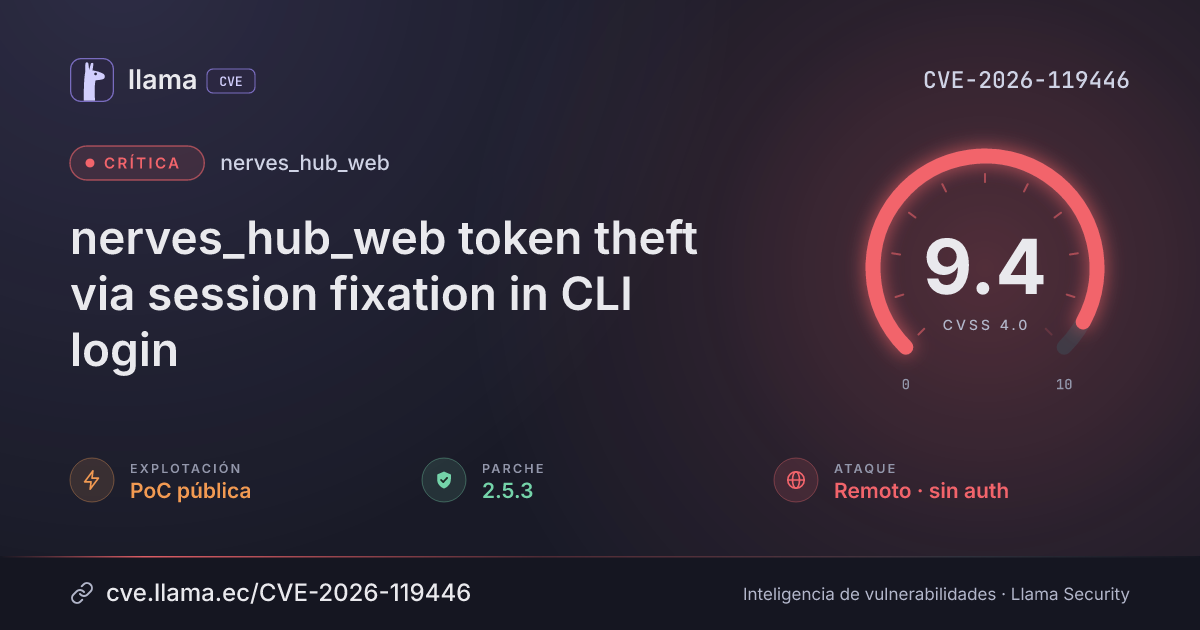
CVE-2026-119446
nerves_hub_web token theft via session fixation in CLI login
A remote attacker can steal a user's API token if they open a crafted login link and click Confirm.
CVSS:4.0/AV:N/AC:L/AT:N/PR:N/UI:A/VC:H/VI:H/VA:H/SC:H/SI:H/SA:H
Fuente: CNA
Ciclo de vida de la vulnerabilidad
| Fecha | Fase | Evento | Detalle |
|---|---|---|---|
| Divulgación | Publicada | CVE-2026-119446 divulgada · CVSS 9.4 (CNA) | |
| Monitoreo | Detectada | Ingresó al índice | |
| Monitoreo | Fuente: NIST NVD | Registro visto por primera vez en NIST NVD | |
| Divulgación | Evaluación SSVC | CISA-ADP · explotación PoC pública | |
| Monitoreo | Fuente: ENISA EUVD | Registro visto por primera vez en ENISA EUVD | |
| Monitoreo | Fuente: OSV | Registro visto por primera vez en OSV | |
| Divulgación | Modificada | Última actualización del registro | |
| Monitoreo | Verificada | Última verificación contra las fuentes |
The Nerves Hub web application (nerves_hub) has a session fixation flaw in its CLI login flow that lets an attacker obtain a user's API token. It can be reached remotely without logging in, but the victim must open a crafted login link and click Confirm.
Affects nerves_hub_web from 2.5.0 before 2.5.3 in the CLI login flow. Rated critical at CVSS 9.4 with no separate vendor rating. Fixed in 2.5.3.
Descripción original del registro (EEF)
Session Fixation vulnerability in the CLI login flow in nerves-hub nerves_hub_web allows an unauthenticated attacker to obtain an API token for another user's account via a crafted login link. Starting a CLI login with POST /api/auth/cli_session needs no authentication and returns a polling token, a confirmation URL that carries that token, and a confirmation code. When a signed-in user opens that URL and clicks Confirm, NervesHub.Accounts.verify_cli_session_token/2 creates an API token for the user's account and stores it on the login, and the next poll of GET /api/auth/cli_session/<token> returns it to whoever started the login. The confirmation code is only displayed and is never compared with anything, so it cannot show that the person confirming is the one who started the login. The confirm form carries a CSRF token and the page cannot be framed, so the attacker has to persuade the user to open the link and click the button themselves. This issue affects nerves_hub: from 2.5.0 before 2.5.3.
Condiciones y alcance
Desglose de métricas
Rangos afectados
Estado del parche por paquete
| Paquete / producto | Estado | Corregida en | Desde divulgación | Última versión |
|---|---|---|---|---|
nerves_hub_web |
Corregida | 2.5.3 | — | — |
2.5.3Arsenal público
Sin exploits, módulos ni PoC públicos conocidos a la fecha de verificación.
https://github.com/nerves-hub/nerves_hub_web/security/advisories/GHSA-9vr9-463q-46qphttps://github.com/nerves-hub/nerves_hub_web/commit/3131f1701194b581ab4b3e5e9d81194fc9c83508https://cna.erlef.org/cves/CVE-2026-119446.htmlhttps://osv.dev/vulnerability/EEF-CVE-2026-119446https://github.com/nerves-hub/nerves_hub_web/commit/e6bf11a812d7aa8b69d854ba8ef02d65516f5564Las referencias externas se muestran para copiar: cve.llama.ec no lo redirige a otros sitios.