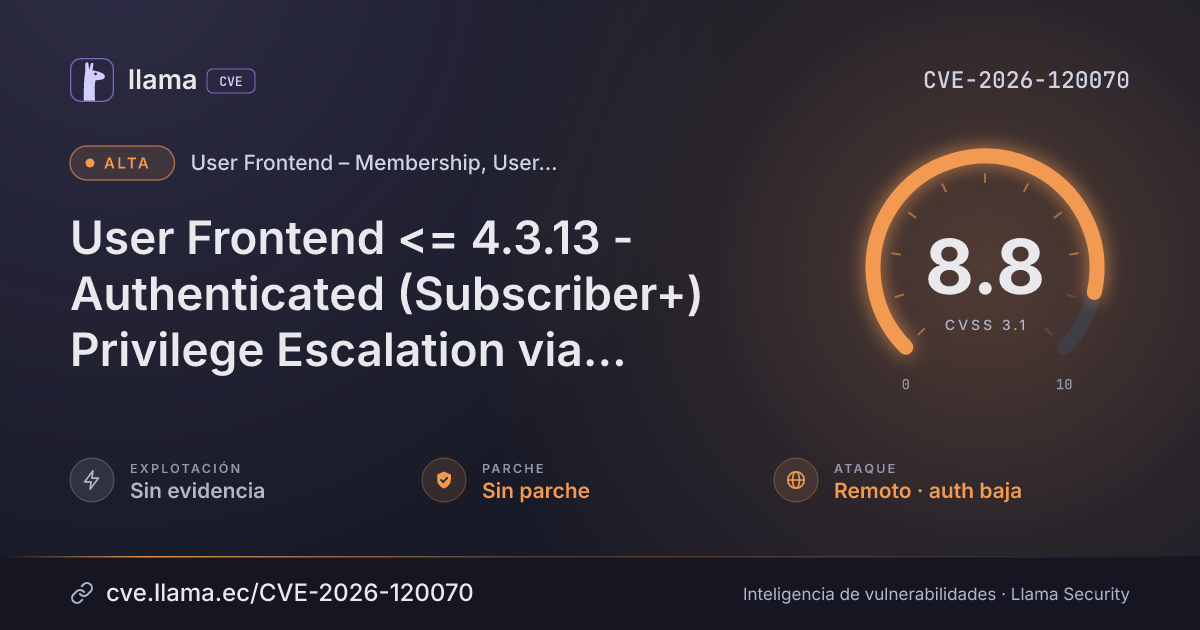
CVE-2026-120070
User Frontend <= 4.3.13 - Authenticated (Subscriber+) Privilege Escalation via post_content Parameter
CVSS:3.1/AV:N/AC:L/PR:L/UI:N/S:U/C:H/I:H/A:H
Fuente: CNA
Ciclo de vida de la vulnerabilidad
| Fecha | Fase | Evento | Detalle |
|---|---|---|---|
| Divulgación | Publicada | CVE-2026-120070 divulgada · CVSS 8.8 (CNA) | |
| Monitoreo | Detectada | Ingresó al índice | |
| Monitoreo | Fuente: NIST NVD | Registro visto por primera vez en NIST NVD | |
| Monitoreo | Fuente: ENISA EUVD | Registro visto por primera vez en ENISA EUVD | |
| Divulgación | Evaluación SSVC | CISA-ADP · explotación ninguna | |
| Divulgación | Modificada | Última actualización del registro | |
| Monitoreo | Verificada | Última verificación contra las fuentes |
The User Frontend WordPress plugin, which provides membership, registration, and frontend post submission features, is affected. A logged-in user with basic subscriber access could abuse the post submission feature to publish a registration form that creates accounts with Editor-level privileges, allowing them to gain higher access to the site.
Descripción original del registro (Wordfence)
The User Frontend – Membership, User Registration, User Profile, User Directory & Content Restriction with Frontend Post Submission plugin for WordPress is vulnerable to Privilege Escalation in all versions up to, and including, 4.3.13 via the `post_content` parameter of the `submit_post()` function. The vulnerability exists because the protected-shortcode blocklist guard inspects the `sanitize_textarea_field()` copy of the submitted `post_content`, while the copy actually persisted to the database is processed through `wp_kses()`, whose `wp_kses_no_null()` step strips C0 control bytes — allowing an attacker to inject a single `\x01` byte inside the `[wpuf-registration]` tag name to defeat the `strpos()` blocklist check while the clean, functional shortcode is stored verbatim; `strip_shortcodes()` does not neutralize the stored shortcode either, because the Frontend container that registers it via `add_shortcode()` is only instantiated when `is_admin()` is false, and `admin-ajax` requests have `is_admin() === true`. This makes it possible for authenticated attackers, with Subscriber-level access and above, to inject a `[wpuf-registration role="editor"]` shortcode into a published post, causing a live Editor-role registration form to be rendered publicly on the frontend that any visitor — or the attacker themselves — can submit to mint a WordPress Editor account with an immediately active privileged session when the default `autologin_after_registration` setting is enabled.
Desglose de métricas
Rangos afectados
Estado del parche por paquete
| Paquete / producto | Estado | Corregida en | Desde divulgación | Última versión |
|---|---|---|---|---|
User Frontend – Membership, User Registration, User Profile, User Directory & Content Restriction with Frontend Post Submission |
Sin parche | — | — | — |
Arsenal público
Sin exploits, módulos ni PoC públicos conocidos a la fecha de verificación.
https://www.wordfence.com/threat-intel/vulnerabilities/id/f84b6767-f254-45c9-8e78-36d4beac2a98?source=cvehttps://plugins.trac.wordpress.org/browser/wp-user-frontend/tags/4.3.13/includes/Ajax/Frontend_Form_Ajax.php#L253https://plugins.trac.wordpress.org/browser/wp-user-frontend/tags/4.3.13/includes/Ajax/Frontend_Form_Ajax.php#L132https://plugins.trac.wordpress.org/browser/wp-user-frontend/tags/4.3.13/includes/Frontend/Registration.php#L116https://plugins.trac.wordpress.org/browser/wp-user-frontend/tags/4.3.13/includes/Frontend/Registration.php#L362https://plugins.trac.wordpress.org/changeset/3770255/wp-user-frontend/trunk/includes/Ajax/Frontend_Form_Ajax.phpLas referencias externas se muestran para copiar: cve.llama.ec no lo redirige a otros sitios.