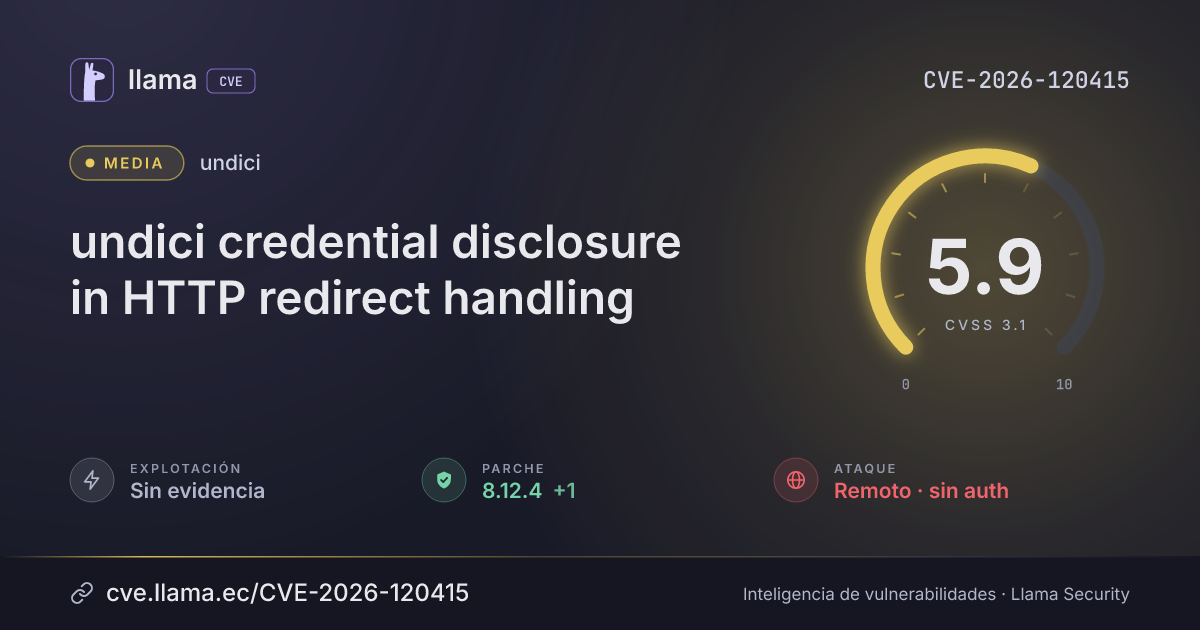
CVE-2026-120415
undici credential disclosure in HTTP redirect handling
A remote attacker can obtain a victim's Authorization and Cookie headers when a cross-origin redirect occurs.
CVSS:3.1/AV:N/AC:H/PR:N/UI:N/S:U/C:H/I:N/A:N
Fuente: CNA
Ciclo de vida de la vulnerabilidad
| Fecha | Fase | Evento | Detalle |
|---|---|---|---|
| Remediación | Parche 7.30.2 | undici · -1 d desde divulgación | |
| Remediación | Parche 8.12.4 | undici · -1 d desde divulgación | |
| Divulgación | Publicada | CVE-2026-120415 divulgada · CVSS 5.9 (CNA) | |
| Monitoreo | Detectada | Ingresó al índice | |
| Monitoreo | Fuente: NIST NVD | Registro visto por primera vez en NIST NVD | |
| Monitoreo | Fuente: ENISA EUVD | Registro visto por primera vez en ENISA EUVD | |
| Divulgación | Evaluación SSVC | CISA-ADP · explotación ninguna | |
| Divulgación | Modificada | Última actualización del registro | |
| Monitoreo | Fuente: OSV | Registro visto por primera vez en OSV | |
| Monitoreo | Verificada | Última verificación contra las fuentes |
undici, an HTTP client for Node.js, can disclose the caller's credentials, such as Authorization and Cookie headers, to an unrelated site after a cross-origin redirect. An attacker can reach this remotely, without logging in or any user action, when request headers are passed as an array of name and value tuples and a cache or deduplicate interceptor is composed outside the redirect interceptor.
Descripción original del registro (openjs)
undici is an HTTP client for Node.js. In versions 7.0.0 through 7.30.1 and 8.0.0 through 8.12.3, the redirect interceptor strips sensitive headers such as Authorization, Cookie, Proxy-Authorization, and Host when a request is redirected to a different origin, but when request headers are supplied as an array of name and value tuples (a valid documented input, for example from Object.entries), the redirect handler misreads them as a flat list so the header names never match and the sensitive headers are not removed. If a header-normalizing interceptor such as cache or deduplicate is composed outside the redirect interceptor, it then serializes the retained headers onto the cross-origin request, disclosing the caller's origin-bound credentials to the unrelated redirect destination. This is a representation-dependent bypass of the cross-origin header stripping added in CVE-2024-30260. The issue is fixed in undici 7.30.2 and 8.12.4, and users should upgrade to one of those versions or later. As a workaround, supply request headers as a plain object or a flat name and value array rather than an array of tuples, or compose the redirect interceptor outside the normalizing interceptor.
Desglose de métricas
Rangos afectados
Estado del parche por paquete
| Paquete / producto | Estado | Corregida en | Desde divulgación | Última versión |
|---|---|---|---|---|
npmundici |
Corregida | 7.30.2, 8.12.4 | -1 d · -1 d | 8.12.4 no afectada |
7.30.28.12.4Arsenal público
Sin exploits, módulos ni PoC públicos conocidos a la fecha de verificación.
https://github.com/nodejs/undici/security/advisories/GHSA-9v6h-8rgp-m69fhttps://cna.openjsf.org/security-advisories.htmlLas referencias externas se muestran para copiar: cve.llama.ec no lo redirige a otros sitios.