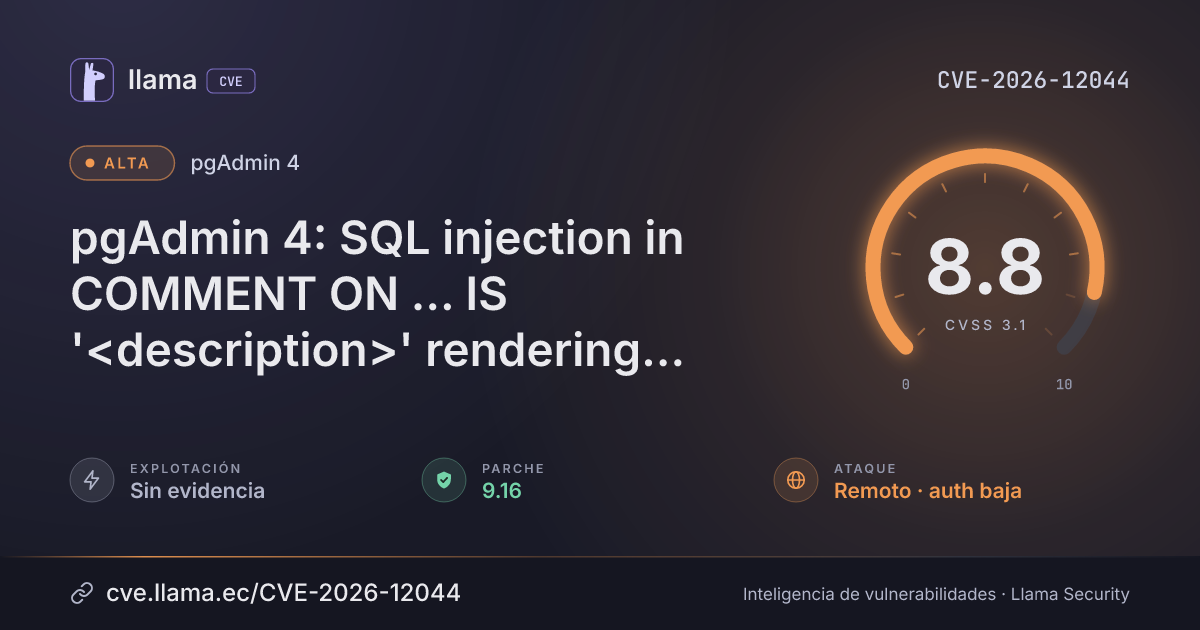
CVE-2026-12044
pgAdmin 4: SQL injection in COMMENT ON ... IS '<description>' rendering across dialog templates
CVSS:3.1/AV:N/AC:L/PR:L/UI:N/S:U/C:H/I:H/A:H
Fuente: CNA
Ciclo de vida de la vulnerabilidad
| Fecha | Fase | Evento | Detalle |
|---|---|---|---|
| Divulgación | Publicada | CVE-2026-12044 divulgada · CVSS 8.8 (CNA) | |
| Divulgación | Evaluación SSVC | CISA-ADP · explotación ninguna | |
| Divulgación | Modificada | Última actualización del registro | |
| Monitoreo | Detectada | Ingresó al índice |
SQL injection in pgAdmin 4 across every dialog template that renders ``COMMENT ON ... IS '<description>'`` for a user-supplied description field. The Jinja templates for Domains (and their constraints), Foreign Tables, Languages, and Event Triggers, plus the Views OID-lookup query, interpolated the description directly inside a single-quoted SQL literal -- ``'{{ data.description }}'`` -- instead of passing it through the ``qtLiteral`` escape filter. An authenticated pgAdmin user with permission to create or alter the affected object types could submit a description containing an apostrophe, break out of the literal and chain arbitrary SQL. The injected SQL runs under the PostgreSQL role the user is already authenticated as; for a connected role with ``COPY ... TO/FROM PROGRAM`` (typically PostgreSQL superuser), this chains to OS command execution on the PostgreSQL host. The defect does not cross a privilege boundary -- the user already has direct SQL access to that role through pgAdmin's Query Tool -- so the attacker gains no capability beyond what their database role already grants. The marginal impact captures bypass of any application-layer Query Tool gating an operator may have configured. The defect was originally reported against the Domain Dialog ``description`` field; a code-wide audit identified sixteen sites of the same pattern across the templates listed above. The same review also surfaced ten related sinks in the pgstattuple/pgstatindex stats templates -- ``pgstattuple('{{schema}}.{{table}}')`` and the matching pgstatindex shape -- where ``qtIdent`` escapes embedded double quotes inside the identifier but not apostrophes, so a user with CREATE privilege on a schema could plant a table or index named ``foo'bar`` and a later stats viewer would render an unbalanced literal. Fix is layered: 1. Sites: replace every ``'{{ x.description }}'`` with ``{{ x.description|qtLiteral(conn) }}`` (no surrounding quotes -- the filter wraps the value in escaped quotes itself). Plumb ``conn=self.conn`` through every ``render_template`` call that loads one of these templates. Also corrects a ``{ % elif`` Jinja typo in the foreign-table schema diff (dead branch). Rewrite the ten pgstattuple/pgstatindex stats sites to address the relation via OID + ``::oid::regclass`` cast (e.g. ``pgstattuple({{ tid }}::oid::regclass)``), eliminating the embedded literal-call form entirely so that bug-class can no longer recur there. 2. Driver hardening: ``qtLiteral`` (in ``utils/driver/psycopg3/__init__.py``) used to silently return the raw unescaped value when its ``conn`` argument was falsy. It now raises ``ValueError`` -- surfacing the entire bug class going forward. The change immediately uncovered eight latent plumbing bugs (in ``schemas/__init__.py``, ``schemas/functions/__init__.py``, ``schemas/tables/utils.py``, ``foreign_servers/__init__.py``, and seven sites in ``roles/__init__.py``) -- all fixed as part of this patch. The inner ``except`` block that swallowed adapter-level failures and returned the raw value is also removed, so unadaptable inputs raise instead of leaking unescaped values. 3. Regression tests: a per-template behavioural test renders each previously-vulnerable template with an apostrophe-injection payload and asserts the escaped fragment is present and the vulnerable fragment absent; a lint test walks every ``*.sql`` template flagging any ``'{{ ... }}'`` single-quote-wrapped interpolation against an explicit allowlist; unit tests cover the new qtLiteral fail-fast and inner-except raise paths. This issue affects pgAdmin 4: from 1.0 before 9.16.
Desglose de métricas
Rangos afectados
Estado del parche por paquete
| Paquete / producto | Estado | Corregida en | Desde divulgación | Última versión |
|---|---|---|---|---|
pgAdmin |
Corregida | 9.16 | — | — |
9.16Arsenal público
Sin exploits, módulos ni PoC públicos conocidos a la fecha de verificación.
https://github.com/pgadmin-org/pgadmin4/commit/658bb585dhttps://github.com/pgadmin-org/pgadmin4/commit/2ae0d3610https://github.com/pgadmin-org/pgadmin4/issues/10078Las referencias externas se muestran para copiar: cve.llama.ec no lo redirige a otros sitios.