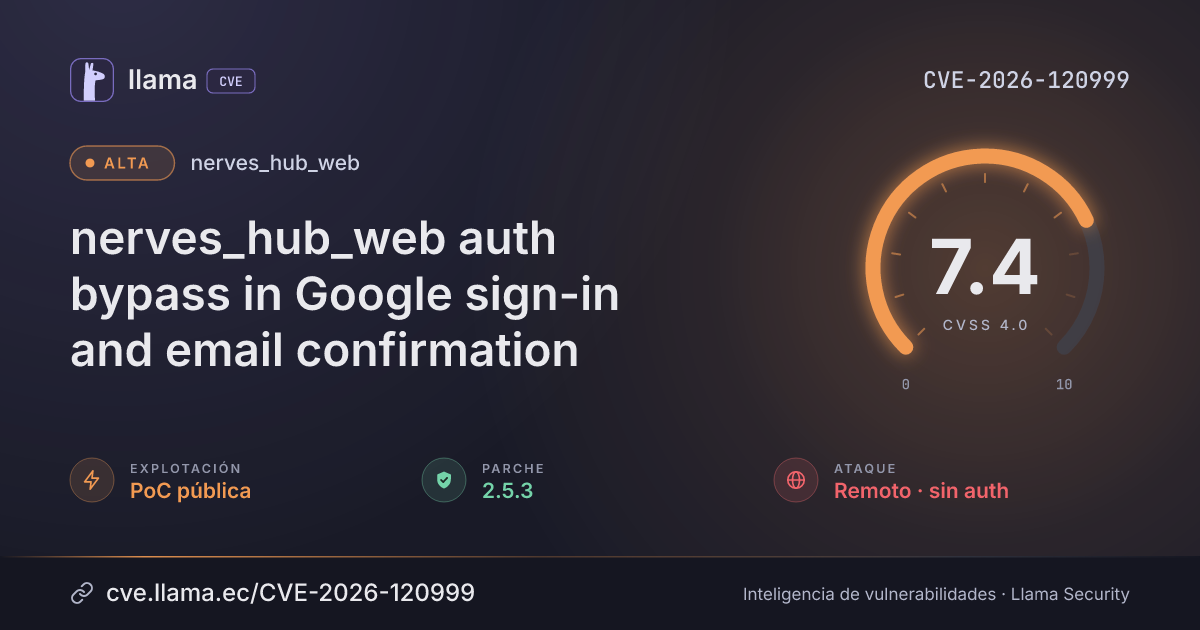
ExplotaciónPoC públicaSSVC: poc · no figura en CISA KEV
Exploits públicos0Ninguno conocido
Parche1 versión2.5.3
Exposición9 dDesde la divulgación, 10 nov 2026, 5:43 a. m.
Detección8 minDesde la divulgación hasta su ingreso al índice
Decisión SSVCSeguir de cerca
Monitorear y programar la remediación
Existe PoC pública, no automatizable e impacto técnico total. Hay versiones corregidas disponibles.
Timeline
Ciclo de vida de la vulnerabilidad
Hoy
Divulgación
Publicada
Evaluación SSVC
Modificada
Explotación
Remediación
Monitoreo
Detectada +1
Fuente: OSV +1
Verificada
10 nov 26
11 nov 26
12 nov 26
19 nov 26
20 nov 26
10 nov 26
12 nov 26
15 nov 26
17 nov 26
20 nov 26
Fecha
Fase
Evento
Detalle
Divulgación
Publicada
CVE-2026-120999 divulgada · CVSS 7.4 (CNA)
Monitoreo
Detectada
Ingresó al índice
Monitoreo
Fuente: NIST NVD
Registro visto por primera vez en NIST NVD
Monitoreo
Fuente: OSV
Registro visto por primera vez en OSV
Monitoreo
Fuente: ENISA EUVD
Registro visto por primera vez en ENISA EUVD
Divulgación
Evaluación SSVC
CISA-ADP · explotación PoC pública
Divulgación
Modificada
Última actualización del registro
Monitoreo
Verificada
Última verificación contra las fuentes
Resumen
Resumen generado por IA · CC-BY 4.0 · 10 nov 2026
Improper authentication in NervesHub's web application lets a remote attacker who registers someone else's email address share that person's account once the owner signs in with Google or follows an email confirmation link. The attacker needs no login of their own, and the victim's sign-in or confirmation click is what gives the attacker access.
Only affects NervesHub web instances 2.3.0 through 2.5.2 with Google sign-in turned on. Fixed in 2.5.3.
¿Qué significa?Google sign-in and email confirmation links can sign a user in to an account registered with their email address, without the account owner's login. An attacker who gets this access keeps a password login to the account and can see and do whatever the victim can, in every organization the victim joins, at the victim's role.
¿Quién está afectado?NervesHub releases 2.3.0 through 2.5.2 are affected, but only instances with Google sign-in turned on, which means GOOGLE_CLIENT_ID is set. To check, look at whether GOOGLE_CLIENT_ID is set in the instance's environment and which NervesHub release is running.
¿Qué hacer?Upgrade to NervesHub 2.5.3, which is the fixed version. Until the upgrade, turn off Google sign-in by unsetting GOOGLE_CLIENT_ID.
Descripción original del registro (EEF)
Improper Authentication vulnerability in Google sign-in and email confirmation in nerves-hub nerves_hub_web allows an attacker who registers another person's email address to share that person's account once they sign in. NervesHub.Accounts.update_or_create_user_from_ueberauth/1 signs a Google user in to any account carrying the same email that is not yet linked to a Google account, links it and marks the email confirmed, without the account's owner ever having proved they own the address. NervesHubWeb.SessionController.confirm/2 likewise signs in whoever follows a confirmation link. An attacker registers the address from the sign-up form, changes their own account's email to it, or registers it as an organization admin from an invite link, and keeps the password; when the address's owner signs in with Google or follows the confirmation link, they land in that account.
The Google path also creates accounts with registrations closed and never checks Google's email_verified claim, and the API's password sign-in in NervesHubWeb.API.UserController issues tokens to accounts whose email was never confirmed. The attacker gains only what the victim is granted afterwards, and nothing on accounts whose owners never use either path.
This issue affects nerves_hub: from 2.3.0 before 2.5.3.
Contexto
Condiciones y alcance
Condiciones necesarias para que el fallo sea explotable
01
Google sign-in is turned on (GOOGLE_CLIENT_ID set) for the Google sign-in path“These only affect instances with Google sign-in turned on”
02
NervesHub releases 2.3.0 through 2.5.2“Releases 2.3.0, when Google sign-in and email confirmation were added, through 2.5.2.”
¿Quién debe revisar?Teams running NervesHub (nerves_hub_web) 2.3.0 through 2.5.2 with Google sign-in enabled or email confirmation, including self-hosted instances.
No protegeTurning off registrations does not stop an org admin registering from an invite link.
MitigaciónTurn off Google sign-in by unsetting GOOGLE_CLIENT_ID until the upgrade.
Vector CVSS 4.0
Desglose de métricas
Opción resaltada = valor del vector · izquierda = peor caso · CNA
Vector de ataqueAV:N
RedAdyacenteLocalFísica
ComplejidadAC:L
BajaAlta
Requisitos de ataqueAT:P
NingunoPresentes
PrivilegiosPR:N
NingunoBajosAltos
InteracciónUI:A
NingunaPasivaActiva
Confid. (sistema)VC:H
AltoBajoNinguno
Integridad (sistema)VI:H
AltoBajoNinguno
Disponib. (sistema)VA:N
AltoBajoNinguno
Confid. (posterior)SC:N
AltoBajoNinguno
Integridad (posterior)SI:N
AltoBajoNinguno
Disponib. (posterior)SA:N
AltoBajoNinguno
Versiones
Rangos afectados
AfectadaCorregida
nerves-hub/nerves-hub · nerves_hub≥ 2.3.0 < 2.5.3
2.3.0
2.5.3
Remediación
Estado del parche por paquete
Paquete / producto
Estado
Corregida en
Desde divulgación
Última versión
nerves_hub_web
Corregida
2.5.3
—
—
Versiones corregidas2.5.3
Explotación
Arsenal público
Sin exploits, módulos ni PoC públicos conocidos a la fecha de verificación.
Registro
EscenarioGENERALEEF
MitigaciónTurn off Google sign-in by unsetting GOOGLE_CLIENT_ID until the upgrade; users who only sign in with Google cannot sign in while it is off. This does not close the confirmation link path. Turning off registrations stops strangers using the sign-up form, but not an organization admin registering from an invite link.EEF
solutionUpgrading does not undo links already made. Review the users rows that carry both a password_hash and a google_id; most are one person signing in both ways, but an account registered for someone else's address was usually created well before its first Google sign-in, so compare inserted_at with google_last_synced_at. For one its owner did not set up, set its google_id to NULL, delete its user_tokens rows to end its sessions and revoke its API tokens, and have the address's owner reset the password. An account taken through a confirmation link looks the same as one its owner set up; its owner can end anyone else's access by resetting the password, which ends every session and revokes every API token. Before upgrading, check how your instance lets people sign up: SIGN_UP_METHODS replaces OPEN_FOR_REGISTRATIONS, and instances that relied on Google sign-in to create accounts while registrations were off need SIGN_UP_METHODS=google.EEF
Usamos cookies propias estrictamente necesarias para que el sitio funcione y sea seguro. Con tu permiso, también usamos almacenamiento local para recordar tus preferencias y medir el uso del sitio de forma agregada. Puedes aceptar, rechazar o configurar cada categoría, y cambiar tu decisión cuando quieras desde el enlace “Preferencias de cookies” del pie de página. Más información
Preferencias de cookies
Elige qué permites
Solo usamos tecnologías propias de este dominio. Sin publicidad ni rastreadores de terceros. Detalle en la Política de cookies.