llamaCVEVulnerability Intelligence
/
Arista EOS

CVE-2026-121367

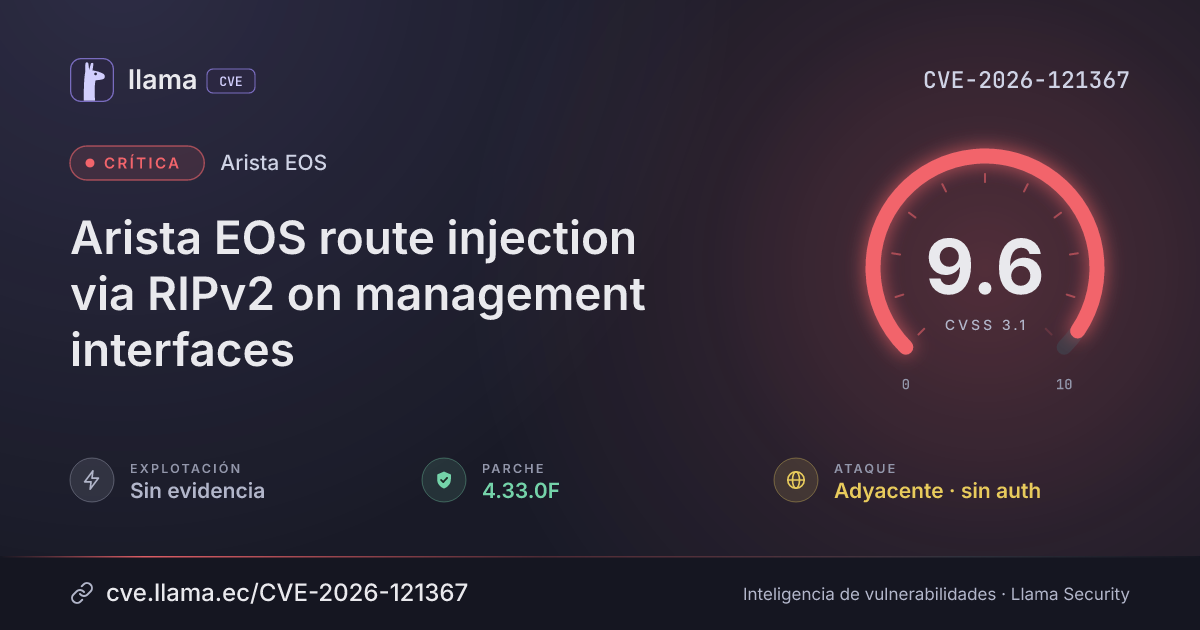
Arista EOS route injection via RIPv2 on management interfaces

A nearby attacker can send crafted RIPv2 updates to inject routes that redirect or blackhole traffic.

UnclearParche disponiblesecurity flaw
Descargar PNG JSON
CVSS 3.1
9.6
Crítica
CVSS:3.1/AV:A/AC:L/PR:N/UI:N/S:C/C:L/I:H/A:H Fuente: CNA
ExplotaciónSin evidenciaSSVC: none · no figura en CISA KEV
Exploits públicos0Ninguno conocido
Parche1 versión4.33.0F
Exposición8 dDesde la divulgación, 10 nov 2026, 3:10 p. m.
Detección1 hDesde la divulgación hasta su ingreso al índice
Decisión SSVCAtender
Priorizar en el próximo ciclo de cambios
Sin explotación conocida, automatizable e impacto técnico total. Hay versiones corregidas disponibles.
Timeline

Ciclo de vida de la vulnerabilidad

Hoy
Divulgación
Publicada
Evaluación SSVC +1
Explotación
Remediación
Monitoreo
Detectada
Verificada
10 nov 26
13 nov 26
16 nov 26
19 nov 26
10 nov 26
13 nov 26
15 nov 26
17 nov 26
19 nov 26
FechaFaseEventoDetalle
Divulgación Publicada CVE-2026-121367 divulgada · CVSS 9.6 (CNA)
Monitoreo Detectada Ingresó al índice
Divulgación Evaluación SSVC CISA-ADP · explotación ninguna
Divulgación Modificada Última actualización del registro
Monitoreo Verificada Última verificación contra las fuentes
Resumen

On affected Arista EOS platforms with Routing Information Protocol version 2 (RIPv2) configured, under certain conditions, RIPv2 might be silently enabled on management interfaces even when the RIP agent intends to disable it. It allows an unauthenticated attacker with access to the adjacent network to send crafted RIPv2 route advertisements to the device's management IP address. The device could accept and install those routes without authentication. Successful exploitation could allow the attacker to redirect traffic flows to an attacker-controlled destination, install more-specific routes that blackhole legitimate traffic, or otherwise disrupt network reachability for systems whose traffic passes through the affected device.

Affects Arista EOS with RIPv2 configured, where RIPv2 can be silently enabled on management interfaces even when the RIP agent is set to disable it. Fixed in 4.33.0F.

¿Qué significa?On affected Arista EOS platforms, RIPv2 might be silently enabled on management interfaces under certain conditions, even when the RIP agent is set to disable it. The advisory says this could let an attacker redirect traffic flows to an attacker-controlled destination, install more-specific routes that blackhole legitimate traffic, or otherwise disrupt network reachability.
¿Quién está afectado?Affected ranges are EOS 1.0.0 up to 4.33.0F (not including 4.33.0F), 4.33.0F through 4.33.10M, 4.34.0F through 4.34.8M, 4.35.0F through 4.35.6M, and 4.36.0F through 4.36.2F. The exposure needs RIPv2 configured, and the advisory's condition is a RIP network statement covering the management interface subnet, such as 10.252.36.128/25, with RIP not shut down. Check the installed EOS version and whether RIP is configured, including any RIP network statement that covers the management subnet.
¿Qué hacer?Upgrade to EOS 4.33.0F or a later fixed release. The advisory names no patch identifiers. If RIP is not required, disable it within each affected VRF instance, or verify that no RIP network prefix matches the management subnet.
Contexto

Condiciones y alcance

Condiciones necesarias para que el fallo sea explotable
01
Arista EOS platform with RIPv2 configured“On affected Arista EOS platforms with Routing Information Protocol version 2 (RIPv2) configured”
02
RIPv2 is silently enabled on management interfaces under certain conditions, even when the RIP agent is set to disable it“under certain conditions, RIPv2 might be silently enabled on management interfaces”
03
A RIP network statement covers the management interface subnet and RIP is not shut down“network 10.252.36.128/25”
¿Quién debe revisar?Operators running Arista EOS with RIPv2 configured, where a RIP network statement covers the management interface subnet
MitigaciónDisable RIP within each affected VRF instance where RIP is not required, or verify no RIP network prefix matches the management subnet
Vector CVSS 3.1

Desglose de métricas

Opción resaltada = valor del vector · izquierda = peor caso · CNA
Vector de ataqueAV:A
RedAdyacenteLocalFísica
ComplejidadAC:L
BajaAlta
PrivilegiosPR:N
NingunoBajosAltos
InteracciónUI:N
NingunaRequerida
AlcanceS:C
CambiadoSin cambio
ConfidencialidadC:L
AltoBajoNinguno
IntegridadI:H
AltoBajoNinguno
DisponibilidadA:H
AltoBajoNinguno
Versiones

Rangos afectados

Afectada Corregida
EOS≥ 1.0.0 < 4.33.0F
EOS≥ 4.33.0F ≤ 4.33.10M
EOS≥ 4.34.0F ≤ 4.34.8M
EOS≥ 4.35.0F ≤ 4.35.6M
EOS≥ 4.36.0F ≤ 4.36.2F
1.0.0
4.33.0F
4.33.10M
4.34.0F
4.34.8M
4.35.0F
4.35.6M
4.36.0F
4.36.2F
Remediación

Estado del parche por paquete

Paquete / productoEstadoCorregida enDesde divulgaciónÚltima versión
EOS
Corregida 4.33.0F — —
Versiones corregidas4.33.0F
Explotación

Arsenal público

Sin exploits, módulos ni PoC públicos conocidos a la fecha de verificación.

Registro
configurationswitch# show running-config section router rip router rip network 10.252.36.128/25 no shutdown switch# show running-config section interface Management1 interface Management1 ip address 10.252.36.194/25Arista
Mitigaciónswitch# configure terminal switch(config)# router rip switch(config-router-rip)# shutdown switch(config-router-rip)# end (Workaround: In environments where RIP is not required, disable it within each affected VRF instance. If RIP is necessary on data interfaces but not the management subnet, verify no RIP network prefix matches the management subnet.)Arista
Referencias
Fabricantehttps://www.arista.com/en/support/advisories-notices/security-advisory/25042-security-advisory-0220

Las referencias externas se muestran para copiar: cve.llama.ec no lo redirige a otros sitios.