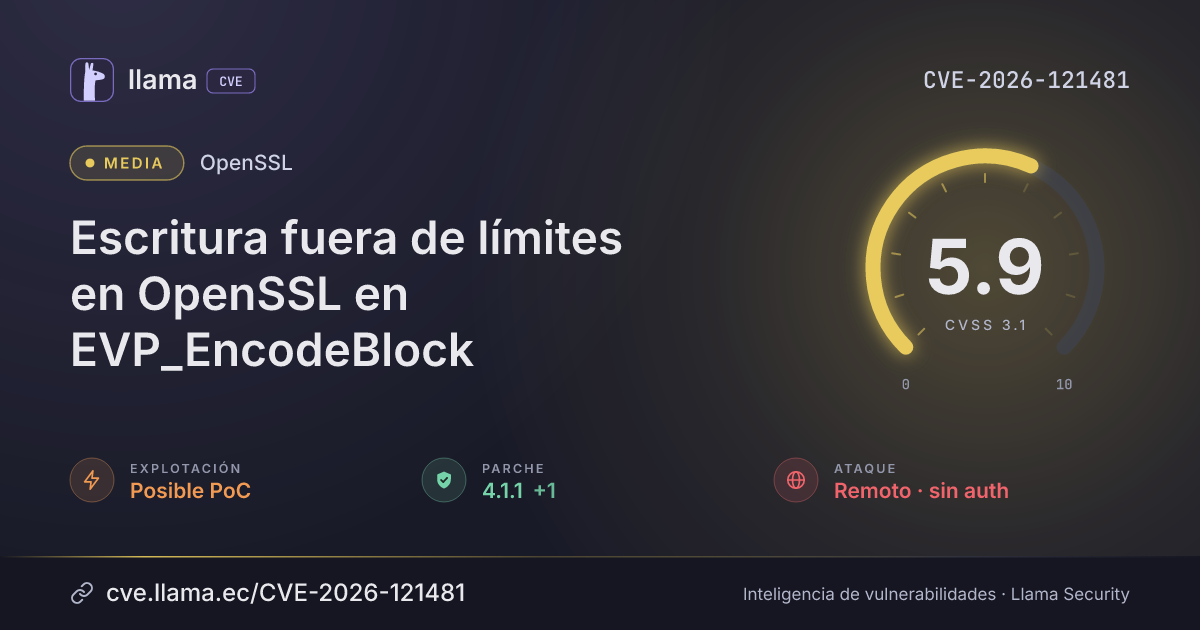
CVE-2026-121481
OpenSSL out-of-bounds write in EVP_EncodeBlock
An attacker who controls a very large input length can write past the end of an output buffer, corrupting memory.
Texto original en inglés · Ver en español
CVSS:3.1/AV:N/AC:H/PR:N/UI:N/S:U/C:N/I:N/A:H
Fuente: CISA-ADP
Ciclo de vida de la vulnerabilidad
| Fecha | Fase | Evento | Detalle |
|---|---|---|---|
| Divulgación | Publicada | CVE-2026-121481 divulgada · CVSS 5.9 (CISA-ADP) | |
| Monitoreo | Detectada | Ingresó al índice | |
| Monitoreo | Fuente: ENISA EUVD | Registro visto por primera vez en ENISA EUVD | |
| Monitoreo | Fuente: PoC-in-GitHub | Registro visto por primera vez en PoC-in-GitHub | |
| Divulgación | Evaluación SSVC | CISA-ADP · explotación ninguna | |
| Divulgación | Modificada | Última actualización del registro | |
| Monitoreo | Verificada | Última verificación contra las fuentes |
Calling EVP_EncodeBlock() in OpenSSL with an input length close to INT_MAX can overflow the calculation of the encoded output size. This causes writes past the end of the caller-supplied output buffer.
Descripción original del registro (openssl)
Issue summary: Calling EVP_EncodeBlock() with an input length close to INT_MAX may overflow the calculation of the encoded output size and write past the end of the caller-supplied output buffer. Impact summary: No path by which an attacker can trigger this has been identified. An application that passes an input length near INT_MAX to EVP_EncodeBlock() could suffer a heap buffer overflow, crashing or corrupting its own memory, but it must itself supply such a length. CWE: CWE-190: Integer Overflow or Wraparound Description: EVP_EncodeBlock() base64-encodes a buffer of a caller-supplied length into an output buffer that the caller allocates. The caller is expected to reserve 4*((len+2)/3)+1 bytes. For input lengths close to INT_MAX, the arithmetic that computes the encoded length overflows a signed integer, so the function writes more data than the documented output size. The result is a heap buffer overflow in the calling process. Reaching this requires an application to pass an input length near INT_MAX to EVP_EncodeBlock(). OpenSSL's TLS, QUIC and CMS implementations never encode buffers of that size, and the command line tools cannot practically be made to do so: the limits on reading a proxy password from a file and on bignum sizes prevent it. An application that accepts an attacker-controlled length and forwards it to EVP_EncodeBlock() without its own bound check is exposed. The severity is Low because no attacker-controlled path to the overflow is known. The caller must already hold a buffer of about two gigabytes before the defect can be reached. FIPS impact: no The affected code is outside the FIPS module boundary.
Desglose de métricas
Rangos afectados
Estado del parche por paquete
| Paquete / producto | Estado | Corregida en | Desde divulgación | Última versión |
|---|---|---|---|---|
OpenSSL |
Corregida | 4.0.4, 4.1.1 | — | — |
4.0.44.1.1Arsenal público
Ver los 1 repositorios de GitHub
Los repositorios públicos incluyen exploits, escáneres, laboratorios y reglas de detección. No ejecute código de terceros sin revisarlo en un entorno aislado.
https://github.com/openssl/openssl/pull/33652https://github.com/Quaerendir/openssl-cve-2026-121481-audithttps://news.ycombinator.com/item?id=50569226Las referencias externas se muestran para copiar: cve.llama.ec no lo redirige a otros sitios.