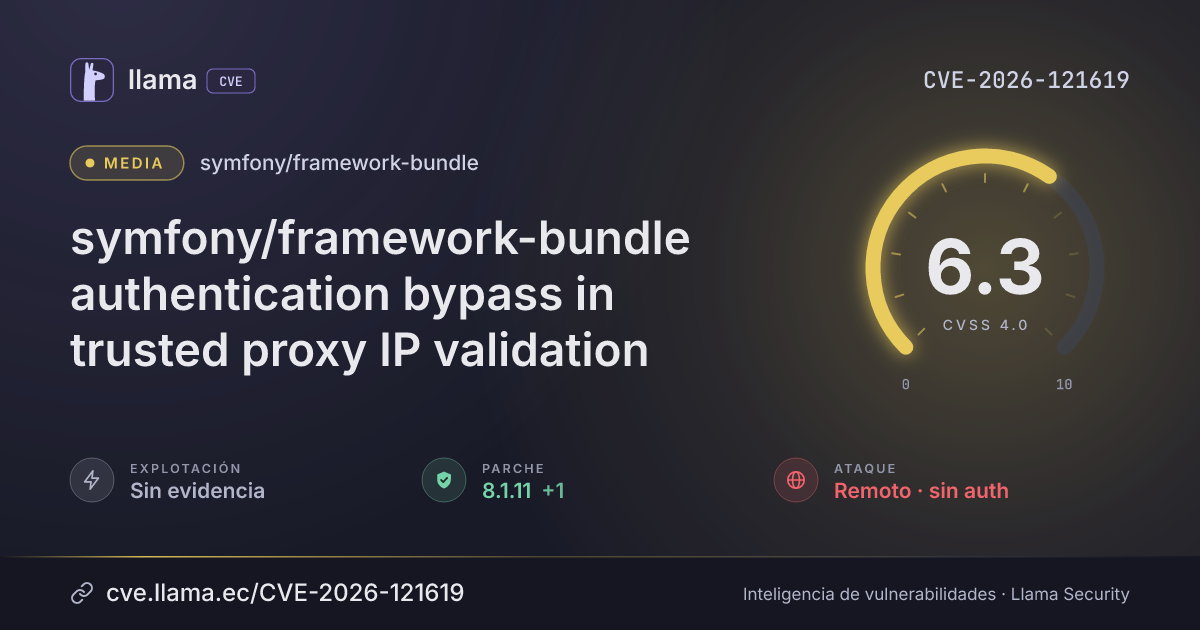
CVE-2026-121619
symfony/framework-bundle authentication bypass in trusted proxy IP validation
Remote attackers without logging in can spoof client IP addresses, host names and schemes.
CVSS:4.0/AV:N/AC:L/AT:P/PR:N/UI:N/VC:L/VI:L/VA:N/SC:N/SI:N/SA:N
Fuente: CNA
Ciclo de vida de la vulnerabilidad
| Fecha | Fase | Evento | Detalle |
|---|---|---|---|
| Divulgación | Publicada | CVE-2026-121619 divulgada · CVSS 6.3 (CNA) | |
| Monitoreo | Detectada | Ingresó al índice | |
| Monitoreo | Fuente: NIST NVD | Registro visto por primera vez en NIST NVD | |
| Monitoreo | Fuente: ENISA EUVD | Registro visto por primera vez en ENISA EUVD | |
| Monitoreo | Fuente: OSV | Registro visto por primera vez en OSV | |
| Divulgación | Evaluación SSVC | CISA-ADP · explotación ninguna | |
| Divulgación | Modificada | Última actualización del registro | |
| Monitoreo | Verificada | Última verificación contra las fuentes |
Symfony's FrameworkBundle and HttpFoundation components can be tricked into treating remote clients as trusted reverse proxies when the "private_ranges" shortcut is used, so an attacker can spoof the client IP address, host name and scheme. The attack is possible remotely and without logging in, by sending a connection from an IPv6-embedded IPv4 address such as an IPv4-mapped one.
Descripción original del registro (Checkmarx)
The Symfony FrameworkBundle framework.trusted_proxies option and the HttpFoundation Request::setTrustedProxies() method trust remote clients as reverse proxies when the private_ranges shortcut is used, allowing remote attackers to spoof the client IP address, host and scheme in Symfony FrameworkBundle versions 7.1 prior to 7.4.23 and 8.x prior to 8.1.11, and HttpFoundation versions 7.2 prior to 7.4.23 and 8.x prior to 8.1.11. The private_ranges and PRIVATE_SUBNETS keywords resolved to IpUtils::PRIVATE_SUBNETS, the deny list of NoPrivateNetworkHttpClient, which lists the private and special-purpose prefixes a server must not connect to. Since the fix for CVE-2026-48736 (7.4.13 and 8.0.13), this list also covers the IPv6 prefixes that embed an IPv4 address: IPv4-mapped (::ffff:0:0/96), IPv4-compatible (::/96), 6to4 (2002::/16), Teredo (2001::/32) and NAT64 (64:ff9b::/96). The IPv4-mapped entry has been in the list since the private_ranges shortcut was introduced, in 7.1 for framework.trusted_proxies and in 7.2 for Request::setTrustedProxies(). Over-blocking is safe for a deny list, but when the same entries are used as the allow list of trusted proxies, they trust remote clients. A client whose connection arrives with such a source address is treated as a reverse proxy, and the X-Forwarded-For, X-Forwarded-Host, X-Forwarded-Proto, X-Forwarded-Port and X-Forwarded-Prefix headers it sends are honoured. For example, with Request::setTrustedProxies(['private_ranges'], ...), a request with REMOTE_ADDR set to ::ffff:203.0.113.7 and the headers X-Forwarded-For: 10.0.0.9, X-Forwarded-Host: evil.example.com and X-Forwarded-Proto: https makes getClientIp() return 10.0.0.9, getHost() return evil.example.com and isSecure() return true. Two kinds of deployments are exposed: a server listening on the IPv6 wildcard address without IPV6_V6ONLY reports every IPv4 client in the IPv4-mapped form, so every client is trusted, and a server reachable over IPv6 trusts any client sourcing from 6to4 or Teredo space, which is globally routed, whatever its listener. A spoofed client address defeats IP allow lists, rate limiting and audit logs; a spoofed host poisons the URLs written into password reset and login link e-mails and into shared caches; a spoofed scheme satisfies requires_channel: https over plain HTTP. Symfony 6.4 does not point any trusted proxy setting at IpUtils::PRIVATE_SUBNETS and is not affected by default, but an application that passes that constant to Request::setTrustedProxies() itself could be exposed in the same way on any version. This issue is fixed in 7.4.23 and 8.1.11.
Desglose de métricas
Rangos afectados
Estado del parche por paquete
| Paquete / producto | Estado | Corregida en | Desde divulgación | Última versión |
|---|---|---|---|---|
symfony/framework-bundle |
Corregida | 7.4.23, 8.1.11 | — | — |
7.4.238.1.11Arsenal público
Sin exploits, módulos ni PoC públicos conocidos a la fecha de verificación.
https://github.com/symfony/symfony/security/advisories/GHSA-xg2q-4rrq-657qhttps://github.com/symfony/symfony/commit/e109aa54d42678e2a72ec148092a8453a67de931Las referencias externas se muestran para copiar: cve.llama.ec no lo redirige a otros sitios.