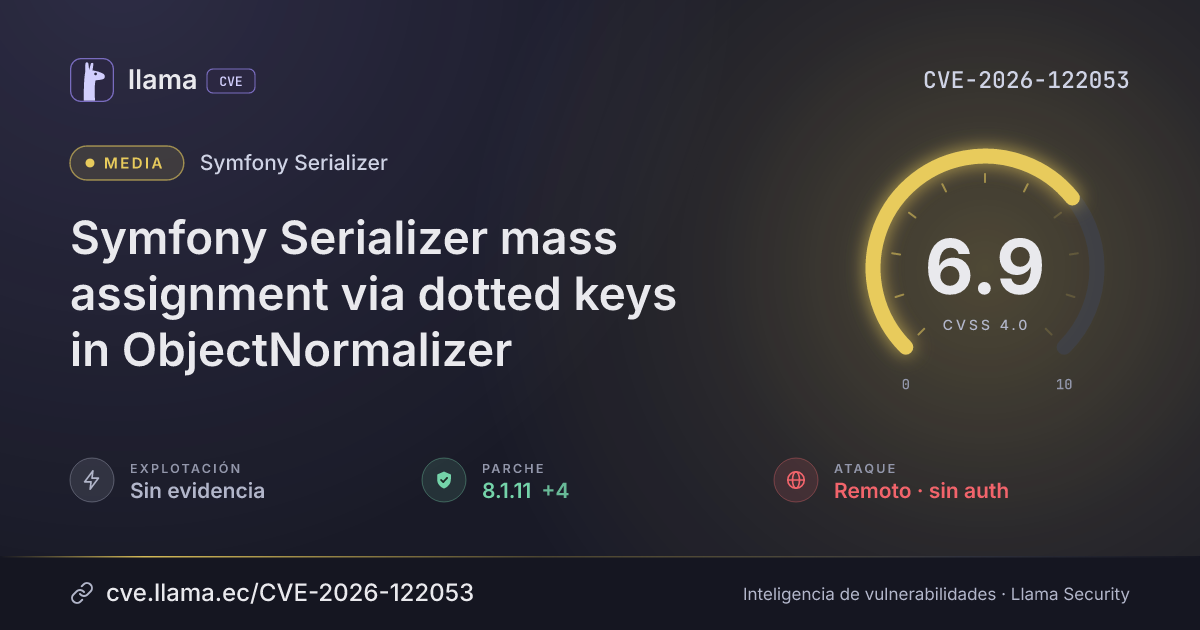
CVE-2026-122053
Symfony Serializer mass assignment via dotted keys in ObjectNormalizer
A remote attacker without logging in can set nested object properties marked #[Ignore] by sending dotted field names.
CVSS:4.0/AV:N/AC:L/AT:N/PR:N/UI:N/VC:L/VI:L/VA:N/SC:N/SI:N/SA:N
Fuente: CNA
CVSS:3.1/AV:N/AC:L/PR:N/UI:N/S:U/C:L/I:L/A:NCiclo de vida de la vulnerabilidad
| Fecha | Fase | Evento | Detalle |
|---|---|---|---|
| Divulgación | Publicada | CVE-2026-122053 divulgada · CVSS 6.9 (CNA) | |
| Monitoreo | Detectada | Ingresó al índice | |
| Monitoreo | Fuente: NIST NVD | Registro visto por primera vez en NIST NVD | |
| Divulgación | Evaluación SSVC | CISA-ADP · explotación ninguna | |
| Divulgación | Modificada | Última actualización del registro | |
| Monitoreo | Fuente: ENISA EUVD | Registro visto por primera vez en ENISA EUVD | |
| Monitoreo | Verificada | Última verificación contra las fuentes |
The Symfony Serializer's ObjectNormalizer component can be tricked into writing to properties of nested objects by using dotted attribute names in input, which bypasses the #[Ignore] attribute on those objects. An attacker can reach this remotely, without logging in, in applications that bind untrusted input to objects, such as controllers using #[MapRequestPayload] or #[MapQueryString].
Descripción original del registro (Checkmarx)
The Symfony Serializer component ObjectNormalizer treats any attribute name containing . (and, from Symfony 6.4, [) as a writable property path, allowing untrusted input to modify properties of nested objects and bypass their #[Ignore] metadata attribute in Symfony versions 5.4.41 prior to 5.4.56, 6.4.9 prior to 6.4.50, 7.0.9 prior to 7.1.0, 7.1.2 prior to 7.4.23, and 8.x prior to 8.1.11. ObjectNormalizer::isAllowedAttribute() accepts such names, and setAttributeValue() hands the name straight to PropertyAccessor::setValue(), which parses it as a property path and traverses into the nested object. A payload key such as customer.admin writes to $order->customer->admin. The #[Ignore] metadata attribute is only consulted when the nested object is denormalized in its own right, never when it is reached through a path. #[Groups] restrictions are not bypassed: the path is only accepted when no groups are passed in the context, and then groups restrict nothing. When the root class carries neither #[Ignore] nor #[Groups], no allowlist applies and every key of the payload is let through. Because PropertyAccessor also resolves a path segment against public methods, a segment matching a public method name invokes that method with the attacker’s value.Applications that bind untrusted input to objects are affected, including controllers using #[MapRequestPayload] or #[MapQueryString], whose default normalizer is ObjectNormalizer. With OBJECT_TO_POPULATE, as used for partial updates, the traversal reaches an already hydrated entity graph, and the modified field may be persisted. The fix accepts a property path only when the class metadata declares an attribute of that exact name. Declared paths keep working unchanged, and a path in the payload with no matching declaration is ignored.
Desglose de métricas
Rangos afectados
Estado del parche por paquete
| Paquete / producto | Estado | Corregida en | Desde divulgación | Última versión |
|---|---|---|---|---|
symfony/serializer |
Corregida | 5.4.56, 6.4.50, 7.1.0, 7.4.23, 8.1.11 | — | — |
5.4.566.4.507.1.07.4.238.1.11Arsenal público
Sin exploits, módulos ni PoC públicos conocidos a la fecha de verificación.
https://github.com/symfony/symfony/security/advisories/GHSA-hqp2-7rr8-hf26https://github.com/symfony/symfony/commit/fcaf87a93c7fa5b7fe9e9e8382d4ed0d0c52c67chttps://github.com/symfony/symfony/commit/9f7390678a255f7962fb1c81c42b26fa907d3437Las referencias externas se muestran para copiar: cve.llama.ec no lo redirige a otros sitios.