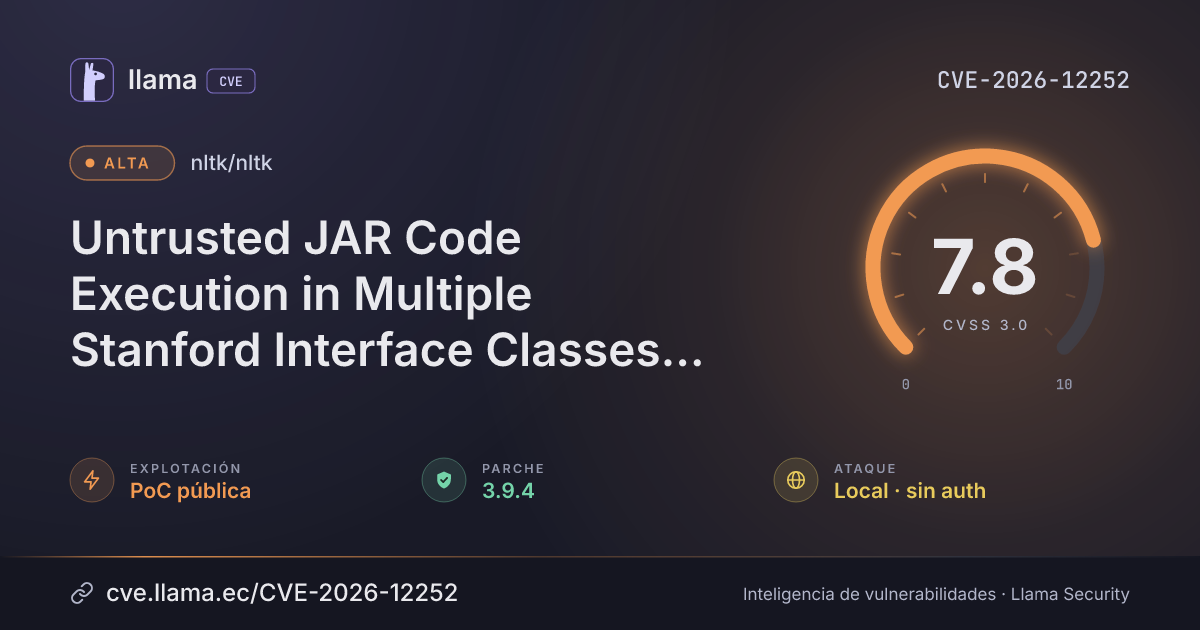
CVE-2026-12252
Untrusted JAR Code Execution in Multiple Stanford Interface Classes in nltk/nltk
CVSS:3.0/AV:L/AC:L/PR:N/UI:R/S:U/C:H/I:H/A:H
Fuente: CNA
Ciclo de vida de la vulnerabilidad
| Fecha | Fase | Evento | Detalle |
|---|---|---|---|
| Divulgación | Publicada | CVE-2026-12252 divulgada · CVSS 7.8 (CNA) | |
| Divulgación | Evaluación SSVC | CISA-ADP · explotación PoC pública | |
| Divulgación | Modificada | Última actualización del registro | |
| Monitoreo | Detectada | Ingresó al índice |
In nltk/nltk versions 3.9.3 and earlier, five Stanford interface classes (StanfordPOSTagger, StanfordNERTagger, StanfordParser, StanfordDependencyParser, and StanfordNeuralDependencyParser) are vulnerable to untrusted JAR code execution. These classes accept user-controllable JAR paths and execute them via the `java()` function, which invokes `subprocess.Popen()` without integrity verification. This vulnerability is identical to CVE-2026-0848, which was fixed for StanfordSegmenter by adding SHA256 verification. However, the fix was not applied to these additional classes, leaving them susceptible to arbitrary code execution when loading untrusted JAR files.
Desglose de métricas
Rangos afectados
Estado del parche por paquete
| Paquete / producto | Estado | Corregida en | Desde divulgación | Última versión |
|---|---|---|---|---|
nltk/nltk |
Corregida | 3.9.4 | — | — |
3.9.4Arsenal público
Sin exploits, módulos ni PoC públicos conocidos a la fecha de verificación.
https://huntr.com/bounties/f5c93982-0cc9-4e2e-bb85-1b6ab29a2efbLas referencias externas se muestran para copiar: cve.llama.ec no lo redirige a otros sitios.