llamaCVEVulnerability Intelligence
/
Go Vikunja API

CVE-2026-123512

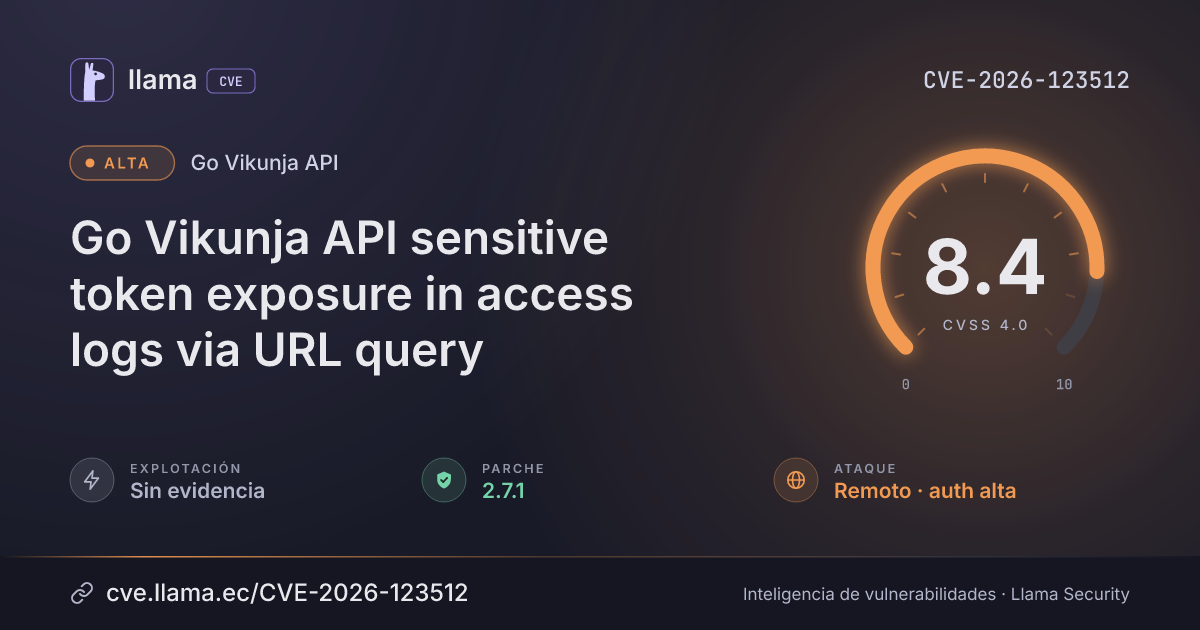
Go Vikunja API sensitive token exposure in access logs via URL query

Anyone who can read the access logs could capture live reset and deletion tokens and use them to take over accounts.

Specific setups onlySin parche publicadosecrets in logs
Descargar PNG JSON
CVSS 4.0
8.4
Alta
CVSS:4.0/AV:N/AC:L/AT:N/PR:H/UI:P/VC:H/VI:H/VA:N/SC:N/SI:N/SA:N Fuente: CNA
ExplotaciónSin evidenciaSSVC: none · no figura en CISA KEV
Exploits públicos0Ninguno conocido
ParcheSin parcheEl fabricante no ha publicado corrección
Exposición11 dDesde la divulgación, 7 nov 2026, 8:37 p. m.
Detección6 minDesde la divulgación hasta su ingreso al índice
Decisión SSVCSeguir de cerca
Monitorear y programar la remediación
Sin explotación conocida, no automatizable e impacto técnico total. No hay versión corregida: aplique mitigaciones.
Timeline

Ciclo de vida de la vulnerabilidad

Hoy
Divulgación
Publicada
Evaluación SSVC +1
Explotación
Remediación
Monitoreo
Detectada +1
Fuente: OSV
Verificada
8 nov 26
12 nov 26
16 nov 26
19 nov 26
8 nov 26
10 nov 26
13 nov 26
16 nov 26
19 nov 26
FechaFaseEventoDetalle
Divulgación Publicada CVE-2026-123512 divulgada · CVSS 8.4 (CNA)
Monitoreo Detectada Ingresó al índice
Monitoreo Fuente: NIST NVD Registro visto por primera vez en NIST NVD
Divulgación Evaluación SSVC CISA-ADP · explotación ninguna
Divulgación Modificada Última actualización del registro
Monitoreo Fuente: OSV Registro visto por primera vez en OSV
Monitoreo Verificada Última verificación contra las fuentes
Resumen
Resumen generado por IA · CC-BY 4.0 · 7 nov 2026

Vikunja, the open-source task manager, before version 2.7.1 places live password-reset, email-confirmation, and account-deletion tokens in the URL of emailed links, so anyone who can read Vikunja's access logs or a reverse proxy's logs can capture them. An attacker who reaches those logs over the network, which requires high privileges and user interaction, could replay an unused password-reset token to take over an account or an account-deletion token to confirm a deletion.

Vikunja 2.7.0 and earlier log full request URIs by default, which can expose emailed password-reset and account-deletion tokens to anyone who can read the access logs. Fixed in 2.7.1.

¿Qué significa?Vikunja's HTTP access logging writes the full request URI, including the token in emailed password-reset, email-confirm and account-deletion links. Anyone who reads those logs can use an unredeemed password-reset token to set a new password and take over the account, or use a deletion token to confirm an account deletion.
¿Quién está afectado?Vikunja versions 2.7.0 and earlier are affected, and access logging is on by default. The reader can check the installed Vikunja version and whether HTTP access logs, or reverse-proxy logs, record full request URIs and can be read by others.
¿Qué hacer?Upgrade Vikunja to version 2.7.1, which is the fixed version listed for this vulnerability.
Descripción original del registro (VulnCheck)

Vikunja before 2.7.1 embeds live password-reset, email-confirmation and account-deletion tokens in the URL query string of emailed links, so the full request URI, including the token, is written to Vikunja's HTTP access log and any reverse-proxy logs when a user clicks the link. Attackers with read access to those logs can replay an unredeemed password-reset token to take over the account or an account-deletion token to confirm the deletion.

Contexto

Condiciones y alcance

Condiciones necesarias para que el fallo sea explotable
01
Vikunja version 2.7.0 or earlier“Affecting vikunja >= 0, < 2.7.1”
02
A user clicks an emailed password-reset, email-confirm or account-deletion link“and a user clicking an emailed link”
03
HTTP access logging is on by default, writing the full request URI“HTTP logging is on by default, to stdout at Info level”
04
Attacker can read Vikunja access logs or reverse-proxy logs“Requires read access to the access logs”
¿Quién debe revisar?Teams running Vikunja before 2.7.1 on the default single-binary deploy, plus anyone whose reverse proxy or log aggregation stores Vikunja access logs.
Vector CVSS 4.0

Desglose de métricas

Opción resaltada = valor del vector · izquierda = peor caso · CNA
Vector de ataqueAV:N
RedAdyacenteLocalFísica
ComplejidadAC:L
BajaAlta
Requisitos de ataqueAT:N
NingunoPresentes
PrivilegiosPR:H
NingunoBajosAltos
InteracciónUI:P
NingunaPasivaActiva
Confid. (sistema)VC:H
AltoBajoNinguno
Integridad (sistema)VI:H
AltoBajoNinguno
Disponib. (sistema)VA:N
AltoBajoNinguno
Confid. (posterior)SC:N
AltoBajoNinguno
Integridad (posterior)SI:N
AltoBajoNinguno
Disponib. (posterior)SA:N
AltoBajoNinguno
Versiones

Rangos afectados

Afectada Corregida Última
code.vikunja.io/api< 2.7.1
v0.24.6
2.7.1
Remediación

Estado del parche por paquete

Paquete / productoEstadoCorregida enDesde divulgaciónÚltima versión
gocode.vikunja.io/api
Sin parche — — v0.24.6 afectada
Versiones corregidas2.7.1
Explotación

Arsenal público

Sin exploits, módulos ni PoC públicos conocidos a la fecha de verificación.

Referencias
Fabricantehttps://github.com/go-vikunja/vikunja/security/advisories/GHSA-qf5p-grf5-wcq4
Otrahttps://www.vulncheck.com/advisories/vikunja-before-2.7.1-sensitive-token-exposure-via-url-query-in-access-logs

Las referencias externas se muestran para copiar: cve.llama.ec no lo redirige a otros sitios.