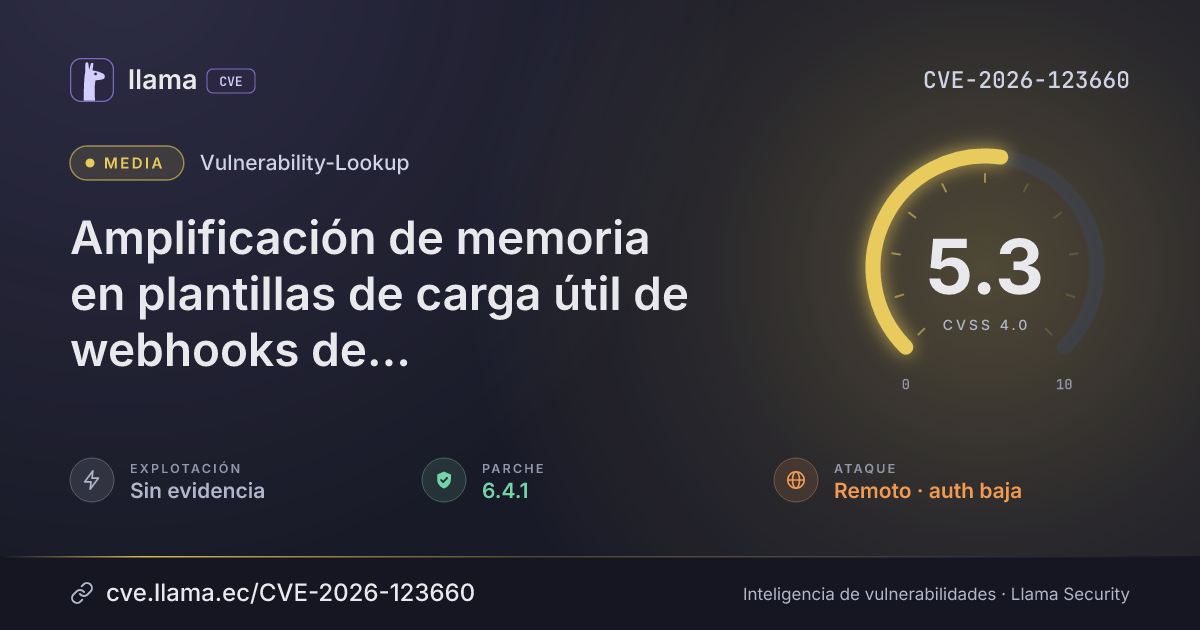
CVE-2026-123660
Vulnerability-Lookup memory amplification in webhook payload templates
A signed-in user with a confirmed account can use webhook templates to exhaust server memory and crash the service.
CVSS:4.0/AV:N/AC:L/AT:N/PR:L/UI:N/VC:N/VI:N/VA:L/SC:N/SI:N/SA:N
Fuente: CNA
Ciclo de vida de la vulnerabilidad
| Fecha | Fase | Evento | Detalle |
|---|---|---|---|
| Divulgación | Publicada | CVE-2026-123660 divulgada · CVSS 5.3 (CNA) | |
| Monitoreo | Detectada | Ingresó al índice | |
| Monitoreo | Fuente: NIST NVD | Registro visto por primera vez en NIST NVD | |
| Divulgación | Evaluación SSVC | CISA-ADP · explotación ninguna | |
| Divulgación | Modificada | Última actualización del registro | |
| Monitoreo | Fuente: OSV | Registro visto por primera vez en OSV | |
| Monitoreo | Verificada | Última verificación contra las fuentes |
Vulnerability-Lookup, a vulnerability tracking application, can be made to use excessive memory through the payload template of its webhook notifications. A signed-in user can reach this remotely, and the default setup lets anyone with a confirmed account create one, so an attacker could exhaust server memory and cause a denial of service.
Descripción original del registro (CIRCL)
In Vulnerability-Lookup 5.5.1 up to but not including 6.4.1, a signed-in user could make the server allocate memory far out of proportion to their input through a webhook notification's payload template. Each placeholder's format specifier was passed unchanged to Python's string formatting, which builds the padded result before its size can be checked. A template of a few dozen bytes, such as {"text": "{title:>999999999}"}, therefore produced a string of about 1 GB when the notification form test-rendered it on save, and repeating such fields multiplied the cost. Templates that passed the save check could also repeat placeholders such as {text} thousands of times; the notification daemon rebuilt those on every webhook delivery. Deeply nested templates raised an unhandled recursion error (HTTP 500). An attacker needs only an account, which the default configuration lets anyone create after e-mail confirmation. They could exhaust the memory of web workers or the notification daemon, causing a denial of service. Version 6.4.1 caps every number in a format specifier at 256, limits a rendered template to 1,000,000 characters both on save and at delivery, and rejects templates nested deeper than 32 levels.
Desglose de métricas
Rangos afectados
Estado del parche por paquete
| Paquete / producto | Estado | Corregida en | Desde divulgación | Última versión |
|---|---|---|---|---|
vulnerability-lookup |
Corregida | 6.4.1 | — | — |
6.4.1Arsenal público
Sin exploits, módulos ni PoC públicos conocidos a la fecha de verificación.
https://github.com/vulnerability-lookup/vulnerability-lookup/commit/2076ffdae3d024649114eeb6fd185338d4bb1f40Las referencias externas se muestran para copiar: cve.llama.ec no lo redirige a otros sitios.