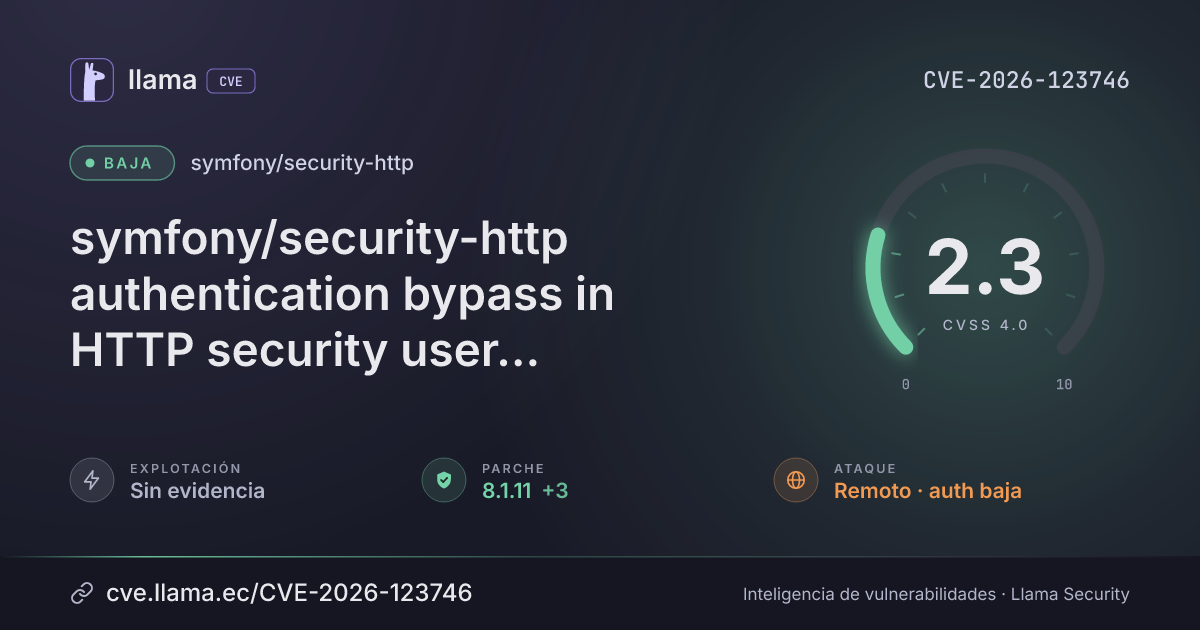
CVE-2026-123746
symfony/security-http authentication bypass in HTTP security user checkers
A user with low privileges can obtain a session on accounts that a custom user checker rejects, such as expired ones.
CVSS:4.0/AV:N/AC:L/AT:P/PR:L/UI:N/VC:L/VI:L/VA:N/SC:N/SI:N/SA:N
Fuente: CNA
Ciclo de vida de la vulnerabilidad
| Fecha | Fase | Evento | Detalle |
|---|---|---|---|
| Divulgación | Publicada | CVE-2026-123746 divulgada · CVSS 2.3 (CNA) | |
| Monitoreo | Detectada | Ingresó al índice | |
| Monitoreo | Fuente: NIST NVD | Registro visto por primera vez en NIST NVD | |
| Monitoreo | Fuente: ENISA EUVD | Registro visto por primera vez en ENISA EUVD | |
| Divulgación | Evaluación SSVC | CISA-ADP · explotación ninguna | |
| Divulgación | Modificada | Última actualización del registro | |
| Monitoreo | Fuente: OSV | Registro visto por primera vez en OSV | |
| Monitoreo | Verificada | Última verificación contra las fuentes |
Symfony's Security HTTP component skips the custom user checker's post-authentication check when users are logged in programmatically, such as after a password reset or e-mail verification link. Remotely, a user who already has low-privilege access can obtain an authenticated session on an account that a custom user checker rejects, such as an expired account.
Descripción original del registro (Checkmarx)
The Symfony Security HTTP component AuthenticatorManager::authenticateUser() does not run the firewall user checker’s checkPostAuth() method when a user is authenticated programmatically, allowing an account rejected by a custom user checker, such as an expired account, to be authenticated in Symfony versions prior to 5.4.56, 6.x prior to 6.4.50, 7.x prior to 7.4.23, and 8.x prior to 8.1.11. AuthenticatorManager::authenticateUser() is used by UserAuthenticatorInterface::authenticateUser() and by the SecurityBundle’s Security::login() to authenticate a user programmatically, but it does not dispatch the security.authentication.success event, on which checkPostAuth() runs. The fix for CVE-2024-50341 made Security::login() call checkPreAuth(), but checkPostAuth() was still skipped. As a result, an account rejected by a custom user checker in checkPostAuth() is refused by form login and the other authenticators of the firewall, but can still be authenticated programmatically. Applications are affected when they use a custom user checker that rejects users in checkPostAuth() and authenticate users programmatically, for example after a password reset or an e-mail verification link. A user whose account is rejected can then obtain an authenticated session through that flow. The default user checker does nothing in checkPostAuth(), so the default configuration is not affected. The fix makes AuthenticatorManager::authenticateUser() dispatch the security.authentication.success event once the token is created and before it is stored, as authentications through the firewall do, so that checkPostAuth() runs and can reject the user.
Desglose de métricas
Rangos afectados
Estado del parche por paquete
| Paquete / producto | Estado | Corregida en | Desde divulgación | Última versión |
|---|---|---|---|---|
symfony/security-http |
Corregida | 5.4.56, 6.4.50, 7.4.23, 8.1.11 | — | — |
5.4.566.4.507.4.238.1.11Arsenal público
Sin exploits, módulos ni PoC públicos conocidos a la fecha de verificación.
https://github.com/symfony/symfony/security/advisories/GHSA-8f57-m8wj-x65whttps://github.com/symfony/symfony/commit/af0aae5012beedf0a0c3fd581fd8b9ef696240c4Las referencias externas se muestran para copiar: cve.llama.ec no lo redirige a otros sitios.