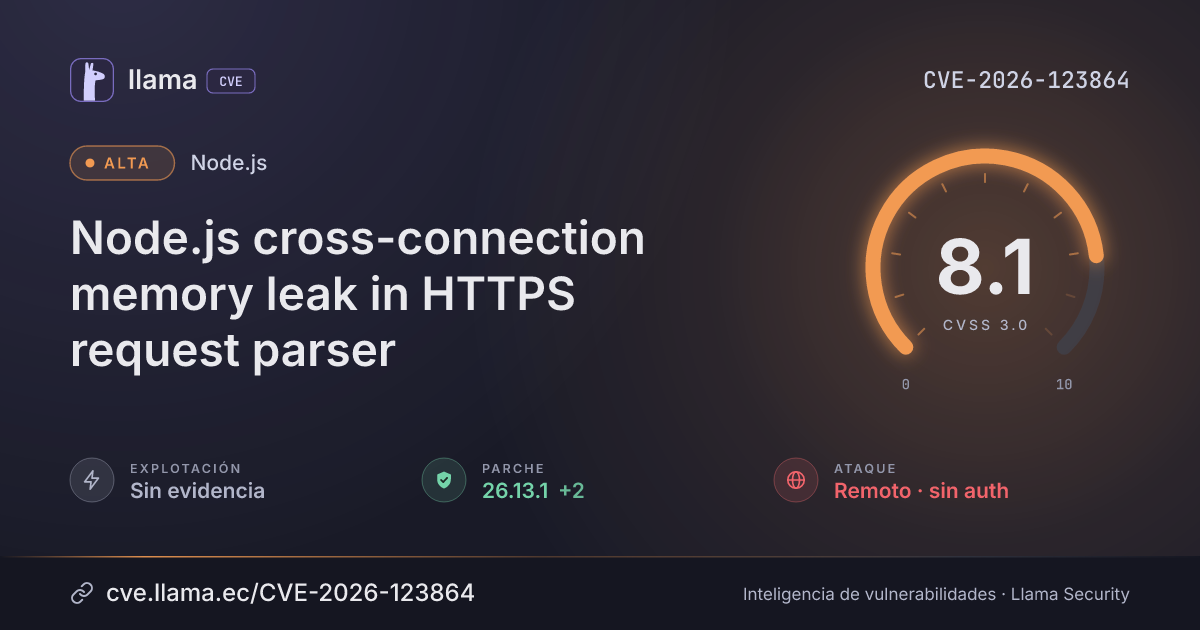
CVE-2026-123864
Node.js cross-connection memory leak in HTTPS request parser
A remote client without credentials can read TLS private keys and other users' requests from HTTPS servers.
CVSS:3.0/AV:N/AC:H/PR:N/UI:N/S:C/C:L/I:L/A:H
Fuente: CNA
Ciclo de vida de la vulnerabilidad
| Fecha | Fase | Evento | Detalle |
|---|---|---|---|
| Divulgación | Publicada | CVE-2026-123864 divulgada · CVSS 8.1 (CNA) | |
| Monitoreo | Detectada | Ingresó al índice | |
| Monitoreo | Fuente: NIST NVD | Registro visto por primera vez en NIST NVD | |
| Monitoreo | Fuente: ENISA EUVD | Registro visto por primera vez en ENISA EUVD | |
| Divulgación | Evaluación SSVC | CISA-ADP · explotación ninguna | |
| Divulgación | Modificada | Última actualización del registro | |
| Monitoreo | Verificada | Última verificación contra las fuentes |
Node.js HTTPS servers can leak memory from other connections, including TLS private keys and other users' requests, to an unauthenticated remote client. The attacker must send a request to a handler that calls res.flushHeaders() before the request body ends and later calls res.end() with a non-empty chunk, and the leak only works when the server echoes or stores request bodies on an ordinary route; cleartext node:http is not affected.
Affects Node.js 22.x, 24.x and 26.x HTTPS servers whose handlers flush headers before the request body ends and echo or store request bodies. Fixed in 22.23.5, 24.22.3 and 26.13.1.
Descripción original del registro (openjs)
A re-entrancy flaw in Node.js HTTPS lets an unauthenticated client read memory belonging to other connections, including TLS private keys and other users' requests. TLSWrap::DoWrite() calls ClearOut() directly when asked to write zero bytes; if that write is issued from JavaScript running inside the HTTP parser's on_body callback, ClearOut() decrypts the next TLS record while the parser is still mid-body, re-entering llhttp_execute() and causing a use-after-free and an out-of-bounds heap read. The server then copies that freed or unrelated heap memory into the response for the request body. Triggering it requires a handler that calls res.flushHeaders() before the request body ends and later calls res.end() with a non-empty chunk, and reading the leaked memory requires any ordinary route that echoes or stores a request body. Cleartext node:http is not affected. This vulnerability affects Node.js 26.x, 24.x, and 22.x.
Condiciones y alcance
Desglose de métricas
Rangos afectados
Estado del parche por paquete
| Paquete / producto | Estado | Corregida en | Desde divulgación | Última versión |
|---|---|---|---|---|
node |
Corregida | 22.23.5, 24.22.3, 26.13.1 | — | — |
22.23.524.22.326.13.1Arsenal público
Sin exploits, módulos ni PoC públicos conocidos a la fecha de verificación.
https://nodejs.org/en/blog/vulnerability/november-2026-security-releaseshttps://cna.openjsf.org/security-advisories.htmlLas referencias externas se muestran para copiar: cve.llama.ec no lo redirige a otros sitios.