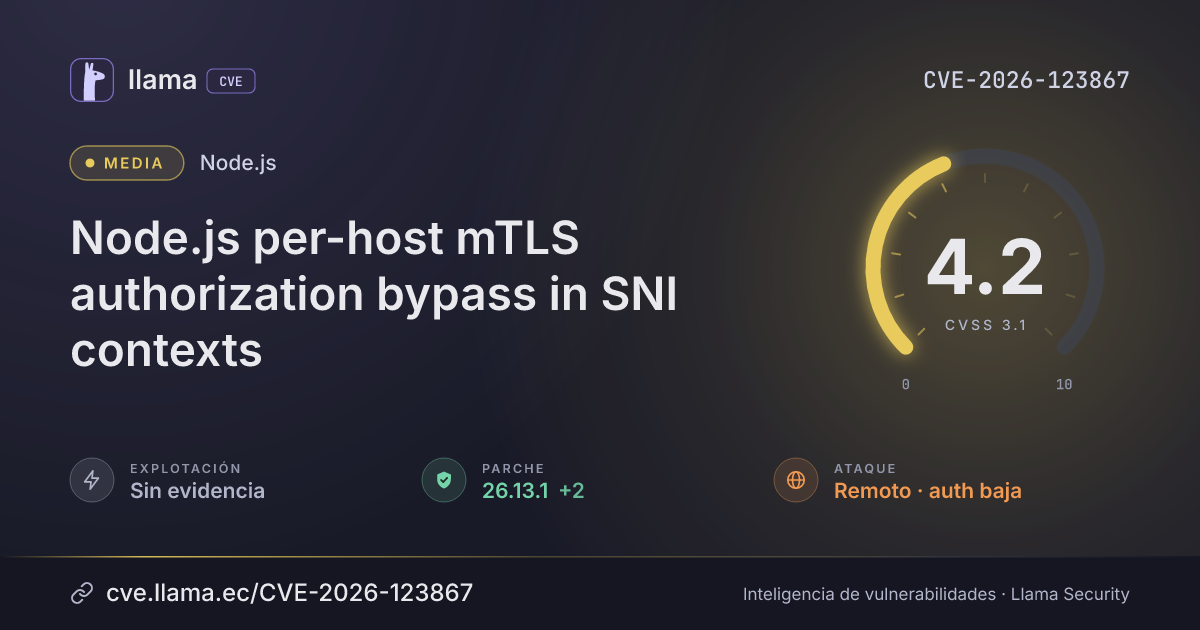
CVE-2026-123867
Node.js per-host mTLS authorization bypass in SNI contexts
A remote attacker with a default-CA client certificate can reach an unauthorized protected host and read its responses.
CVSS:3.1/AV:N/AC:H/PR:L/UI:N/S:U/C:L/I:L/A:N
Fuente: CNA
Ciclo de vida de la vulnerabilidad
| Fecha | Fase | Evento | Detalle |
|---|---|---|---|
| Divulgación | Publicada | CVE-2026-123867 divulgada · CVSS 4.2 (CNA) | |
| Monitoreo | Detectada | Ingresó al índice | |
| Monitoreo | Fuente: NIST NVD | Registro visto por primera vez en NIST NVD | |
| Monitoreo | Fuente: ENISA EUVD | Registro visto por primera vez en ENISA EUVD | |
| Divulgación | Evaluación SSVC | CISA-ADP · explotación ninguna | |
| Divulgación | Modificada | Última actualización del registro | |
| Monitoreo | Verificada | Última verificación contra las fuentes |
Node.js is affected by a per-host mutual TLS authorization bypass: when a server assigns a hostname its own client-certificate CA through an SNI context with no server certificate, Node.js silently falls back to the default CA. A remote attacker who holds a client certificate trusted only by the default CA can complete mutual TLS to a protected hostname they are not authorized for and read its responses.
Descripción original del registro (openjs)
A per-host mutual-TLS authorization bypass in Node.js lets a client authorized for the default hostname reach a protected hostname it is not authorized for. When a TLS server assigns a hostname a different client-certificate CA with `server.addContext(host, { ca: protectedCA })` but no server certificate in that SNI context, the per-host client CA is never installed and the handshake falls back to the default client CA. In `src/crypto/crypto_tls.cc`, `CertCbDone` installs the SNI context's CA only when `setSniContext` succeeds, but `setSniContext` returns `false` for a context with no server certificate, so a CA-only SNI context silently keeps the default CA. A client holding a certificate trusted by the default CA, but not the protected CA, can therefore complete mTLS to the protected hostname and read its response even with `requestCert` and `rejectUnauthorized` enabled, while a client certified by the protected CA is rejected. This vulnerability affects Node.js 26.x, 24.x, and 22.x.
Desglose de métricas
Rangos afectados
Estado del parche por paquete
| Paquete / producto | Estado | Corregida en | Desde divulgación | Última versión |
|---|---|---|---|---|
node |
Corregida | 22.23.5, 24.22.3, 26.13.1 | — | — |
22.23.524.22.326.13.1Arsenal público
Sin exploits, módulos ni PoC públicos conocidos a la fecha de verificación.
https://nodejs.org/en/blog/vulnerability/november-2026-security-releaseshttps://cna.openjsf.org/security-advisories.htmlLas referencias externas se muestran para copiar: cve.llama.ec no lo redirige a otros sitios.