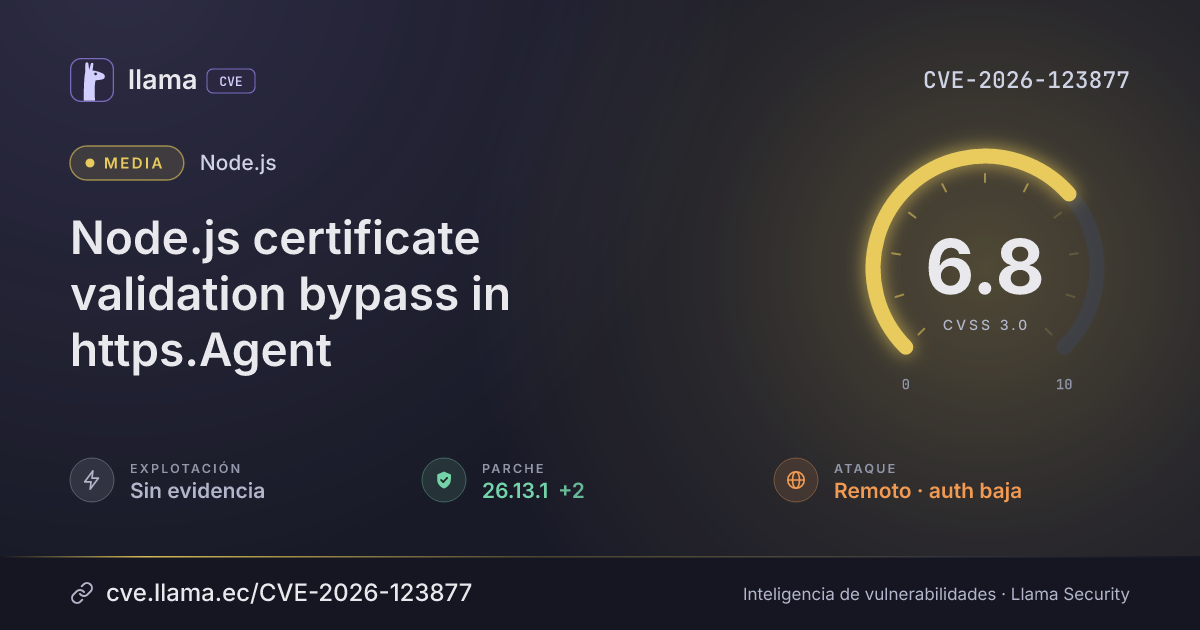
CVE-2026-123877
Node.js certificate validation bypass in https.Agent
A low-privileged network attacker could make a client send confidential data to a server it should have rejected.
CVSS:3.0/AV:N/AC:H/PR:L/UI:N/S:U/C:H/I:H/A:N
Fuente: CNA
Ciclo de vida de la vulnerabilidad
| Fecha | Fase | Evento | Detalle |
|---|---|---|---|
| Divulgación | Publicada | CVE-2026-123877 divulgada · CVSS 6.8 (CNA) | |
| Monitoreo | Detectada | Ingresó al índice | |
| Monitoreo | Fuente: NIST NVD | Registro visto por primera vez en NIST NVD | |
| Monitoreo | Fuente: ENISA EUVD | Registro visto por primera vez en ENISA EUVD | |
| Divulgación | Evaluación SSVC | CISA-ADP · explotación ninguna | |
| Divulgación | Modificada | Última actualización del registro | |
| Monitoreo | Verificada | Última verificación contra las fuentes |
Node.js is affected by a certificate validation bypass in its https.Agent, where a cached TLS session authenticated under the default trust store can be reused for a later request that uses a stricter custom CA list. An attacker who can get a client to make such requests over the network, with low privileges and no user action, could cause confidential data to be sent to a server that should have been rejected.
Descripción original del registro (openjs)
A certificate validation bypass in Node.js https.Agent lets a cached TLS session authenticated under one CA policy be reused by a later request with a stricter policy. https.Agent.prototype.getName() assigns the same Agent and session-cache key to a request that omits ca and one that explicitly supplies ca: [], because an omitted value appends nothing to the key while an empty array stringifies to an empty string. The two policies differ: omitting ca uses the default trust store, while supplying ca replaces it. Since they share a key, a TLS session authenticated under the broader default policy is handed to a new connection made under the later ca: [] policy, and TLS 1.3 session resumption carries the earlier authentication forward, so the second request reports authorized === true and transmits confidential data to a server its own CA policy would reject on a fresh connection. This vulnerability affects Node.js 26.x, 24.x, and 22.x.
Desglose de métricas
Rangos afectados
Estado del parche por paquete
| Paquete / producto | Estado | Corregida en | Desde divulgación | Última versión |
|---|---|---|---|---|
node |
Corregida | 22.23.5, 24.22.3, 26.13.1 | — | — |
22.23.524.22.326.13.1Arsenal público
Sin exploits, módulos ni PoC públicos conocidos a la fecha de verificación.
https://nodejs.org/en/blog/vulnerability/november-2026-security-releaseshttps://cna.openjsf.org/security-advisories.htmlLas referencias externas se muestran para copiar: cve.llama.ec no lo redirige a otros sitios.