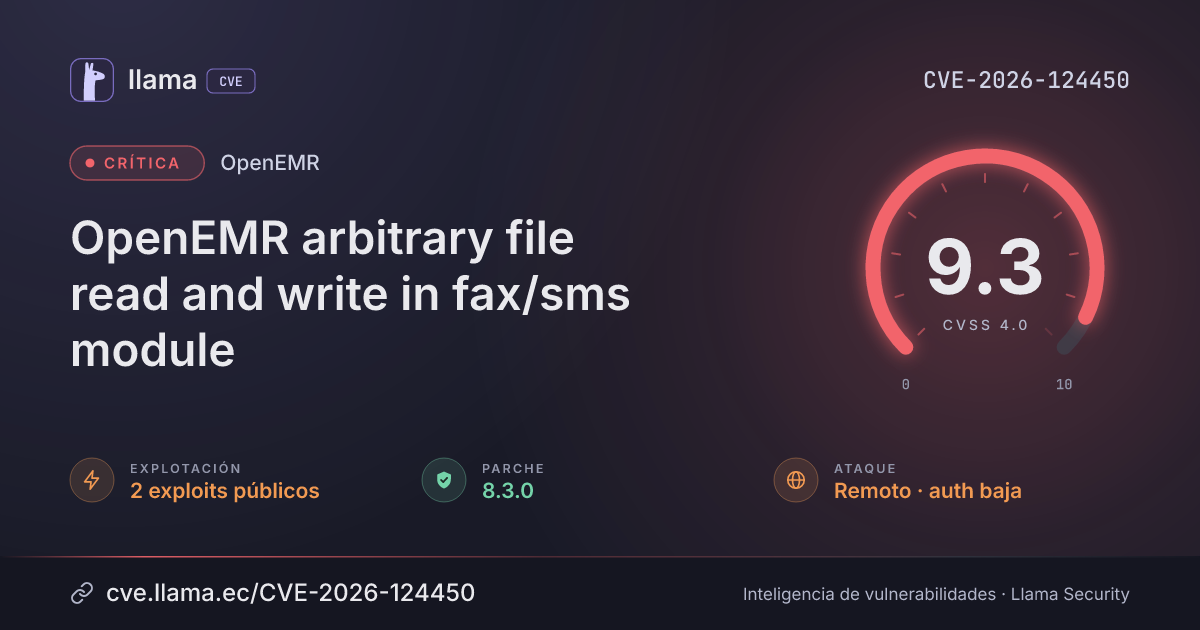
OpenEMR
CVE-2026-124450
OpenEMR arbitrary file read and write in fax/sms module
Low-privilege users can read database credentials and write arbitrary files, enabling remote code execution.
Specific setups onlyParche disponiblefile path manipulation
CVSS 4.0
9.3
Crítica
CVSS:4.0/AV:N/AC:L/AT:N/PR:L/UI:N/VC:H/VI:H/VA:L/SC:H/SI:L/SA:N
Fuente: CNA
Decisión SSVCSeguir de cerca
Monitorear y programar la remediación
Existe PoC pública, no automatizable e impacto técnico total. Hay versiones corregidas disponibles.
Timeline
Ciclo de vida de la vulnerabilidad
| Fecha | Fase | Evento | Detalle |
|---|---|---|---|
| Divulgación | Publicada | CVE-2026-124450 divulgada · CVSS 9.3 (CNA) | |
| Monitoreo | Detectada | Ingresó al índice | |
| Monitoreo | Fuente: NIST NVD | Registro visto por primera vez en NIST NVD | |
| Monitoreo | Fuente: ENISA EUVD | Registro visto por primera vez en ENISA EUVD | |
| Monitoreo | Fuente: PoC-in-GitHub | Registro visto por primera vez en PoC-in-GitHub | |
| Monitoreo | Fuente: OSV | Registro visto por primera vez en OSV | |
| Divulgación | Evaluación SSVC | CISA-ADP · explotación PoC pública | |
| Divulgación | Modificada | Última actualización del registro | |
| Monitoreo | Fuente: Nuclei templates | Registro visto por primera vez en Nuclei templates | |
| Monitoreo | Verificada | Última verificación contra las fuentes |
Resumen
OpenEMR before 8.3.0 contains a broken access control and path traversal vulnerability in the fax/sms module disposeDocument action via an unvalidated file_path parameter. Authenticated low-privilege users can read sqlconf.php to recover database credentials and write arbitrary files as the web user, enabling remote code execution.
¿Qué significa?A user with a low-privilege account can abuse a broken access control in the disposeDocument function to read and write arbitrary files as the web user. Reading sites/default/sqlconf.php exposes the database credentials, and arbitrary file writes can lead to remote code execution.
¿Quién está afectado?OpenEMR versions before 8.3.0 are affected, but only when the fax/sms module (oe-module-faxsms) is installed and active under Modules > Manage Modules, with RingCentral or SignalWire set as the fax/sms vendor. The user's role must also carry the broad patients/demo ACL, which most clinical and clerical roles hold. You can check the OpenEMR version and the module state in Modules > Manage Modules.
¿Qué hacer?Upgrade OpenEMR to version 8.3.0 or later, which is the fixed version.
Contexto
Condiciones y alcance
Condiciones necesarias para que el fallo sea explotable
01
The fax/sms module (oe-module-faxsms) is installed and active.“the fax/sms module ( oe-module-faxsms ) is installed and active under Modules > Manage Modules”
02
The fax/sms vendor is RingCentral or SignalWire.“with RingCentral or SignalWire as the fax/sms vendor”
03
The user's role carries the patients/demo ACL.“a user holding only the broad patients/demo ACL (most clinical and clerical roles)”
04
OpenEMR versions before 8.3.0.“OpenEMR before 8.3.0 contains a broken access control”
¿Quién debe revisar?Teams running OpenEMR before 8.3.0 with the fax/sms module active and RingCentral or SignalWire as the fax vendor, including staff accounts holding patients/demo.
Vector CVSS 4.0
Desglose de métricas
Vector de ataqueAV:N
RedAdyacenteLocalFísica
ComplejidadAC:L
BajaAlta
Requisitos de ataqueAT:N
NingunoPresentes
PrivilegiosPR:L
NingunoBajosAltos
InteracciónUI:N
NingunaPasivaActiva
Confid. (sistema)VC:H
AltoBajoNinguno
Integridad (sistema)VI:H
AltoBajoNinguno
Disponib. (sistema)VA:L
AltoBajoNinguno
Confid. (posterior)SC:H
AltoBajoNinguno
Integridad (posterior)SI:L
AltoBajoNinguno
Disponib. (posterior)SA:N
AltoBajoNinguno
Versiones
Rangos afectados
Afectada
Corregida
< 8.3.0
8.3.0
Remediación
Estado del parche por paquete
| Paquete / producto | Estado | Corregida en | Desde divulgación | Última versión |
|---|---|---|---|---|
openemr |
Corregida | 8.3.0 | — | — |
Versiones corregidas
8.3.0Explotación
Arsenal público
Exploit-DB
0
Metasploit
0
Nuclei
1
PoC en GitHub
1
Ver los 1 repositorios de GitHub
Los repositorios públicos incluyen exploits, escáneres, laboratorios y reglas de detección. No ejecute código de terceros sin revisarlo en un entorno aislado.
Referencias
Fabricante
https://github.com/openemr/openemr/security/advisories/GHSA-wf4w-mx2w-j4vvExploit
https://github.com/projectdiscovery/nuclei-templates/blob/main/http/cves/2026/CVE-2026-124450.yamlExploit
https://github.com/Nxploited/CVE-2026-124450Otra
https://www.vulncheck.com/advisories/openemr-before-8.3.0-arbitrary-file-read-write-via-disposedocumentLas referencias externas se muestran para copiar: cve.llama.ec no lo redirige a otros sitios.