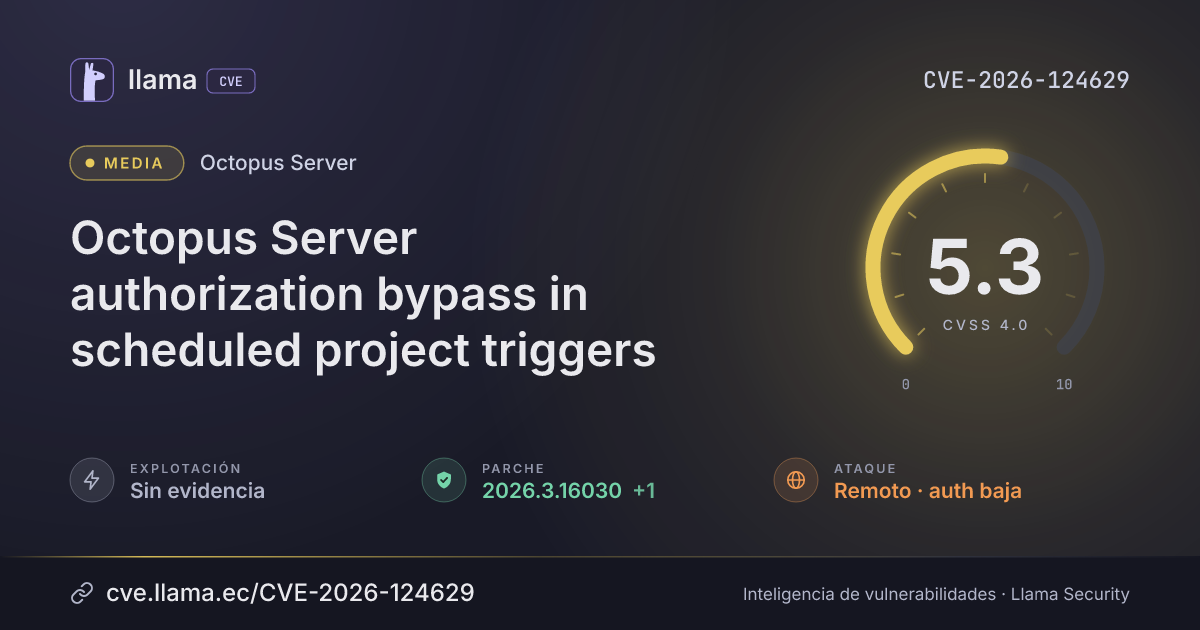
CVE-2026-124629
Octopus Server authorization bypass in scheduled project triggers
Low-privilege users can set up scheduled triggers that create and deploy releases without the required permission.
CVSS:4.0/AV:N/AC:L/AT:N/PR:L/UI:N/VC:N/VI:L/VA:N/SC:N/SI:N/SA:N
Fuente: CNA
Ciclo de vida de la vulnerabilidad
| Fecha | Fase | Evento | Detalle |
|---|---|---|---|
| Divulgación | Publicada | CVE-2026-124629 divulgada · CVSS 5.3 (CNA) | |
| Monitoreo | Detectada | Ingresó al índice | |
| Monitoreo | Fuente: NIST NVD | Registro visto por primera vez en NIST NVD | |
| Divulgación | Evaluación SSVC | CISA-ADP · explotación ninguna | |
| Divulgación | Modificada | Última actualización del registro | |
| Monitoreo | Fuente: ENISA EUVD | Registro visto por primera vez en ENISA EUVD | |
| Monitoreo | Verificada | Última verificación contra las fuentes |
In affected versions of Octopus Server, a user who could deploy existing releases but not create new ones could configure a scheduled project trigger that creates and deploys new releases without holding the required permission. The attack can be launched over the network by a logged-in user with low privileges, and the resulting audit events were recorded against the system rather than the user who set up the trigger.
Descripción original del registro (Octopus)
In affected versions of Octopus Server, insufficient authorization checks on scheduled project triggers allowed users who were permitted to deploy existing releases, but not to create new ones, to configure a trigger that could result in new releases being created and deployed without the required permission being assigned. The resulting audit events were attributed to the system rather than to the user who configured the trigger.
Desglose de métricas
Rangos afectados
Estado del parche por paquete
| Paquete / producto | Estado | Corregida en | Desde divulgación | Última versión |
|---|---|---|---|---|
Octopus Server |
Corregida | 2026.2.13558, 2026.3.16030 | — | — |
2026.2.135582026.3.16030Arsenal público
Sin exploits, módulos ni PoC públicos conocidos a la fecha de verificación.
https://advisories.octopus.com/post/2026/sa2026-25Las referencias externas se muestran para copiar: cve.llama.ec no lo redirige a otros sitios.