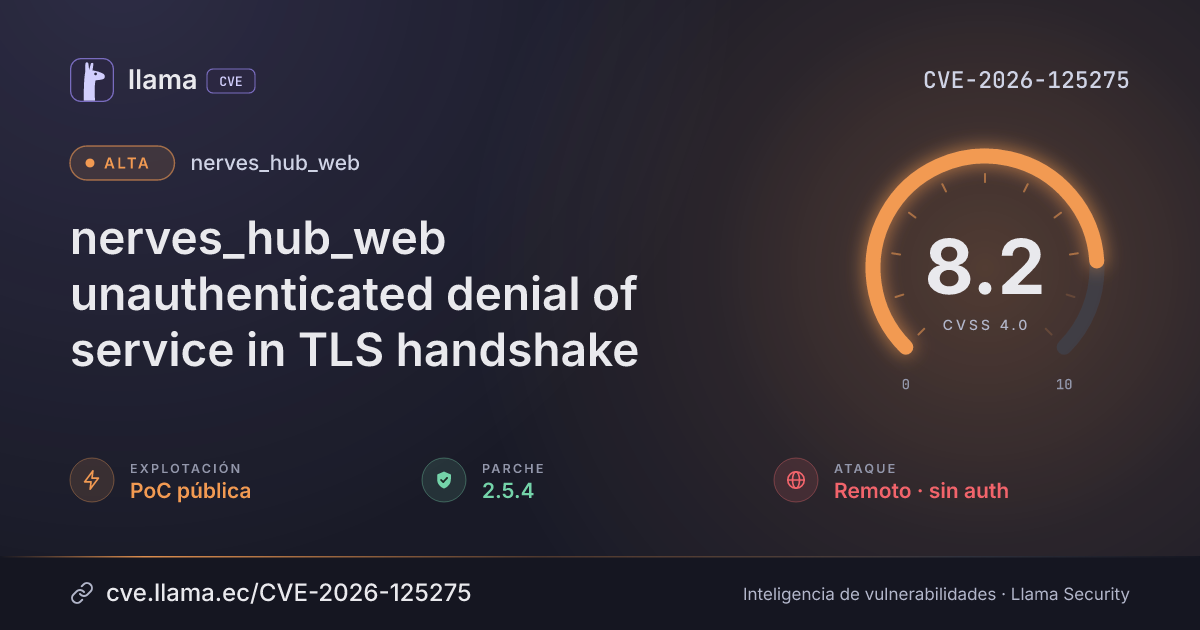
ExplotaciónPoC públicaSSVC: poc · no figura en CISA KEV
Exploits públicos0Ninguno conocido
Parche1 versión2.5.4
Exposición3 dDesde la divulgación, 16 nov 2026, 9:54 p. m.
Detección7 minDesde la divulgación hasta su ingreso al índice
Decisión SSVCSeguir de cerca
Monitorear y programar la remediación
Existe PoC pública, no automatizable e impacto técnico parcial. Hay versiones corregidas disponibles.
Timeline
Ciclo de vida de la vulnerabilidad
Hoy
Divulgación
Publicada +1
Modificada
Explotación
Remediación
Monitoreo
Detectada +3
Verificada
17 nov 26
19 nov 26
20 nov 26
17 nov 26
17 nov 26
18 nov 26
19 nov 26
20 nov 26
Fecha
Fase
Evento
Detalle
Divulgación
Publicada
CVE-2026-125275 divulgada · CVSS 8.2 (CNA)
Monitoreo
Detectada
Ingresó al índice
Monitoreo
Fuente: NIST NVD
Registro visto por primera vez en NIST NVD
Divulgación
Evaluación SSVC
CISA-ADP · explotación PoC pública
Monitoreo
Fuente: ENISA EUVD
Registro visto por primera vez en ENISA EUVD
Monitoreo
Fuente: OSV
Registro visto por primera vez en OSV
Divulgación
Modificada
Última actualización del registro
Monitoreo
Verificada
Última verificación contra las fuentes
Resumen
Resumen generado por IA · CC-BY 4.0 · 16 nov 2026
Attackers can remotely, without logging in, cause a denial of service in nerves-hub's nerves_hub_web by presenting a TLS client certificate whose CA is not registered in NervesHub. The resulting TLS handshake loops endlessly and keeps running after the client disconnects, until the node restarts.
Affects nerves_hub_web from 1.0.0 before 2.5.4 when DEVICE_SSL_CACERTFILE is unset, the default from 2.0.0. Fixed in 2.5.4.
¿Qué significa?A device certificate whose certificate authority is not registered can keep a TLS handshake running indefinitely. The handshake process keeps querying the database after the client disconnects, until the node restarts, which causes a denial of service.
¿Quién está afectado?nerves_hub is affected from version 1.0.0 before 2.5.4. The certificate chain must end at a root in the device endpoint's trust store, which is the case when DEVICE_SSL_CACERTFILE is unset (the default from 2.0.0) and the trust store holds the public roots from CAStore. The Erlang/OTP ssl retry was confirmed on Erlang/OTP 28.3, 29.0 and 29.1, and earlier releases were not checked. To check, look at the nerves_hub_web version and at whether DEVICE_SSL_CACERTFILE is set in the environment.
¿Qué hacer?Upgrade nerves_hub_web to 2.5.4 or later, which is the listed fixed version. No vendor patch ids are named.
Descripción original del registro (EEF)
Loop with Unreachable Exit Condition ('Infinite Loop') vulnerability in device certificate verification in nerves-hub nerves_hub_web allows an unauthenticated remote attacker to cause a denial of service via a TLS client certificate whose CA is not registered. When a client certificate chains to a root in the device endpoint's trust store but no CA in the chain is registered in NervesHub, NervesHub.SSL.decide/2 refuses it with the reason :unknown_ca. Erlang/OTP ssl reads that reason as a missing trust anchor, looks for an alternative root, finds the same root and validates again without end. The handshake process queries the database on each pass and keeps running after the client disconnects, until the node restarts.
The device endpoint trusts the public roots from CAStore unless DEVICE_SSL_CACERTFILE is set, so a client certificate from a public CA whose chain allows client authentication is sufficient. A chain that ends at a root outside the trust store is refused once.
This issue affects nerves_hub: from 1.0.0 before 2.5.4.
Contexto
Condiciones y alcance
Condiciones necesarias para que el fallo sea explotable
01
The certificate chain must end at a root in the device endpoint's trust store.“The certificate chain must end at a root in the device endpoint's trust store.”
02
DEVICE_SSL_CACERTFILE is unset (default from 2.0.0), so the trust store holds the public roots from CAStore.“With DEVICE_SSL_CACERTFILE unset, which is the default from 2.0.0, the trust store holds the public roots from CAStore.”
03
nerves_hub versions from 1.0.0 before 2.5.4.“This issue affects nerves_hub: from 1.0.0 before 2.5.4.”
04
Erlang/OTP ssl retry confirmed on Erlang/OTP 28.3, 29.0 and 29.1; earlier releases not checked.“The retry in Erlang/OTP ssl was confirmed on Erlang/OTP 28.3, 29.0 and 29.1.”
¿Quién debe revisar?Operators running NervesHub nerves_hub_web from 1.0.0 before 2.5.4 with a device endpoint, including those using the default CAStore trust store.
MitigaciónSet DEVICE_SSL_CACERTFILE to a bundle that holds no public root and no root that signs device certificates, for example a file with one self-signed certificate made for this purpose.
Vector CVSS 4.0
Desglose de métricas
Opción resaltada = valor del vector · izquierda = peor caso · CNA
Vector de ataqueAV:N
RedAdyacenteLocalFísica
ComplejidadAC:L
BajaAlta
Requisitos de ataqueAT:P
NingunoPresentes
PrivilegiosPR:N
NingunoBajosAltos
InteracciónUI:N
NingunaPasivaActiva
Confid. (sistema)VC:N
AltoBajoNinguno
Integridad (sistema)VI:N
AltoBajoNinguno
Disponib. (sistema)VA:H
AltoBajoNinguno
Confid. (posterior)SC:N
AltoBajoNinguno
Integridad (posterior)SI:N
AltoBajoNinguno
Disponib. (posterior)SA:N
AltoBajoNinguno
Versiones
Rangos afectados
AfectadaCorregida
nerves-hub · nerves_hub≥ 1.0.0 < 2.5.4
1.0.0
2.5.4
Remediación
Estado del parche por paquete
Paquete / producto
Estado
Corregida en
Desde divulgación
Última versión
nerves_hub_web
Corregida
2.5.4
—
—
Versiones corregidas2.5.4
Explotación
Arsenal público
Sin exploits, módulos ni PoC públicos conocidos a la fecha de verificación.
Registro
EscenarioGENERALEEF
configurationThe certificate chain must end at a root in the device endpoint's trust store. With DEVICE_SSL_CACERTFILE unset, which is the default from 2.0.0, the trust store holds the public roots from CAStore. With DEVICE_SSL_CACERTFILE set to a bundle that holds a root which signs device certificates, any certificate from that root whose CA is not registered is sufficient, including the certificate of a deleted device.
The retry in Erlang/OTP ssl was confirmed on Erlang/OTP 28.3, 29.0 and 29.1. Earlier releases were not checked.EEF
MitigaciónSet DEVICE_SSL_CACERTFILE to a bundle that holds no public root and no root that signs device certificates, for example a file with one self-signed certificate made for this purpose. A certificate from an unregistered CA is then refused once and the handshake ends. Devices whose certificate or CA is registered in NervesHub continue to connect.
Restarting a node ends the handshakes that are already stuck on it.EEF
Usamos cookies propias estrictamente necesarias para que el sitio funcione y sea seguro. Con tu permiso, también usamos almacenamiento local para recordar tus preferencias y medir el uso del sitio de forma agregada. Puedes aceptar, rechazar o configurar cada categoría, y cambiar tu decisión cuando quieras desde el enlace “Preferencias de cookies” del pie de página. Más información
Preferencias de cookies
Elige qué permites
Solo usamos tecnologías propias de este dominio. Sin publicidad ni rastreadores de terceros. Detalle en la Política de cookies.