llamaCVEVulnerability Intelligence
/
Tencent BrowserSkill

CVE-2026-125361

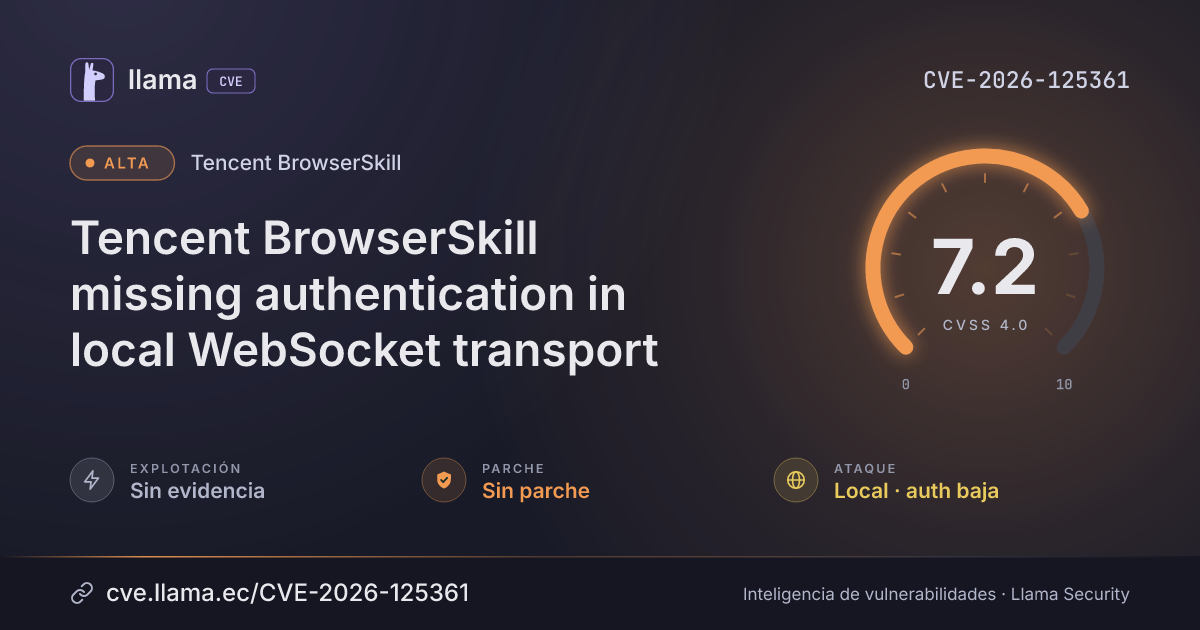
Tencent BrowserSkill missing authentication in local WebSocket transport

A local attacker can impersonate the background daemon and run JavaScript in logged-in browser tabs.

Specific setups onlySin parche publicadounrestricted network endpoint
Descargar PNG JSON
CVSS 4.0
7.2
Alta
CVSS:4.0/AV:L/AC:H/AT:P/PR:L/UI:N/VC:H/VI:H/VA:N/SC:N/SI:N/SA:N Fuente: CNA
ExplotaciónSin evidenciaSSVC: none · no figura en CISA KEV
Exploits públicos0Ninguno conocido
ParcheSin parcheEl fabricante no ha publicado corrección
Exposición9 dDesde la divulgación, 9 nov 2026, 6:27 p. m.
Detección9 minDesde la divulgación hasta su ingreso al índice
Decisión SSVCSeguir de cerca
Monitorear y programar la remediación
Sin explotación conocida, no automatizable e impacto técnico total. No hay versión corregida: aplique mitigaciones.
Timeline

Ciclo de vida de la vulnerabilidad

Hoy
Divulgación
Publicada
Evaluación SSVC +1
Explotación
Remediación
Monitoreo
Detectada
Fuente: NIST NVD +1
Fuente: OSV
Verificada
9 nov 26
10 nov 26
12 nov 26
14 nov 26
16 nov 26
19 nov 26
9 nov 26
12 nov 26
14 nov 26
17 nov 26
19 nov 26
FechaFaseEventoDetalle
Divulgación Publicada CVE-2026-125361 divulgada · CVSS 7.2 (CNA)
Monitoreo Detectada Ingresó al índice
Monitoreo Fuente: NIST NVD Registro visto por primera vez en NIST NVD
Monitoreo Fuente: ENISA EUVD Registro visto por primera vez en ENISA EUVD
Monitoreo Fuente: OSV Registro visto por primera vez en OSV
Divulgación Evaluación SSVC CISA-ADP · explotación ninguna
Divulgación Modificada Última actualización del registro
Monitoreo Verificada Última verificación contra las fuentes
Resumen
Resumen generado por IA · CC-BY 4.0 · 9 nov 2026

Tencent BrowserSkill through 0.4.2 has a missing authentication flaw in its local WebSocket transport that lets a local attacker impersonate the bsk daemon by binding its port before it starts or after it exits. The attacker can then receive the extension's tool surface, including an evaluate function that runs JavaScript in logged-in browser tabs.

Affects BrowserSkill through 0.4.2 in its default local-only mode, where the daemon WebSocket opens with no credential. The fix is commit 7e862a44, merged in #620; no fixed version is named.

¿Qué significa?A local process can bind the daemon's loopback port before the real bsk daemon starts or after it exits, and then impersonate the daemon. It receives the extension's full tool surface, including evaluate, which runs JavaScript through CDP in logged-in browser tabs.
¿Quién está afectado?BrowserSkill versions through 0.4.2 are listed as affected. The exposed setup is the default local-only mode with no remote endpoint paired, where the daemon WebSocket is opened without any credential. To check this setup, look at whether a remote endpoint is paired in the extension; with none paired, the default local-only mode applies.
¿Qué hacer?Update to a build that includes the mutual local pairing and WebSocket authentication stack merged in #620, commit 7e862a44. The advisory names no fixed version number.
Descripción original del registro (VulnCheck)

Tencent BrowserSkill through 0.4.2 contains a missing authentication vulnerability that allows local attackers to impersonate the bsk daemon because remoteSocket() connects to the loopback WebSocket without credentials or peer verification. Attackers who bind the daemon port before it starts or after it exits receive the extension's full tool surface, including evaluate, to run JavaScript through CDP in logged-in browser tabs.

Contexto

Condiciones y alcance

Condiciones necesarias para que el fallo sea explotable
01
The extension is in default local-only mode with no remote endpoint paired, so the daemon WebSocket is opened without any credential.“In the default local-only mode, the socket is opened with no credential at all.”
02
The attacker binds the daemon's loopback port before the real bsk daemon starts or after it exits.“Attackers who bind the daemon port before it starts or after it exits receive the extension's full tool surface”
¿Quién debe revisar?Teams running BrowserSkill 0.4.2 or earlier with the Chrome or Edge extension in default local-only mode (no remote endpoint paired).
Vector CVSS 4.0

Desglose de métricas

Opción resaltada = valor del vector · izquierda = peor caso · CNA
Vector de ataqueAV:L
RedAdyacenteLocalFísica
ComplejidadAC:H
BajaAlta
Requisitos de ataqueAT:P
NingunoPresentes
PrivilegiosPR:L
NingunoBajosAltos
InteracciónUI:N
NingunaPasivaActiva
Confid. (sistema)VC:H
AltoBajoNinguno
Integridad (sistema)VI:H
AltoBajoNinguno
Disponib. (sistema)VA:N
AltoBajoNinguno
Confid. (posterior)SC:N
AltoBajoNinguno
Integridad (posterior)SI:N
AltoBajoNinguno
Disponib. (posterior)SA:N
AltoBajoNinguno
Versiones

Rangos afectados

Afectada Corregida
browser-skill≤ 0.4.2
0.4.2
Remediación

Estado del parche por paquete

Paquete / productoEstadoCorregida enDesde divulgaciónÚltima versión
npmbrowser-skill
Sin parche — — —
Explotación

Arsenal público

Sin exploits, módulos ni PoC públicos conocidos a la fecha de verificación.

Referencias
Parchehttps://github.com/Tencent/BrowserSkill/commit/7e862a44d19d0c1e492901fe29562cc7d79af590
Reportehttps://github.com/Tencent/BrowserSkill/issues/402
Otrahttps://github.com/Tencent/BrowserSkill
Otrahttps://github.com/Tencent/BrowserSkill/blob/ext-v0.4.2/apps/extension/src/transport/remote-endpoint.ts#L79-L85
Otrahttps://www.vulncheck.com/advisories/tencent-browserskill-through-0.4.2-missing-authentication-in-local-websocket-transport

Las referencias externas se muestran para copiar: cve.llama.ec no lo redirige a otros sitios.