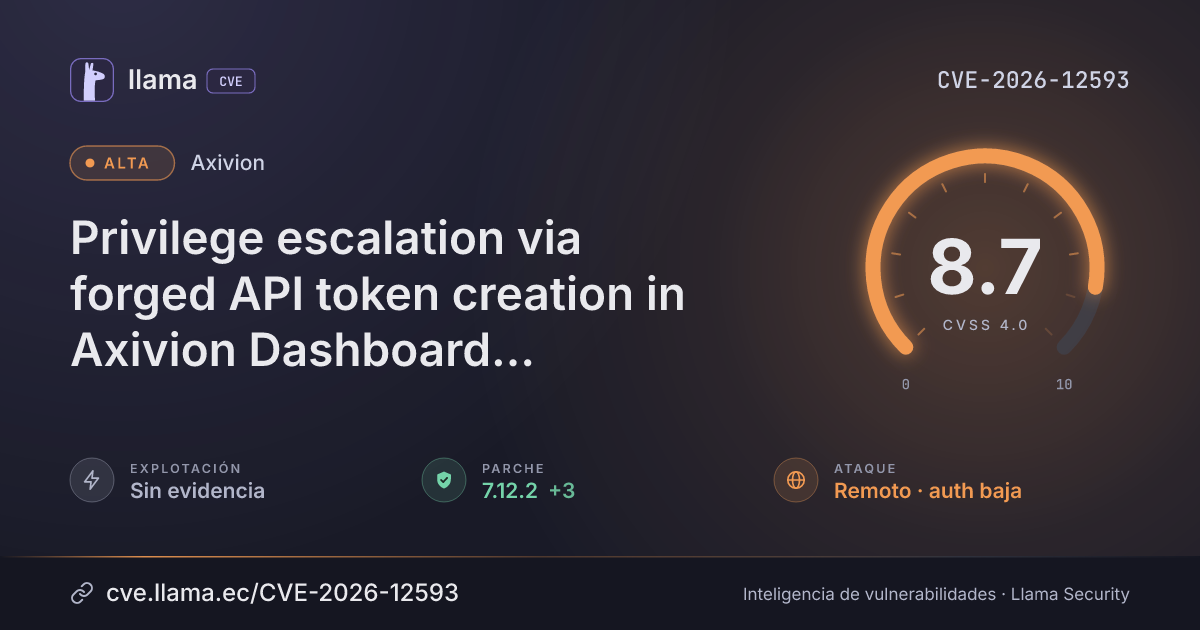
CVE-2026-12593
Privilege escalation via forged API token creation in Axivion Dashboard OIDC/OAuth2/SSO subsystem
CVSS:4.0/AV:N/AC:L/AT:N/PR:L/UI:N/VC:H/VI:H/VA:H/SC:L/SI:L/SA:L
Fuente: CNA
Ciclo de vida de la vulnerabilidad
| Fecha | Fase | Evento | Detalle |
|---|---|---|---|
| Divulgación | Publicada | CVE-2026-12593 divulgada · CVSS 8.7 (CNA) | |
| Divulgación | Evaluación SSVC | CISA-ADP · explotación ninguna | |
| Divulgación | Modificada | Última actualización del registro | |
| Monitoreo | Detectada | Ingresó al índice |
The implementation of an internal and undocumented Dashboard API endpoint (POST /api/users/~/{user}/tokens) forgot to ensure an HTTP request for creating an API Token for another user had sufficient permission to do so. Precondition for successful exploitation was a preexisting internal user (with more privileges than the attacker), the attacker knowing its login name and the attacker being able to authenticate to the Dashboard via OAuth/OIDC. The attacker would then have had to forge a token creation API request on behalf of the other user and could have authenticated and finalized the token creation with their own OAuth/OIDC credentials. In the worst case, this would mean an attacker could have become Dashboard Administrator and been able to perform all administrative actions if the preexisting internal user had administrative privileges. In combination with a separate weakness, this could have further led to code execution on the host system running the Dashboard with the privileges of the OS-User running the Dashboard server.
Desglose de métricas
Rangos afectados
Estado del parche por paquete
| Paquete / producto | Estado | Corregida en | Desde divulgación | Última versión |
|---|---|---|---|---|
Axivion |
Corregida | 7.9.13, 7.10.11, 7.11.7, 7.12.2 | — | — |
7.9.137.10.117.11.77.12.2Arsenal público
Sin exploits, módulos ni PoC públicos conocidos a la fecha de verificación.
https://wiki.qt.io/List_of_known_vulnerabilities_in_Qt_products#CVE-2026-12593Las referencias externas se muestran para copiar: cve.llama.ec no lo redirige a otros sitios.