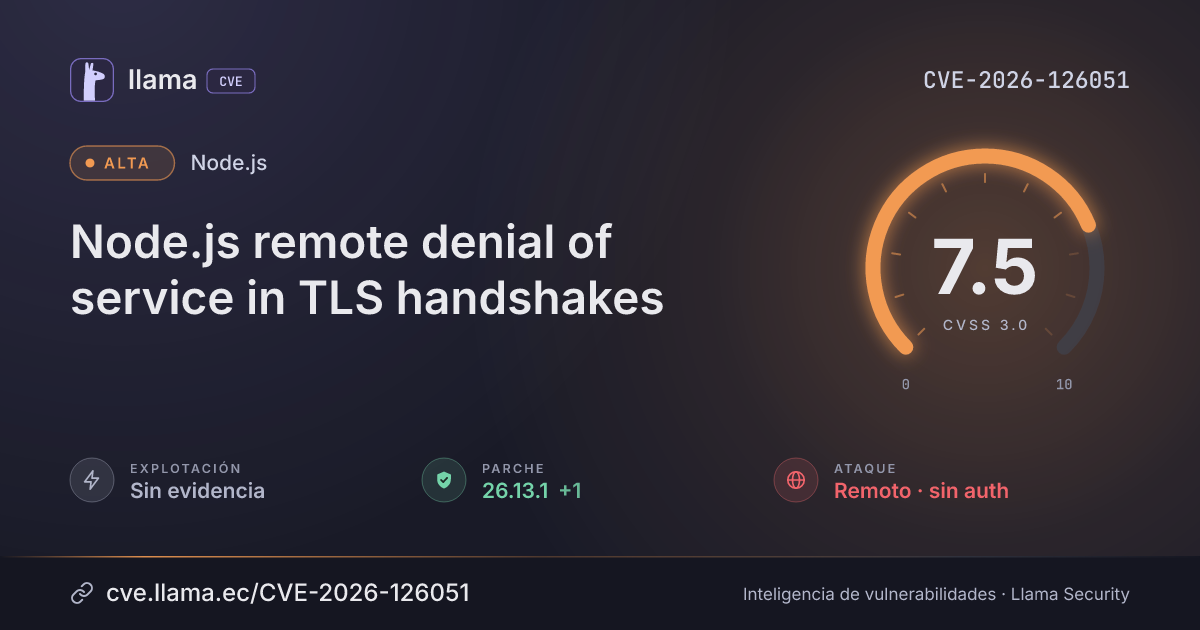
CVE-2026-126051
Node.js remote denial of service in TLS handshakes
An unauthenticated remote attacker can crash a TLS server process by sending a specially crafted connection.
CVSS:3.0/AV:N/AC:L/PR:N/UI:N/S:U/C:N/I:N/A:H
Fuente: CNA
Ciclo de vida de la vulnerabilidad
| Fecha | Fase | Evento | Detalle |
|---|---|---|---|
| Divulgación | Publicada | CVE-2026-126051 divulgada · CVSS 7.5 (CNA) | |
| Monitoreo | Detectada | Ingresó al índice | |
| Monitoreo | Fuente: NIST NVD | Registro visto por primera vez en NIST NVD | |
| Monitoreo | Fuente: ENISA EUVD | Registro visto por primera vez en ENISA EUVD | |
| Divulgación | Evaluación SSVC | CISA-ADP · explotación ninguna | |
| Divulgación | Modificada | Última actualización del registro | |
| Monitoreo | Verificada | Última verificación contra las fuentes |
Node.js TLS servers that use certain handshake hooks, such as SNICallback, OCSPRequest, newSession, resumeSession, or addContext(), can be crashed remotely, without logging in, by a specially crafted connection. An attacker can make the server process terminate with an uncaught exception by sending a client hello followed by padding and a connection close.
Affects Node.js 24.x and 26.x TLS servers that use the SNICallback, OCSPRequest, newSession or resumeSession hook, or server.addContext(). Fixed in 24.22.3 and 26.13.1.
Descripción original del registro (openjs)
A deferred-callback use-after-destroy in Node.js TLS server handshake handling allows a remote, unauthenticated attacker to terminate the server process. When a TLS server uses any of the SNICallback, OCSPRequest, newSession, or resumeSession hooks, or server.addContext(), the corresponding OpenSSL callbacks are deferred, and the deferred code does not handle the underlying socket being destroyed between scheduling and execution. By sending a client hello that reaches the vulnerable path (for example, no SNI together with an OCSP request) followed by padding and a socket FIN, an attacker makes OpenSSL deliver the client hello and the end-of-file in the same tick, so the socket is destroyed before the deferred callback runs and the process raises an uncaught exception instead of emitting an 'error' event. This vulnerability affects Node.js 26.x and 24.x.
Condiciones y alcance
Desglose de métricas
Rangos afectados
Estado del parche por paquete
| Paquete / producto | Estado | Corregida en | Desde divulgación | Última versión |
|---|---|---|---|---|
node |
Corregida | 24.22.3, 26.13.1 | — | — |
24.22.326.13.1Arsenal público
Sin exploits, módulos ni PoC públicos conocidos a la fecha de verificación.
https://nodejs.org/en/blog/vulnerability/november-2026-security-releaseshttps://cna.openjsf.org/security-advisories.htmlLas referencias externas se muestran para copiar: cve.llama.ec no lo redirige a otros sitios.