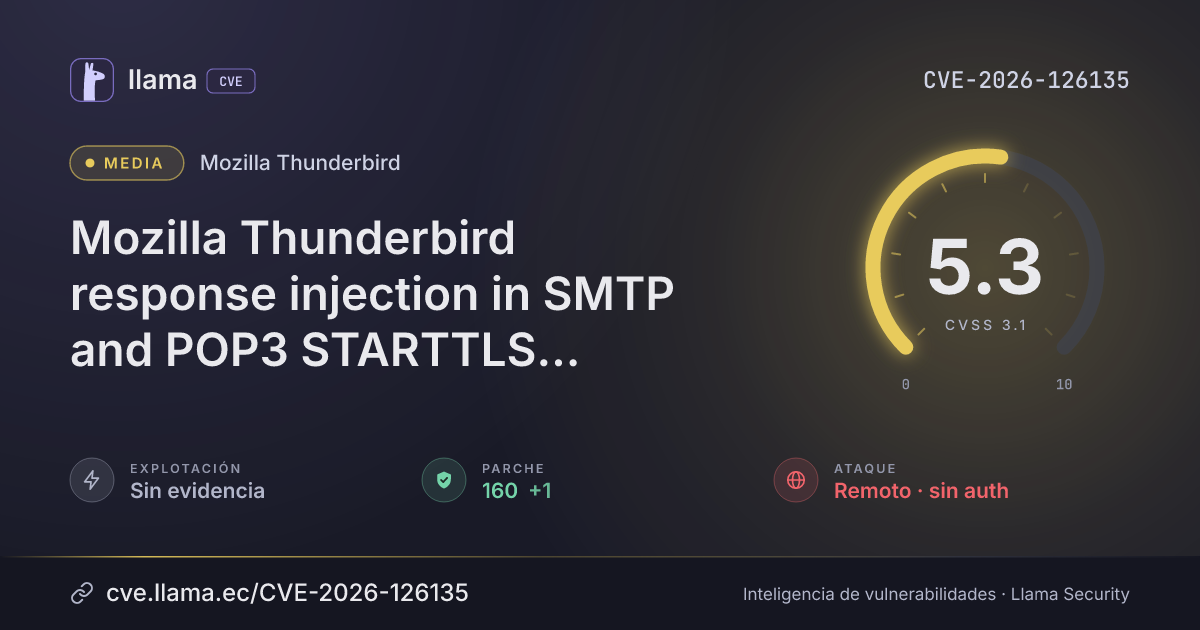
CVE-2026-126135
Mozilla Thunderbird response injection in SMTP and POP3 STARTTLS sessions
A network attacker can inject fake server replies before TLS starts, faking mail send or fetch results.
CVSS:3.1/AV:N/AC:H/PR:N/UI:R/S:U/C:H/I:N/A:N
Fuente: CISA-ADP
Ciclo de vida de la vulnerabilidad
| Fecha | Fase | Evento | Detalle |
|---|---|---|---|
| Divulgación | Publicada | CVE-2026-126135 divulgada · CVSS 5.3 (CISA-ADP) | |
| Monitoreo | Detectada | Ingresó al índice | |
| Divulgación | Evaluación SSVC | CISA-ADP · explotación ninguna | |
| Divulgación | Modificada | Última actualización del registro | |
| Monitoreo | Verificada | Última verificación contra las fuentes |
Thunderbird is affected when it connects to SMTP or POP3 servers using STARTTLS. An attacker who can perform a man-in-the-middle attack on that connection can inject server responses before the TLS handshake completes, and Thunderbird treats them as if they came over the encrypted connection, which can make it report a false mail send or fetch result and show attacker-chosen text in error messages.
Descripción original del registro (mozilla)
If an attacker was able to perform a man-in-the-middle attack on an SMTP or POP3 server connection using STARTTLS, the attacker could inject server responses before the TLS handshake completed. Thunderbird would process these responses after the handshake, as if they had been received from the server over the encrypted connection. This could be used to make Thunderbird report a different outcome for sending or fetching mail, and to show attacker-controlled text in error messages. The encrypted connection itself was not compromised, and credentials were not exposed. Connections using SSL/TLS instead of STARTTLS were not affected. This vulnerability was fixed in Thunderbird 160 and Thunderbird 153.7.
Desglose de métricas
Rangos afectados
Estado del parche por paquete
| Paquete / producto | Estado | Corregida en | Desde divulgación | Última versión |
|---|---|---|---|---|
Thunderbird |
Corregida | 153.7, 160 | — | — |
153.7160Arsenal público
Sin exploits, módulos ni PoC públicos conocidos a la fecha de verificación.
https://bugzilla.mozilla.org/show_bug.cgi?id=2085343https://www.mozilla.org/security/advisories/mfsa2026-128/https://www.mozilla.org/security/advisories/mfsa2026-129/Las referencias externas se muestran para copiar: cve.llama.ec no lo redirige a otros sitios.