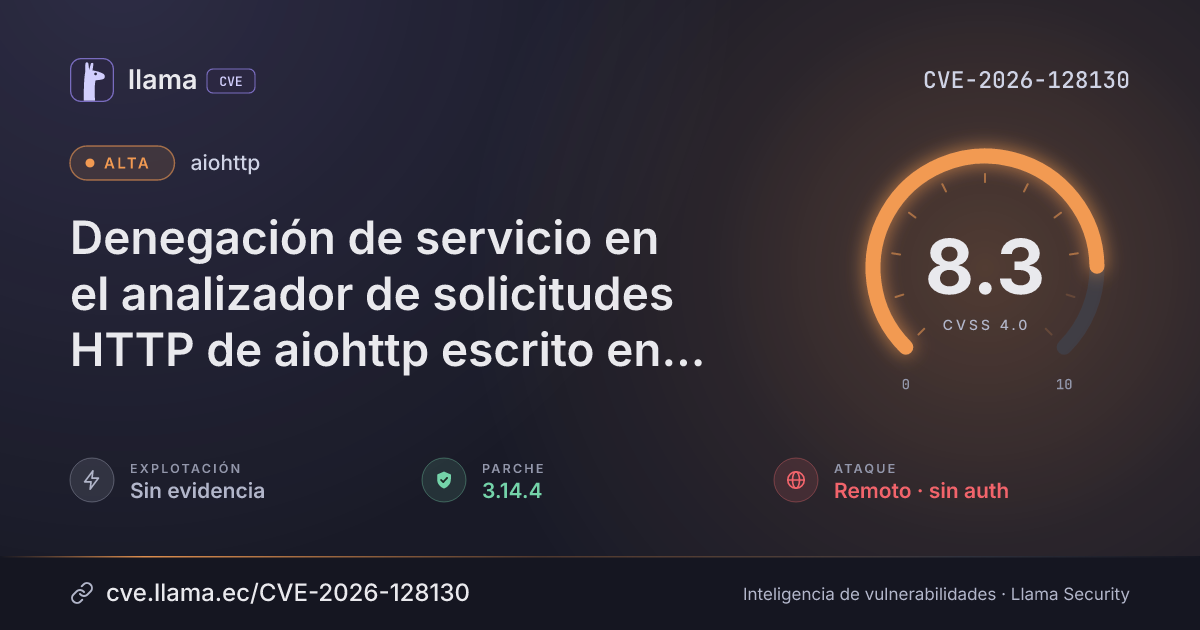
CVE-2026-128130
aiohttp denial of service in pure-Python HTTP request parser
A remote attacker can send requests without logging in to make memory use grow and repeat handled requests.
Texto original en inglés · Ver en español
CVSS:4.0/AV:N/AC:L/AT:P/PR:N/UI:N/VC:N/VI:L/VA:H/SC:N/SI:N/SA:N
Fuente: CNA
Ciclo de vida de la vulnerabilidad
| Fecha | Fase | Evento | Detalle |
|---|---|---|---|
| Remediación | Parche 3.14.4 | aiohttp · -39 d desde divulgación | |
| Divulgación | Publicada | CVE-2026-128130 divulgada · CVSS 8.3 (CNA) | |
| Monitoreo | Detectada | Ingresó al índice | |
| Monitoreo | Fuente: NIST NVD | Registro visto por primera vez en NIST NVD | |
| Monitoreo | Fuente: ENISA EUVD | Registro visto por primera vez en ENISA EUVD | |
| Monitoreo | Fuente: OSV | Registro visto por primera vez en OSV | |
| Divulgación | Evaluación SSVC | CISA-ADP · explotación ninguna | |
| Divulgación | Modificada | Última actualización del registro | |
| Monitoreo | Verificada | Última verificación contra las fuentes |
AIOHTTP, an asynchronous HTTP client and server framework for Python, is affected when its pure-Python request parser is in use, which can happen when the C extensions are disabled. A remote attacker who can send requests without logging in can make the parser buffer grow and replay already-handled requests, which can cause excessive memory use and repeated processing.
Descripción original del registro (GitHub_M)
AIOHTTP is an asynchronous HTTP client/server framework for asyncio and Python. Prior to 3.14.4, when the pipelined request queue is full, the pure-Python parser stores the unparsed remainder internally and also returns the same data to its caller. After a handler declines an upgrade request, the caller feeds the remainder back to the parser, causing the buffer to grow with each handled request and dispatching already-handled requests to the application again. The issue affects deployments using AIOHTTP_NO_EXTENSIONS or otherwise running without the standard C-extension wheel, and can cause excessive memory use and repeated request processing. This issue is fixed in version 3.14.4.
Condiciones y alcance
Desglose de métricas
Rangos afectados
Estado del parche por paquete
| Paquete / producto | Estado | Corregida en | Desde divulgación | Última versión |
|---|---|---|---|---|
pypiaiohttp |
Corregida | 3.14.4 | -39 d | 3.14.5 no afectada |
3.14.4Arsenal público
Sin exploits, módulos ni PoC públicos conocidos a la fecha de verificación.
https://github.com/aio-libs/aiohttp/security/advisories/GHSA-28qf-cpwq-vmc2https://github.com/aio-libs/aiohttp/pull/13356https://github.com/aio-libs/aiohttp/pull/13360https://github.com/aio-libs/aiohttp/commit/47babd8c23ca79e2bae6cc8dcb5752b61e369fc7https://github.com/aio-libs/aiohttp/commit/72eaa429cf89b1e20212590f3e704444239569fbhttps://github.com/aio-libs/aiohttp/releases/tag/v3.14.4Las referencias externas se muestran para copiar: cve.llama.ec no lo redirige a otros sitios.