llamaCVEVulnerability Intelligence
/
Fastify HTTP Proxy

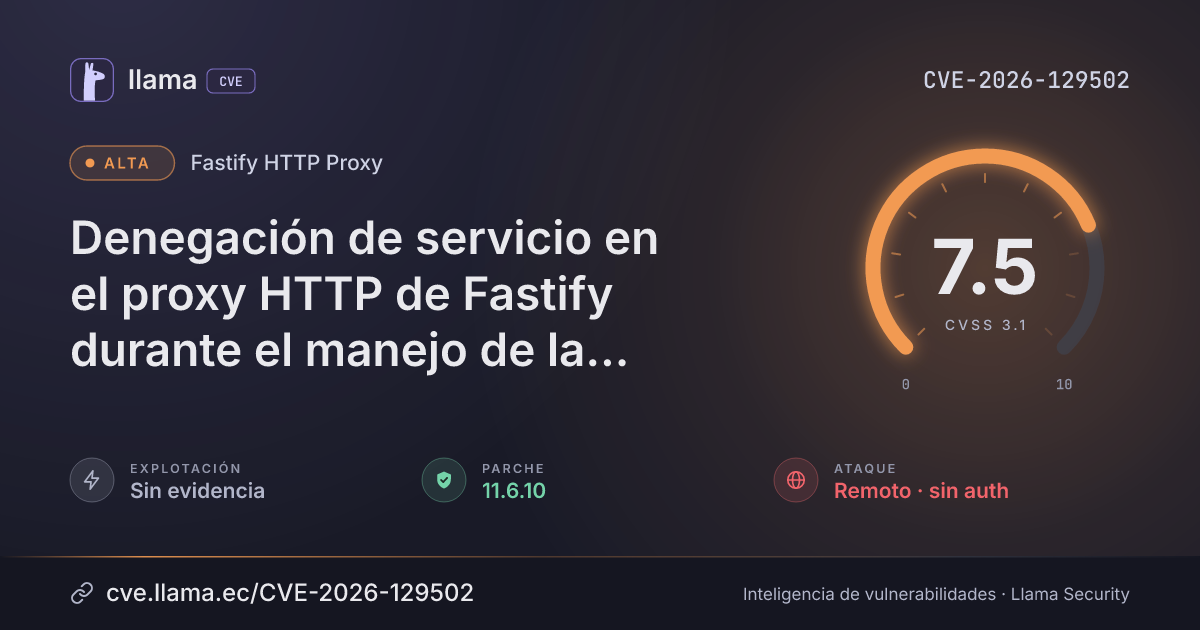
CVE-2026-129502

Fastify HTTP Proxy denial of service in WebSocket upgrade handling

An unauthenticated attacker can crash the server with one WebSocket upgrade request and repeat it to keep it down.

Texto original en inglés · Ver en español

UnclearSin parche publicadouncaught exception
Descargar PNG JSON
CVSS 3.1
7.5
Alta
CVSS:3.1/AV:N/AC:L/PR:N/UI:N/S:U/C:N/I:N/A:H Fuente: CNA
ExplotaciónSin evidenciaSSVC: ninguna · no figura en CISA KEV
Exploits públicos0Ninguno conocido
ParcheSin parcheEl fabricante no ha publicado corrección
Exposición2 dDesde la divulgación, 19 nov 2026, 1:20 p. m.
Detección13 minDesde la divulgación hasta su ingreso al índice
Decisión SSVCSeguir
Remediar en la ventana regular de mantenimiento
Sin explotación conocida, automatizable e impacto técnico parcial. No hay versión corregida: aplique mitigaciones.
Huele a "ya lo veré". No la dejes así.Anótala en tu libreta de pendientes serios.
Timeline

Ciclo de vida de la vulnerabilidad

Hoy
Divulgación
Publicada
Evaluación SSVC +1
Explotación
Remediación
Monitoreo
Detectada
Fuente: NIST NVD
Fuente: ENISA EUVD +1
01:20 p. m.
02:25 p. m.
03:59 p. m.
04:07 p. m.
02:30 p. m.
01:20 p. m.
01:38 a. m.
01:55 p. m.
02:13 a. m.
02:30 p. m.
FechaFaseEventoDetalle
Divulgación Publicada CVE-2026-129502 divulgada · CVSS 7.5 (CNA)
Monitoreo Detectada Ingresó al índice
Monitoreo Fuente: NIST NVD Registro visto por primera vez en NIST NVD
Divulgación Evaluación SSVC CISA-ADP · explotación ninguna
Divulgación Modificada Última actualización del registro
Monitoreo Fuente: ENISA EUVD Registro visto por primera vez en ENISA EUVD
Monitoreo Verificada Última verificación contra las fuentes
Resumen
Resumen generado por IA · CC-BY 4.0 · 19 nov 2026

The @fastify/http-proxy plugin for Fastify can be crashed remotely, without logging in, when WebSocket support is enabled. A single WebSocket upgrade request whose path includes a URL fragment, followed by one frame, terminates the Node.js process, and the attack can be repeated to keep the server down.

Affects @fastify/http-proxy from 9.4.0 before 11.6.10 when websocket support is enabled (websocket: true). Fixed in 11.6.10.

¿Qué significa?An unauthenticated remote client can send a WebSocket upgrade request whose target is not a valid URL reference, such as one with a fragment or a malformed host. The next frame the client sends then triggers an unhandled error that terminates the Node.js process, and the crash can be repeated.
¿Quién está afectado?Versions from 9.4.0 before 11.6.10 are affected when the plugin is registered with websocket: true. Check the installed version with npm ls @fastify/http-proxy and look for websocket: true in the plugin registration. The crash path also needs a non-valid upgrade request target reaching a parameterized prefix, with ignoreDuplicateSlashes enabled in the example.
¿Qué hacer?Upgrade @fastify/http-proxy to 11.6.10 or later, which is the fixed version listed for this vulnerability.
Descripción original del registro (openjs)

@fastify/http-proxy is a Fastify plugin that proxies HTTP and WebSocket traffic to an upstream server. In versions from 9.4.0 up to but not including 11.6.10, when the plugin is registered with websocket support enabled, a WebSocket upgrade request whose path carries a URL fragment is matched by the router and answered with a successful upgrade before the upstream link is created. Building the upstream target then throws, the error is only logged, and the accepted client socket is left open with no error listener, so the next frame the client sends becomes an unhandled error and terminates the Node.js process. A request target that is not a valid URL reference reaching a parameterized prefix triggers the same path. A single unauthenticated upgrade request followed by one frame is enough to crash the server, and it can be repeated to keep the process down. The issue is fixed in @fastify/http-proxy 11.6.10, and users should upgrade to 11.6.10 or later.

Contexto

Condiciones y alcance

Condiciones necesarias para que el fallo sea explotable
01
The plugin is registered with websocket support enabled (websocket: true).“Applications are affected when websocket: true is used.”
02
The upgrade request target is not a valid URL reference, such as one with a fragment or a malformed host, reaching a parameterized prefix (with ignoreDuplicateSlashes enabled in the example).“A request-target that is not a valid URL reference (for example //a:99999999/ws/x reaching a parameterized prefix with ignoreDuplicateSlashes enabled) triggers the same path.”
¿Quién debe revisar?Teams running @fastify/http-proxy from 9.4.0 before 11.6.10 with WebSocket support enabled, such as Fastify services proxying WebSocket traffic upstream.
Vector CVSS 3.1

Desglose de métricas

Opción resaltada = valor del vector · izquierda = peor caso · CNA
Vector de ataqueAV:N
RedAdyacenteLocalFísica
ComplejidadAC:L
BajaAlta
PrivilegiosPR:N
NingunoBajosAltos
InteracciónUI:N
NingunaRequerida
AlcanceS:U
CambiadoSin cambio
ConfidencialidadC:N
AltoBajoNinguno
IntegridadI:N
AltoBajoNinguno
DisponibilidadA:H
AltoBajoNinguno
Score de explotaciónQué tan fácil y probable es que la exploten
10.0/ 10Muy alto
Vector 10.0 (muy fácil) · sin evidencia de explotación.
Versiones

Rangos afectados

Afectada Corregida Última
@fastify/http-proxy≥ 9.4.0 < 11.6.10
9.4.0
11.6.8
11.6.10
Remediación

Estado del parche por paquete

Paquete / productoEstadoCorregida enDesde divulgaciónÚltima versión
npm@fastify/http-proxy
Sin parche — — 11.6.8 afectada
Versiones corregidas11.6.10
Explotación

Arsenal público

Sin exploits, módulos ni PoC públicos conocidos a la fecha de verificación.

Registro
EscenarioGENERALopenjs
Referencias
Fabricantehttps://github.com/fastify/fastify-http-proxy/security/advisories/GHSA-29w6-p7r8-xmf9
Otrahttps://cna.openjsf.org/security-advisories.html

Las referencias externas se muestran para copiar: cve.llama.ec no lo redirige a otros sitios.