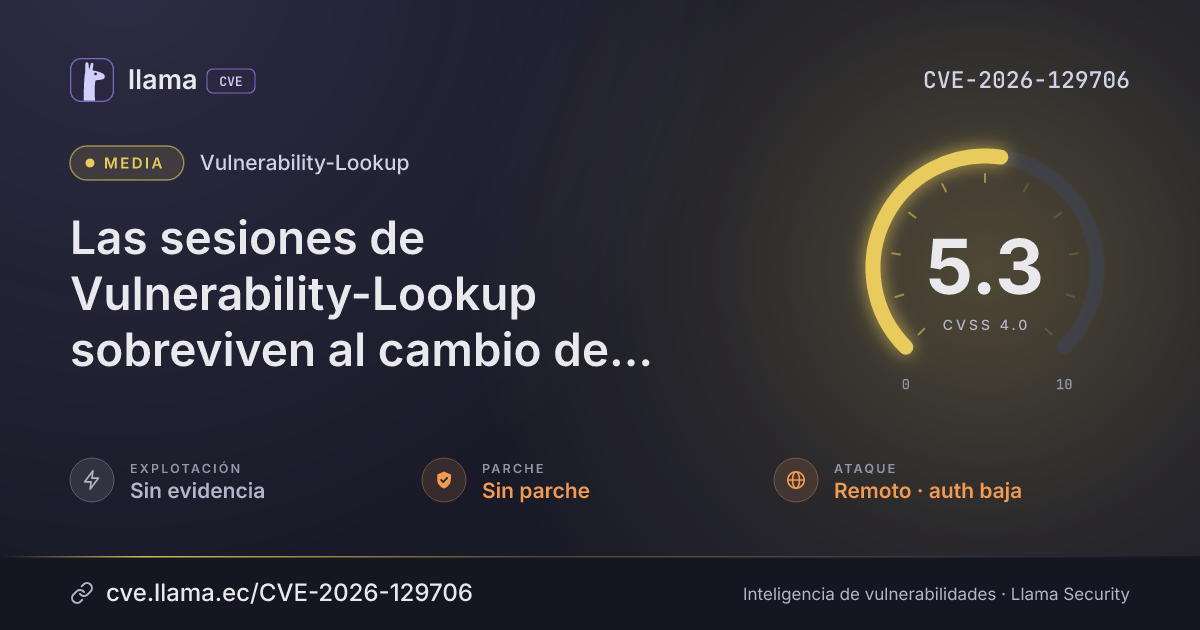
CVE-2026-129706
Vulnerability-Lookup sessions survive password change in session handling
An attacker with an existing session can keep accessing an account after its password is changed or reset.
CVSS:4.0/AV:N/AC:L/AT:N/PR:L/UI:N/VC:L/VI:L/VA:L/SC:N/SI:N/SA:N
Fuente: CNA
Ciclo de vida de la vulnerabilidad
| Fecha | Fase | Evento | Detalle |
|---|---|---|---|
| Divulgación | Publicada | CVE-2026-129706 divulgada · CVSS 5.3 (CNA) | |
| Monitoreo | Detectada | Ingresó al índice | |
| Monitoreo | Fuente: NIST NVD | Registro visto por primera vez en NIST NVD | |
| Divulgación | Evaluación SSVC | CISA-ADP · explotación ninguna | |
| Divulgación | Modificada | Última actualización del registro | |
| Monitoreo | Fuente: ENISA EUVD | Registro visto por primera vez en ENISA EUVD | |
| Monitoreo | Verificada | Última verificación contra las fuentes |
The vulnerability-lookup application keeps a user's login session valid after the password is changed, so an attacker who already holds a valid session for an account can keep accessing it. The attacker reaches it remotely over the network and needs an existing session for the target account, and a password change, account recovery, or administrator reset does not end that access.
Descripción original del registro (CIRCL)
In the vulnerability-lookup web application, the Flask-Login session identifier was set to the bare numeric user ID (User.get_id() returned self.id). Because the session ID contained no component derived from the user's credential, it remained valid indefinitely regardless of any subsequent password change, account recovery, or administrator-initiated password reset. An attacker who had obtained a valid session for a user account (for example through cross-site scripting, session hijacking, or a previously exposed feed or API key) could continue to access that user's account after the user changed their password, because the session cookie still carried the same static user ID and the user_loader accepted it without any credential-bound validation. The affected component is the session management layer of the vulnerability-lookup Flask application, specifically the User.get_id() method in website/models/user.py and the load_user callback in website/web/views/session_mgmt.py. The vulnerability required that an attacker already possessed a valid session for the target user; no additional authentication or special deployment configuration was needed beyond a standard deployment of the application. The security impact is that a user cannot effectively revoke an attacker's access by changing their password, performing an account recovery, or having an administrator reset the credential. The attacker retains full authenticated access to the user's profile, subscriptions, and any role-gated functionality for the lifetime of the session cookie. Additionally, sessions that were opened via a feed key or API key before a prior fix (commit 3605d5b6) also persisted indefinitely.
Desglose de métricas
Estado del parche por paquete
| Paquete / producto | Estado | Corregida en | Desde divulgación | Última versión |
|---|---|---|---|---|
vulnerability-lookup |
Sin parche | — | — | — |
Arsenal público
Sin exploits, módulos ni PoC públicos conocidos a la fecha de verificación.
https://github.com/vulnerability-lookup/vulnerability-lookup/commit/d762810fb3b9d1ee34938a71cd8cbee544c1527dLas referencias externas se muestran para copiar: cve.llama.ec no lo redirige a otros sitios.