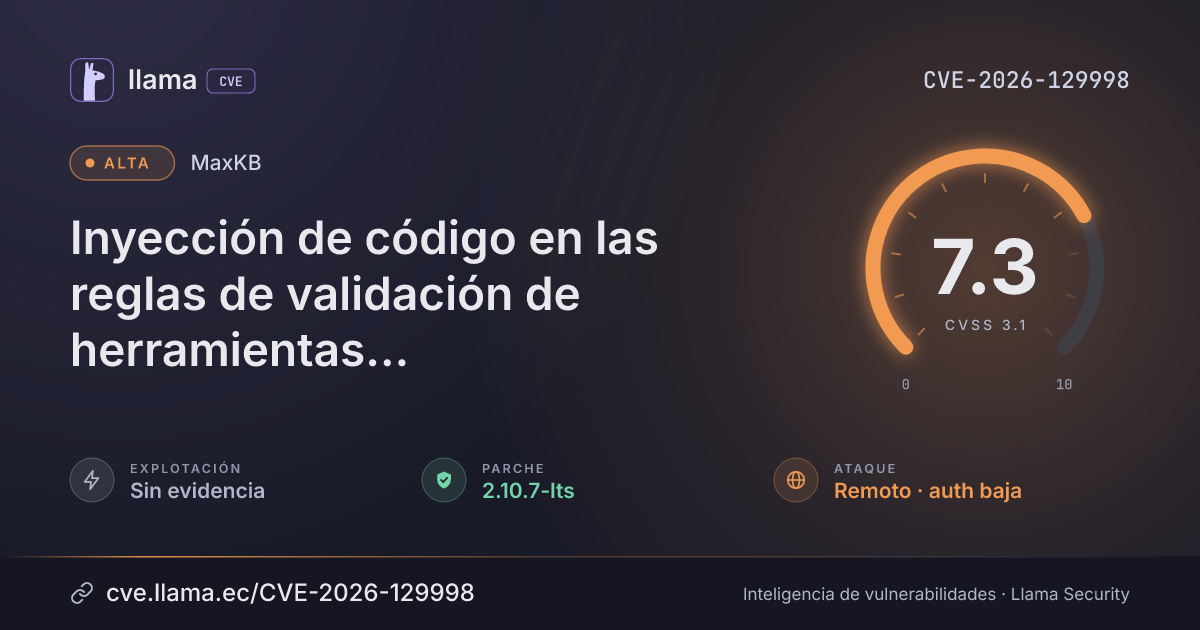
CVE-2026-129998
MaxKB code injection in custom tool validator rules
A low-privileged user can store JavaScript that runs in the web origin when someone opens the tool's Debug screen.
Texto original en inglés · Ver en español
CVSS:3.1/AV:N/AC:L/PR:L/UI:R/S:U/C:H/I:H/A:N
Fuente: CNA
Ciclo de vida de la vulnerabilidad
| Fecha | Fase | Evento | Detalle |
|---|---|---|---|
| Divulgación | Publicada | CVE-2026-129998 divulgada · CVSS 7.3 (CNA) | |
| Monitoreo | Detectada | Ingresó al índice | |
| Monitoreo | Fuente: NIST NVD | Registro visto por primera vez en NIST NVD | |
| Monitoreo | Verificada | Última verificación contra las fuentes |
MaxKB by 1Panel-dev has a flaw in how custom tool Init Param validator rules are handled. A logged-in user with low privileges can store JavaScript that runs in the MaxKB web origin when the tool's Debug screen is opened, and the attack is reached over the network but needs a user to take action such as opening that screen.
Affects MaxKB 2.10.6-lts and earlier, where a logged-in workspace account can create a custom tool with a crafted Init Param validator rule. Fixed in 2.10.7-lts.
Descripción original del registro (GitHub_M)
MaxKB is an open-source AI assistant for enterprise. Prior to 2.10.7-lts, custom Tool Init Param definitions accept attacker-controlled props_info.rules[].validator strings through POST /admin/api/workspace/{workspace_id}/tool and PUT /admin/api/workspace/{workspace_id}/tool/{tool_id}, store them without restriction, and pass them to eval() when the parameter form renders. An authenticated user with the default USER workspace role can store JavaScript and trigger execution by opening the tool's Debug screen before entering or submitting a parameter value. The same Init Param form is exposed to accounts with edit permission on the tool, but execution by a different account was not independently verified. The confirmed script runs in the MaxKB origin; access to another user's bearer token and authenticated account authority is plausible only if that user renders the malicious form. This issue is fixed in version 2.10.7-lts.
Condiciones y alcance
Desglose de métricas
Rangos afectados
Estado del parche por paquete
| Paquete / producto | Estado | Corregida en | Desde divulgación | Última versión |
|---|---|---|---|---|
MaxKB |
Corregida | 2.10.7-lts | — | — |
2.10.7-ltsArsenal público
Sin exploits, módulos ni PoC públicos conocidos a la fecha de verificación.
https://github.com/1Panel-dev/MaxKB/security/advisories/GHSA-c4xr-7rr6-43mrhttps://github.com/1Panel-dev/MaxKB/pull/7257https://github.com/1Panel-dev/MaxKB/commit/fad2427ab46558c5fad764993a08e3661ab4b7f9https://github.com/1Panel-dev/MaxKB/releases/tag/v2.10.7-ltsLas referencias externas se muestran para copiar: cve.llama.ec no lo redirige a otros sitios.