llamaCVEVulnerability Intelligence
/
Temporal Technologies temporal-proxy

CVE-2026-130089

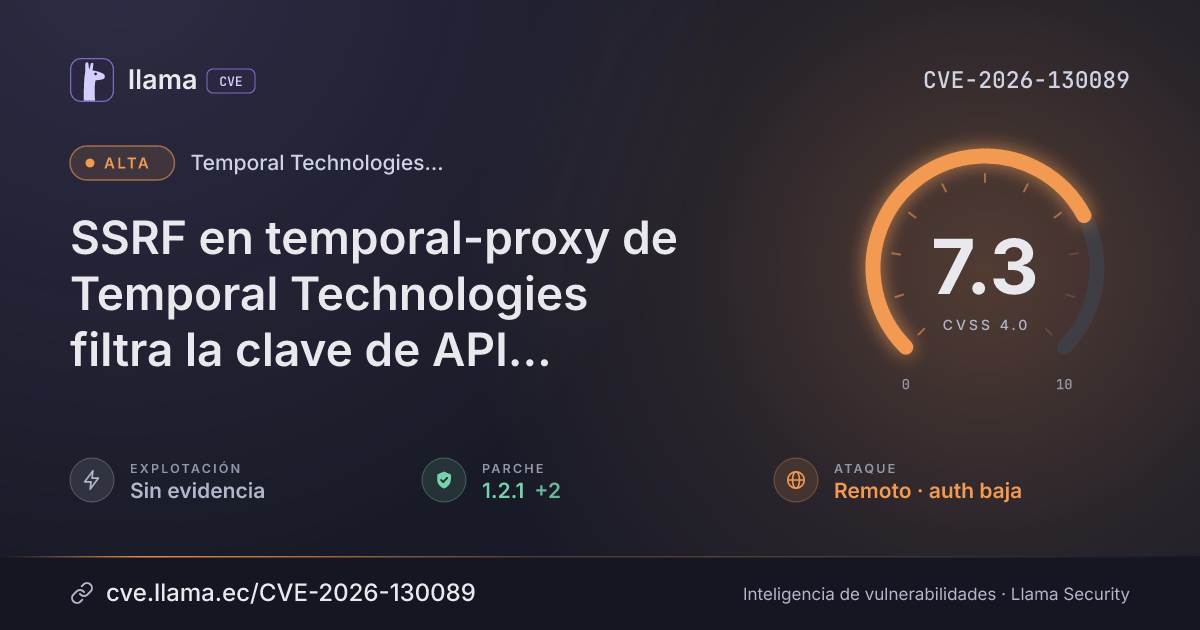
Temporal Technologies temporal-proxy SSRF leaks upstream API key via namespace routing

A remote attacker with low-privilege access can steal an upstream's static API key and use it directly.

Solo en configuraciones específicasSin parche publicadoserver-side request forgery (SSRF)
Descargar PNG JSON
CVSS 4.0
7.3
Alta
CVSS:4.0/AV:N/AC:L/AT:P/PR:L/UI:N/VC:H/VI:N/VA:N/SC:H/SI:H/SA:H Fuente: CNA
ExplotaciónSin evidenciaSSVC: ninguna · no figura en CISA KEV
Exploits públicos0Ninguno conocido
ParcheSin parcheEl fabricante no ha publicado corrección
Exposición2 dDesde la divulgación, 18 nov 2026, 3:20 p. m.
Detección8 minDesde la divulgación hasta su ingreso al índice
Decisión SSVCSeguir
Remediar en la ventana regular de mantenimiento
Sin explotación conocida, no automatizable e impacto técnico parcial. No hay versión corregida: aplique mitigaciones.
Timeline

Ciclo de vida de la vulnerabilidad

Hoy
Divulgación
Publicada
Evaluación SSVC +1
Explotación
Remediación
Monitoreo
Detectada
Fuente: NIST NVD +1
Verificada
03:20 p. m.
04:19 p. m.
05:23 p. m.
02:35 a. m.
03:20 p. m.
06:09 a. m.
08:58 p. m.
11:47 a. m.
02:35 a. m.
FechaFaseEventoDetalle
Divulgación Publicada CVE-2026-130089 divulgada · CVSS 7.3 (CNA)
Monitoreo Detectada Ingresó al índice
Monitoreo Fuente: NIST NVD Registro visto por primera vez en NIST NVD
Monitoreo Fuente: ENISA EUVD Registro visto por primera vez en ENISA EUVD
Divulgación Evaluación SSVC CISA-ADP · explotación ninguna
Divulgación Modificada Última actualización del registro
Monitoreo Verificada Última verificación contra las fuentes
Resumen
Resumen generado por IA · CC-BY 4.0 · 18 nov 2026

temporal-proxy from Temporal Technologies lets a remote caller with low-privilege login to its gRPC listener obtain the static API key of an upstream whose address is built from the request namespace. The attacker can then use that key directly against the upstream Temporal service.

Affects temporal-proxy 0.1.0 to 0.10.1 and earlier 1.x releases before each fix when an upstream hostPort is templated from the request namespace or metadata with a static credential. Fixed in 1.0.2, 1.1.2, and 1.2.1.

¿Qué significa?A caller's request namespace or request metadata can redirect a templated upstream to a different host, which leaks that upstream's static API key.
¿Quién está afectado?Affected are temporal-proxy 0.1.0 through 0.10.1, 1.0.0 before 1.0.2, 1.1.0 before 1.1.2, and 1.2.0 before 1.2.1. The setup also needs a templated upstream hostPort, a static outbound credential on that upstream, TLS verified against the system trust store with no literal tls.serverName, and a route such as a default route that sends the caller's namespace to that upstream. Check the installed version and the upstream and route configuration.
¿Qué hacer?Upgrade to temporal-proxy 1.0.2, 1.1.2, or 1.2.1, matching the deployed minor release line. Until the upgrade is applied, use fixed upstream addresses or routing rules that match literal namespace names, with no default or system route to a templated upstream, or set a literal tls.serverName on the templated upstream.
Descripción original del registro (Temporal)

A caller who can send requests to the temporal-proxy gRPC listener can obtain the static API key of an upstream whose address is templated from the request namespace, and then use that key directly against the upstream Temporal service. temporal-proxy does not validate the request namespace before rendering it into a templated upstream address, so when an upstream's hostPort is templated from the namespace, as in the published Temporal Cloud configuration example, a crafted namespace changes the host the proxy dials. If that upstream verifies TLS against the system trust store and sets no literal server name, a caller-controlled host with a publicly trusted certificate passes verification and receives the key. The built-in static-token and JWKS authenticators do not restrict namespaces, so any caller they admit can do this; an external authenticator that admits only listed namespaces prevents it. temporal-proxy versions 0.1.0 through 1.2.0 are affected. The issue is fixed in 1.0.2, 1.1.2, and 1.2.1, and releases before 1.0.0 receive no fix. Upgrade to the fixed release for the deployed minor release line, and rotate any upstream API key that untrusted callers could reach.

Contexto

Condiciones y alcance

Condiciones necesarias para que el fallo sea explotable
01
Upstream hostPort is templated from the request namespace or request metadata“an upstream whose hostPort template includes the request namespace or request metadata”
02
Upstream uses a static outbound credential“a static outbound credential on that upstream”
03
TLS is verified against the system trust store with no literal tls.serverName set“TLS verified against the system trust store with no literal tls.serverName”
04
A route, such as a default route, sends the caller's namespace to the templated upstream“a route, such as a default route, that sends the caller's namespace to that upstream”
MitigaciónUse fixed upstream addresses, or routing rules that match literal namespace names, with no default or system route to a templated upstream. Alternatively, set a literal tls.serverName on the templated upstream, or use an external authenticator that admits only listed namespaces.
Vector CVSS 4.0

Desglose de métricas

Opción resaltada = valor del vector · izquierda = peor caso · CNA
Vector de ataqueAV:N
RedAdyacenteLocalFísica
ComplejidadAC:L
BajaAlta
Requisitos de ataqueAT:P
NingunoPresentes
PrivilegiosPR:L
NingunoBajosAltos
InteracciónUI:N
NingunaPasivaActiva
Confid. (sistema)VC:H
AltoBajoNinguno
Integridad (sistema)VI:N
AltoBajoNinguno
Disponib. (sistema)VA:N
AltoBajoNinguno
Confid. (posterior)SC:H
AltoBajoNinguno
Integridad (posterior)SI:H
AltoBajoNinguno
Disponib. (posterior)SA:H
AltoBajoNinguno
Score de explotaciónQué tan fácil y probable es que la exploten
5.9/ 10Medio
Vector 5.9 (moderada) · sin evidencia de explotación.
Versiones

Rangos afectados

Afectada Corregida Última
github.com/temporalio/temporal-proxy≥ 0.1.0 ≤ 0.10.1
github.com/temporalio/temporal-proxy≥ 1.0.0 < 1.0.2
github.com/temporalio/temporal-proxy≥ 1.1.0 < 1.1.2
github.com/temporalio/temporal-proxy≥ 1.2.0 < 1.2.1
0.1.0
v0.9.1
0.10.1
1.0.0
1.0.2
1.1.0
1.1.2
1.2.0
1.2.1
Remediación

Estado del parche por paquete

Paquete / productoEstadoCorregida enDesde divulgaciónÚltima versión
gogithub.com/temporalio/temporal-proxy
Sin parche — — v0.9.1 afectada
Versiones corregidas1.0.21.1.21.2.1
Explotación

Arsenal público

Sin exploits, módulos ni PoC públicos conocidos a la fecha de verificación.

Registro
EscenarioGENERALTemporal
configurationExploitation requires all of the following: an upstream whose hostPort template includes the request namespace or request metadata; a static outbound credential on that upstream; TLS verified against the system trust store with no literal tls.serverName; and a route, such as a default route, that sends the caller's namespace to that upstream. The published Temporal Cloud configuration example has this shape but listens on loopback only.Temporal
configurationAttack Requirements is Present because the deployment must use the upstream configuration above. Privileges Required is Low because the score assumes inbound authentication is configured; under the default, which admits every caller, no credential is needed. The subsequent-system metrics are High because the key works against the upstream Temporal service independently of the proxy.Temporal
MitigaciónUse fixed upstream addresses, or routing rules that match literal namespace names, with no default or system route to a templated upstream. Alternatively, set a literal tls.serverName on the templated upstream, or use an external authenticator that admits only listed namespaces.Temporal
solutionUpgrade to temporal-proxy 1.0.2, 1.1.2, or 1.2.1, as appropriate for the deployed minor release line. Fixed releases reject a request whose templated upstream address does not render to a plain host name or IP address with an optional port, or whose templated TLS server name is not a plain host name. They also refuse at configuration load a templated hostPort or tls.serverName whose host does not end in a literal domain, as in {{ .RemoteNamespace }}.tmprl.cloud:7233, so a configuration that templates the whole host must be changed before upgrading. Rotate any upstream API key held by an affected deployment that untrusted callers could reach. Releases before 1.0.0 receive no fix.Temporal
Referencias
Parchehttps://github.com/temporalio/temporal-proxy/pull/284
Parchehttps://github.com/temporalio/temporal-proxy/commit/b902dcfcc1d32288c9d1d14fc2c71d2e8052a4b8
Parchehttps://github.com/temporalio/temporal-proxy/pull/294
Parchehttps://github.com/temporalio/temporal-proxy/commit/cd60785edd81cfa0c599b17f94ee7de7d8eaf061
Parchehttps://github.com/temporalio/temporal-proxy/pull/293
Parchehttps://github.com/temporalio/temporal-proxy/commit/dfb4b83f0ed20db5a9f772dd249470f7f7f15c90
Parchehttps://github.com/temporalio/temporal-proxy/pull/292
Parchehttps://github.com/temporalio/temporal-proxy/commit/c73636037045e31162420a13f6f0aee48ce3313a
Otrahttps://github.com/temporalio/temporal-proxy/blob/v1.2.0/internal/proxy/resolver.go#L259-L282
Otrahttps://github.com/temporalio/temporal-proxy/releases/tag/v1.0.2
Otrahttps://github.com/temporalio/temporal-proxy/releases/tag/v1.1.2
Otrahttps://github.com/temporalio/temporal-proxy/releases/tag/v1.2.1

Las referencias externas se muestran para copiar: cve.llama.ec no lo redirige a otros sitios.