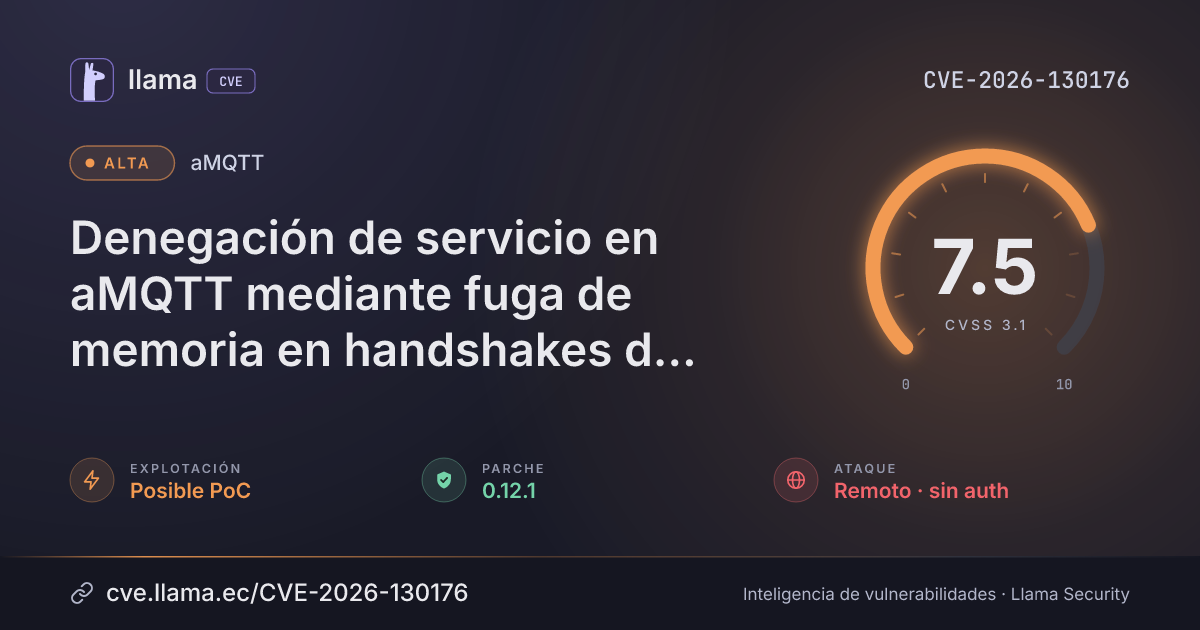
CVE-2026-130176
aMQTT denial of service via memory leak in QoS 2 handshakes
A remote attacker without login can exhaust memory and crash the service via abandoned QoS 2 handshakes.
CVSS:3.1/AV:N/AC:L/PR:N/UI:N/S:U/C:N/I:N/A:H
Fuente: CNA
Ciclo de vida de la vulnerabilidad
| Fecha | Fase | Evento | Detalle |
|---|---|---|---|
| Divulgación | Publicada | CVE-2026-130176 divulgada · CVSS 7.5 (CNA) | |
| Monitoreo | Detectada | Ingresó al índice | |
| Monitoreo | Fuente: NIST NVD | Registro visto por primera vez en NIST NVD | |
| Monitoreo | Fuente: OSV | Registro visto por primera vez en OSV | |
| Divulgación | Evaluación SSVC | CISA-ADP · explotación ninguna | |
| Divulgación | Modificada | Última actualización del registro | |
| Monitoreo | Fuente: ENISA EUVD | Registro visto por primera vez en ENISA EUVD | |
| Monitoreo | Verificada | Última verificación contra las fuentes |
The Yakifo amqtt MQTT broker and client can be forced to exhaust memory until the process terminates, causing a denial of service. A remote attacker can trigger this over the network without logging in by repeatedly starting QoS 2 message flows and disconnecting before they complete.
Affects amqtt 0.11.0 through 0.12.0 when a client begins a QoS 2 transaction and disconnects before the handshake completes. Fixed in 0.12.1.
Descripción original del registro (GitHub_M)
aMQTT is an open source MQTT broker and client. From 0.11.0 until 0.12.1, the QoS 2 transaction handler in amqtt/mqtt/protocol/handler.py, _handle_qos2_message_flow(), can retain transaction state and packet identifiers when a client disconnects before the handshake completes, unlike QoS 1 flows that expire after the default five-second timeout. A remote client can repeatedly begin QoS 2 flows and disconnect without maintaining long-lived connections; anonymous clients can do this with the default configuration, while authenticated deployments remain affected when a client may initiate QoS 2 flows. The retained state grows broker memory until resource exhaustion can terminate the process; no confidentiality or integrity impact is identified. This issue is fixed in version 0.12.1.
Condiciones y alcance
Desglose de métricas
Rangos afectados
Estado del parche por paquete
| Paquete / producto | Estado | Corregida en | Desde divulgación | Última versión |
|---|---|---|---|---|
amqtt |
Corregida | 0.12.1 | — | — |
0.12.1Arsenal público
Sin exploits, módulos ni PoC públicos conocidos a la fecha de verificación.
https://github.com/Yakifo/amqtt/security/advisories/GHSA-wcqj-wx85-c75phttps://github.com/Yakifo/amqtt/pull/404https://github.com/Yakifo/amqtt/commit/2755fd801a6f95e9b73e11116948b57a95348466https://github.com/Yakifo/amqtt/commit/64a6f8c3ebc47640f2e092885c1d504c8f34f1afhttps://github.com/Yakifo/amqtt/releases/tag/v0.12.1Las referencias externas se muestran para copiar: cve.llama.ec no lo redirige a otros sitios.