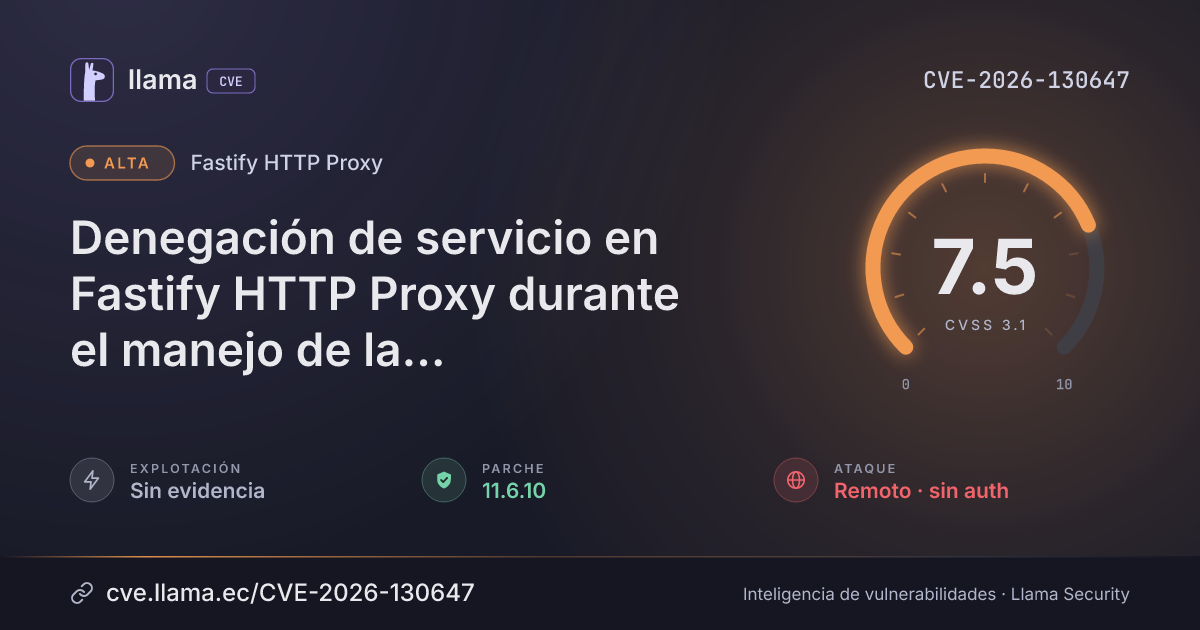
CVE-2026-130647
Fastify HTTP Proxy denial of service in WebSocket upgrade handling
An unauthenticated remote attacker can crash the server with a pipelined WebSocket upgrade and connection reset.
Texto original en inglés · Ver en español
CVSS:3.1/AV:N/AC:L/PR:N/UI:N/S:U/C:N/I:N/A:H
Fuente: CNA
Ciclo de vida de la vulnerabilidad
| Fecha | Fase | Evento | Detalle |
|---|---|---|---|
| Divulgación | Publicada | CVE-2026-130647 divulgada · CVSS 7.5 (CNA) | |
| Monitoreo | Detectada | Ingresó al índice | |
| Monitoreo | Fuente: NIST NVD | Registro visto por primera vez en NIST NVD | |
| Divulgación | Evaluación SSVC | CISA-ADP · explotación ninguna | |
| Divulgación | Modificada | Última actualización del registro | |
| Monitoreo | Fuente: ENISA EUVD | Registro visto por primera vez en ENISA EUVD | |
| Monitoreo | Verificada | Última verificación contra las fuentes |
The @fastify/http-proxy plugin, when WebSocket support is enabled, can be crashed by a remote attacker who does not need to log in. Sending a WebSocket upgrade pipelined behind a normal HTTP request on a plain, unencrypted connection and then resetting it can terminate the Node.js process, and one connection can repeat this to keep the server down.
@fastify/http-proxy from 9.0.0 before 11.6.10 is affected when registered with websocket: true, and from 11.6.4 only on cleartext HTTP/1 listeners. Fixed in 11.6.10.
Descripción original del registro (openjs)
@fastify/http-proxy is a Fastify plugin that proxies HTTP and WebSocket traffic to an upstream server. In versions from 9.0.0 up to but not including 11.6.10, when the plugin is registered with websocket support enabled, a WebSocket upgrade that is pipelined behind another HTTP request on the same cleartext connection arrives while that request's response is still attached to the socket. The shared upgrade listener sees the socket is already claimed and returns early without taking the upgrade, but it does not attach an error listener to the raw socket, and Node.js has already removed its own error listener before emitting the upgrade event. A later socket error on that connection, such as a client connection reset, is therefore unhandled and terminates the Node.js process. A single unauthenticated connection that pipelines an upgrade behind a normal request and then resets is enough to crash the server, and it can be repeated to keep the process down. Upgrades over TLS are not affected. The issue is fixed in @fastify/http-proxy 11.6.10, and users should upgrade to 11.6.10 or later.
Condiciones y alcance
Desglose de métricas
Rangos afectados
Estado del parche por paquete
| Paquete / producto | Estado | Corregida en | Desde divulgación | Última versión |
|---|---|---|---|---|
npm@fastify/http-proxy |
Sin parche | — | — | 11.6.8 afectada |
11.6.10Arsenal público
Sin exploits, módulos ni PoC públicos conocidos a la fecha de verificación.
https://github.com/fastify/fastify-http-proxy/security/advisories/GHSA-6fhg-8r33-fcwwhttps://cna.openjsf.org/security-advisories.htmlLas referencias externas se muestran para copiar: cve.llama.ec no lo redirige a otros sitios.