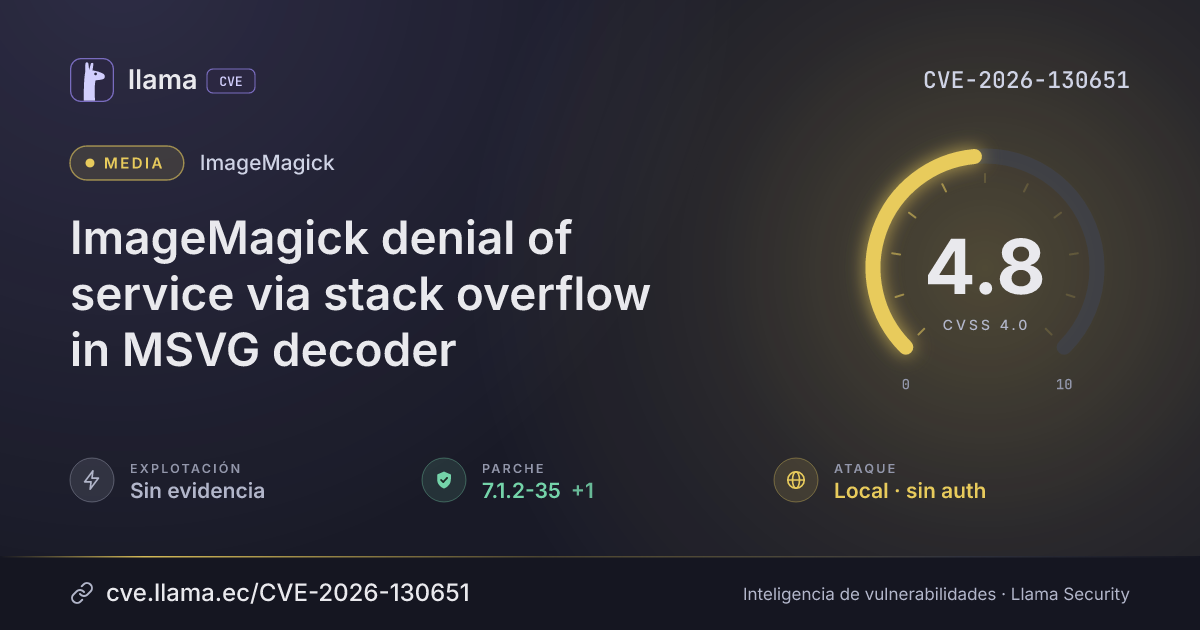
CVE-2026-130651
ImageMagick denial of service via stack overflow in MSVG decoder
A local attacker can crash the application by tricking a user into processing a crafted image.
CVSS:4.0/AV:L/AC:L/AT:N/PR:N/UI:P/VC:N/VI:N/VA:L/SC:N/SI:N/SA:N
Fuente: CNA
Ciclo de vida de la vulnerabilidad
| Fecha | Fase | Evento | Detalle |
|---|---|---|---|
| Divulgación | Publicada | CVE-2026-130651 divulgada · CVSS 4.8 (CNA) | |
| Monitoreo | Detectada | Ingresó al índice | |
| Monitoreo | Fuente: NIST NVD | Registro visto por primera vez en NIST NVD | |
| Monitoreo | Verificada | Última verificación contra las fuentes |
ImageMagick contains a stack overflow flaw in its MSVG decoder that lets an attacker crash the application with a crafted image. The attacker must reach it locally and get a user to process the malicious image, which causes a denial of service.
Descripción original del registro (VulnCheck)
ImageMagick before 7.1.2-35 contains a stack overflow vulnerability in the MSVG decoder that allows attackers to crash the application by supplying a crafted image. Attackers can submit a malicious image for processing to exhaust the stack and terminate the application, causing denial of service.
Desglose de métricas
Rangos afectados
Estado del parche por paquete
| Paquete / producto | Estado | Corregida en | Desde divulgación | Última versión |
|---|---|---|---|---|
ImageMagick |
Corregida | 6.9.13-60, 7.1.2-35 | — | — |
6.9.13-607.1.2-35Arsenal público
Sin exploits, módulos ni PoC públicos conocidos a la fecha de verificación.
https://github.com/ImageMagick/ImageMagick/security/advisories/GHSA-h9f8-qmvx-p39mLas referencias externas se muestran para copiar: cve.llama.ec no lo redirige a otros sitios.