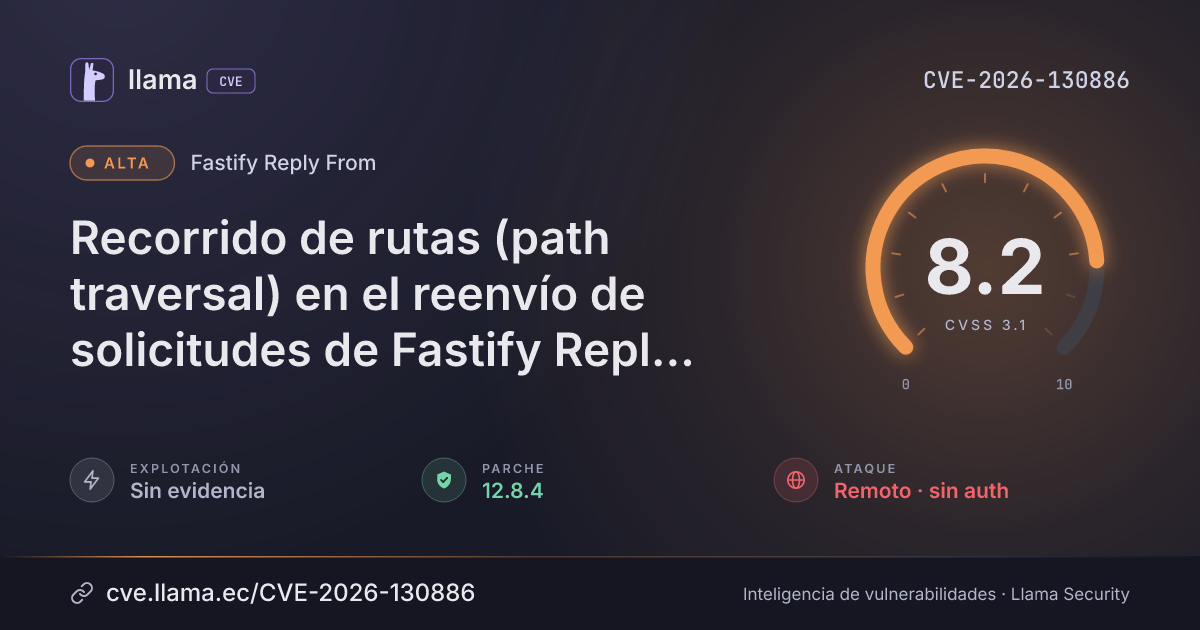
CVE-2026-130886
Fastify Reply From path traversal in request forwarding
A remote attacker without login can send an encoded request to reach endpoints outside the configured path prefix.
Texto original en inglés · Ver en español
CVSS:3.1/AV:N/AC:L/PR:N/UI:N/S:U/C:H/I:L/A:N
Fuente: CNA
Ciclo de vida de la vulnerabilidad
| Fecha | Fase | Evento | Detalle |
|---|---|---|---|
| Divulgación | Publicada | CVE-2026-130886 divulgada · CVSS 8.2 (CNA) | |
| Monitoreo | Detectada | Ingresó al índice | |
| Monitoreo | Fuente: NIST NVD | Registro visto por primera vez en NIST NVD | |
| Divulgación | Evaluación SSVC | CISA-ADP · explotación ninguna | |
| Divulgación | Modificada | Última actualización del registro | |
| Monitoreo | Fuente: ENISA EUVD | Registro visto por primera vez en ENISA EUVD | |
| Monitoreo | Verificada | Última verificación contra las fuentes |
A path traversal flaw in the @fastify/reply-from plugin lets a remote, unauthenticated attacker send a request with a scheme-prefixed, percent-encoded parent-directory sequence that passes the plugin's check and is forwarded unchanged. If the upstream server decodes the path before resolving it, the attacker can escape the configured prefix and reach sibling or parent endpoints.
Only affects @fastify/reply-from 12.8.1 through 12.8.3 when the application scopes proxying to an upstream prefix or the upstream percent-decodes request paths. Fixed in 12.8.4.
Descripción original del registro (openjs)
@fastify/reply-from is a Fastify plugin that forwards requests to an upstream HTTP server. In versions 12.8.1 through 12.8.3, its buildURL function checked the attacker-supplied source string for parent-directory segments, but when the source begins with the same special scheme as the base, such as http or https, the WHATWG URL parser drops the scheme and resolves the remainder as a relative path. A payload that glues the scheme to a percent-encoded parent-directory sequence therefore passes the check, because the inspected segment reads as the scheme plus the dots rather than a bare parent-directory token, while the proxy forwards the encoded traversal unchanged. An upstream that percent-decodes the request path before resolving dot-segments then serves a path outside the configured prefix, so an unauthenticated client scoped to an upstream prefix, or relying on Fastify route guards in front of the proxy, can escape that prefix and reach sibling or parent upstream endpoints. The per-segment check added in 12.8.1 is what the scheme prefix bypasses, and releases up to 12.8.0 already rejected the decoded form. The issue is fixed in @fastify/reply-from 12.8.4, and users should upgrade to 12.8.4 or later.
Condiciones y alcance
Desglose de métricas
Rangos afectados
Estado del parche por paquete
| Paquete / producto | Estado | Corregida en | Desde divulgación | Última versión |
|---|---|---|---|---|
npm@fastify/reply-from |
Sin parche | — | — | 12.8.2 afectada |
12.8.4Arsenal público
Sin exploits, módulos ni PoC públicos conocidos a la fecha de verificación.
https://github.com/fastify/fastify-reply-from/security/advisories/GHSA-2ccw-8rvh-6cmghttps://cna.openjsf.org/security-advisories.htmlLas referencias externas se muestran para copiar: cve.llama.ec no lo redirige a otros sitios.