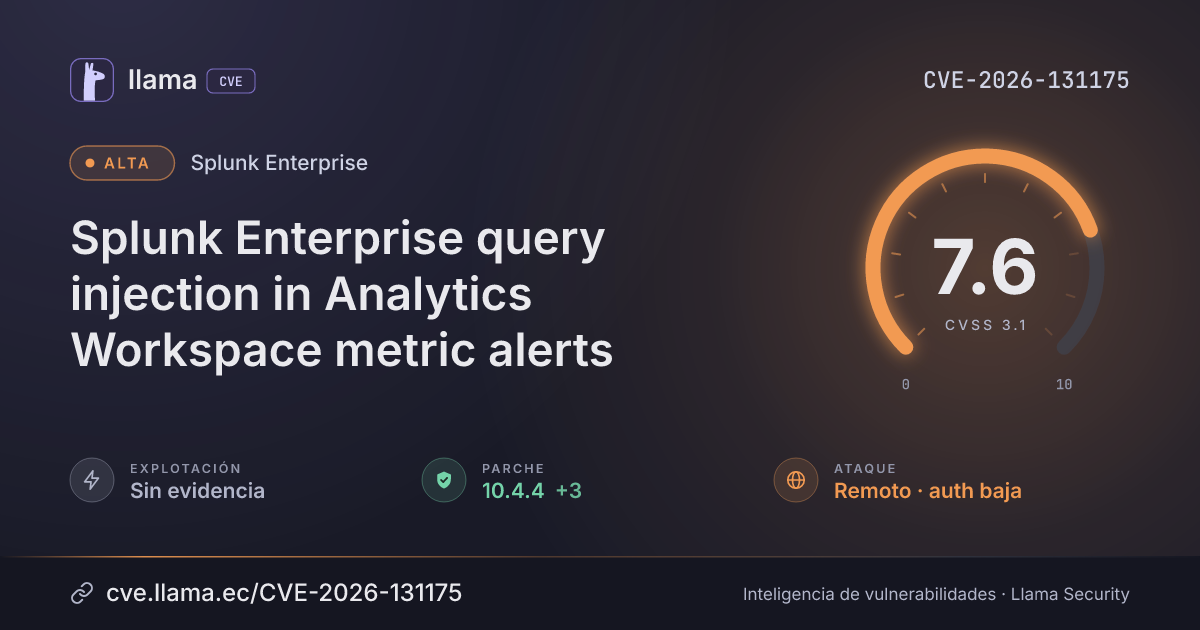
CVE-2026-131175
Splunk Enterprise query injection in Analytics Workspace metric alerts
A user with the power role can make a shared metric alert run malicious SPL when another user opens its link.
CVSS:3.1/AV:N/AC:L/PR:L/UI:R/S:U/C:H/I:H/A:L
Fuente: CNA
Ciclo de vida de la vulnerabilidad
| Fecha | Fase | Evento | Detalle |
|---|---|---|---|
| Divulgación | Publicada | CVE-2026-131175 divulgada · CVSS 7.6 (CNA) | |
| Monitoreo | Detectada | Ingresó al índice | |
| Monitoreo | Fuente: NIST NVD | Registro visto por primera vez en NIST NVD | |
| Divulgación | Evaluación SSVC | CISA-ADP · explotación ninguna | |
| Monitoreo | Fuente: ENISA EUVD | Registro visto por primera vez en ENISA EUVD | |
| Divulgación | Modificada | Última actualización del registro | |
| Monitoreo | Verificada | Última verificación contra las fuentes |
Splunk Enterprise is affected by an SPL injection flaw in Analytics Workspace metric alerts. A user with the "power" role can create and share a metric alert that makes Analytics Workspace run malicious SPL when another logged-in user opens the alert link over the network, which requires that user to be tricked into clicking it.
Splunk Enterprise versions below 10.4.4, 10.2.8, 10.0.11, or 9.4.16 are affected when Analytics Workspace metric alerts are used. Fixed in 10.4.4, 10.2.8, 10.0.11, and 9.4.16.
Descripción original del registro (cisco)
In Splunk Enterprise versions below 10.4.4, 10.2.8, 10.0.11, and 9.4.16, a user who holds the "power" Splunk role could create and share a metric alert that causes Analytics Workspace to run a malicious Search Processing Language (SPL) when another authenticated user opens a link to the alert. The malicious SPL could expose data, modify data, or disrupt services available in the affected session. The vulnerability is possible because Analytics Workspace does not fully neutralize metric alert names before including the names in SPL. The vulnerability requires the attacker to phish the user by tricking them into opening a link that the attacker creates. The user who holds the "power" Splunk role should not be able to exploit the vulnerability at will. For more information see Alerts in the Analytics Workspace (https://help.splunk.com/en/splunk-enterprise/create-dashboards-and-reports/analytics-workspace/10.4/using-the-analytics-workspace/alerts-in-the-analytics-workspace) and Define roles on the Splunk platform with capabilities (https://help.splunk.com/en/splunk-enterprise/administer/manage-users-and-security/10.4/manage-splunk-platform-users-and-roles/define-roles-on-the-splunk-platform-with-capabilities) in the Splunk documentation.
Condiciones y alcance
Desglose de métricas
Rangos afectados
Estado del parche por paquete
| Paquete / producto | Estado | Corregida en | Desde divulgación | Última versión |
|---|---|---|---|---|
Splunk Enterprise |
Corregida | 9.4.16, 10.0.11, 10.2.8, 10.4.4 | — | — |
9.4.1610.0.1110.2.810.4.4Arsenal público
Sin exploits, módulos ni PoC públicos conocidos a la fecha de verificación.
https://advisory.splunk.com/advisories/SVD-2026-1103Las referencias externas se muestran para copiar: cve.llama.ec no lo redirige a otros sitios.