llamaCVEVulnerability Intelligence
/
Splunk Enterprise

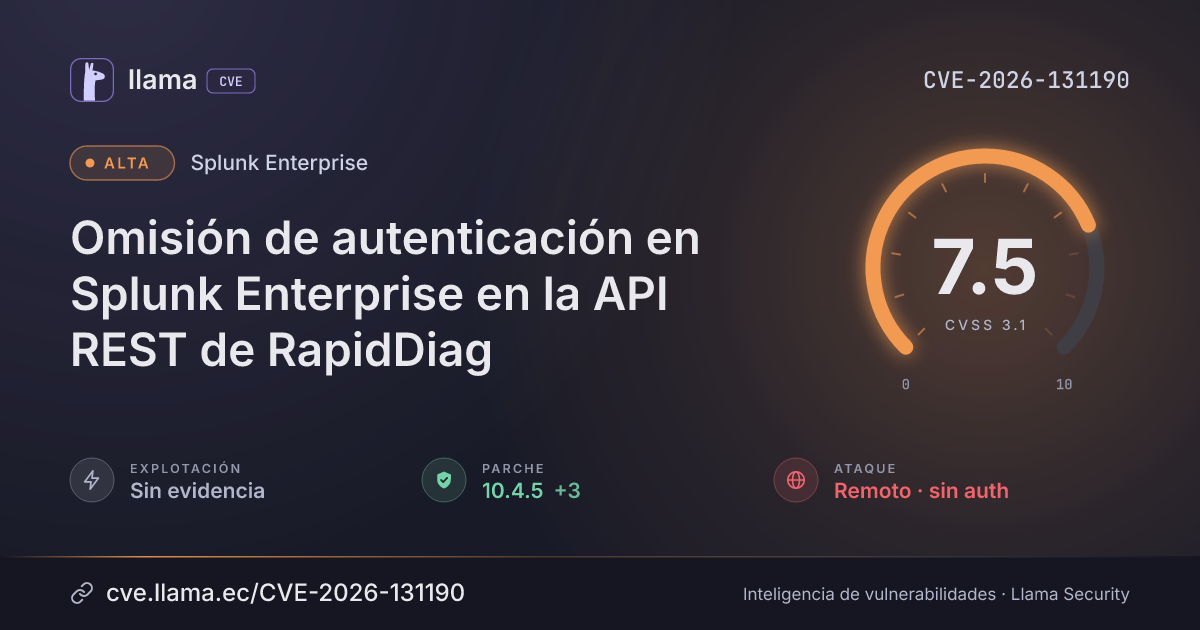
CVE-2026-131190

Splunk Enterprise auth bypass in RapidDiag REST API

A network attacker with no login can view RapidDiag process metadata and log file lists.

UnclearParche disponiblehard-coded credentials
Descargar PNG JSON
CVSS 3.1
7.5
Alta
CVSS:3.1/AV:N/AC:L/PR:N/UI:N/S:U/C:H/I:N/A:N Fuente: CNA
ExplotaciónSin evidenciaSSVC: ninguna · no figura en CISA KEV
Exploits públicos0Ninguno conocido
Parche4 versiones9.4.17 · 10.0.12 · 10.2.9 · 10.4.5
Exposición1 dDesde la divulgación, 19 nov 2026, 2:55 p. m.
Detección5 minDesde la divulgación hasta su ingreso al índice
Decisión SSVCSeguir
Remediar en la ventana regular de mantenimiento
Sin explotación conocida, automatizable e impacto técnico parcial. Hay versiones corregidas disponibles.
Timeline

Ciclo de vida de la vulnerabilidad

Hoy
Divulgación
Publicada
Evaluación SSVC +1
Explotación
Remediación
Monitoreo
Detectada +1
Fuente: ENISA EUVD +1
02:55 p. m.
03:00 p. m.
11:56 a. m.
12:01 p. m.
02:49 a. m.
02:55 p. m.
11:54 p. m.
08:52 a. m.
05:51 p. m.
02:49 a. m.
FechaFaseEventoDetalle
Divulgación Publicada CVE-2026-131190 divulgada · CVSS 7.5 (CNA)
Monitoreo Detectada Ingresó al índice
Monitoreo Fuente: NIST NVD Registro visto por primera vez en NIST NVD
Divulgación Evaluación SSVC CISA-ADP · explotación ninguna
Divulgación Modificada Última actualización del registro
Monitoreo Fuente: ENISA EUVD Registro visto por primera vez en ENISA EUVD
Monitoreo Verificada Última verificación contra las fuentes
Resumen
Resumen generado por IA · CC-BY 4.0 · 19 nov 2026

Splunk Enterprise has an authentication bypass in its RapidDiag REST API. An unauthenticated attacker on the network can reach it without logging in and view RapidDiag process metadata and log file inventory information, because certain endpoints accept a factory-default shared key for node authentication.

Only affects Splunk Enterprise below 10.4.5, 10.2.9, 10.0.12, and 9.4.17 with the RapidDiag app installed and enabled. Fixed in 10.4.5, 10.2.9, 10.0.12, and 9.4.17.

¿Qué significa?Certain RapidDiag REST API endpoints accept a factory-default shared key for node authentication. An unauthenticated user could access RapidDiag process metadata and log file inventory information, bypassing Splunk user authentication.
¿Quién está afectado?Splunk Enterprise versions below 10.4.5, 10.2.9, 10.0.12, and 9.4.17 are affected when the RapidDiag app is installed and enabled. Check the installed Splunk Enterprise version and whether the RapidDiag app is installed and enabled.
¿Qué hacer?Upgrade Splunk Enterprise to 10.4.5, 10.2.9, 10.0.12, or 9.4.17 or higher. Splunk recommends 10.6.1 as a newer version. Until the upgrade, turn off or remove the RapidDiag app.
Descripción original del registro (cisco)

In Splunk Enterprise versions below 10.4.5, 10.2.9, 10.0.12, and 9.4.17, an unauthenticated user could access RapidDiag process metadata and log file inventory information through the Representational State Transfer (REST) API. The vulnerability is possible because certain RapidDiag REST API endpoints accept a factory-default shared key for node authentication, which lets requests bypass Splunk user authentication. For more information see Using RapidDiag (https://help.splunk.com/en/splunk-enterprise/administer/troubleshoot/9.0/contact-splunk-support/using-rapiddiag) and Secure Splunk Enterprise services with pass4SymmKey (https://help.splunk.com/en/splunk-enterprise/administer/manage-users-and-security/10.0/secure-distributed-and-clustered-splunk-environments/secure-splunk-enterprise-services-with-pass4symmkey) in the Splunk documentation.

Contexto

Condiciones y alcance

Condiciones necesarias para que el fallo sea explotable
01
Splunk Enterprise versions below 10.4.5, 10.2.9, 10.0.12, and 9.4.17“In Splunk Enterprise versions below 10.4.5, 10.2.9, 10.0.12, and 9.4.17”
02
RapidDiag REST API endpoints accept a factory-default shared key for node authentication“certain RapidDiag REST API endpoints accept a factory-default shared key for node authentication”
03
The RapidDiag app is installed and enabled“Turn off or remove the RapidDiag app.”
¿Quién debe revisar?Teams running Splunk Enterprise below 10.4.5, 10.2.9, 10.0.12, or 9.4.17 that use the RapidDiag app or its REST API, including Splunk support-diagnostics deployments
MitigaciónTurn off or remove the RapidDiag app.
Vector CVSS 3.1

Desglose de métricas

Opción resaltada = valor del vector · izquierda = peor caso · CNA
Vector de ataqueAV:N
RedAdyacenteLocalFísica
ComplejidadAC:L
BajaAlta
PrivilegiosPR:N
NingunoBajosAltos
InteracciónUI:N
NingunaRequerida
AlcanceS:U
CambiadoSin cambio
ConfidencialidadC:H
AltoBajoNinguno
IntegridadI:N
AltoBajoNinguno
DisponibilidadA:N
AltoBajoNinguno
Score de explotaciónQué tan fácil y probable es que la exploten
10.0/ 10Muy alto
Vector 10.0 (muy fácil) · sin evidencia de explotación.
Versiones

Rangos afectados

Afectada Corregida
Splunk Enterprise≥ 9.4 < 9.4.17
Splunk Enterprise≥ 10.0 < 10.0.12
Splunk Enterprise≥ 10.2 < 10.2.9
Splunk Enterprise≥ 10.4 < 10.4.5
9.4
9.4.17
10.0
10.0.12
10.2
10.2.9
10.4
10.4.5
Remediación

Estado del parche por paquete

Paquete / productoEstadoCorregida enDesde divulgaciónÚltima versión
Splunk Enterprise
Corregida 9.4.17, 10.0.12, 10.2.9, 10.4.5 — —
Versiones corregidas9.4.1710.0.1210.2.910.4.5
Explotación

Arsenal público

Sin exploits, módulos ni PoC públicos conocidos a la fecha de verificación.

Registro
EscenarioGENERALcisco
MitigaciónTurn off or remove the RapidDiag app. For more information see [Manage app and add-on objects](https://help.splunk.com/en/splunk-enterprise/administer/admin-manual/10.2/meet-splunk-apps/manage-app-and-add-on-objects) in the Splunk documentation.cisco
solutionUpgrade Splunk Enterprise versions 10.6.1, 10.4.5, 10.2.9, 10.0.12, and 9.4.17 or higher.cisco
Referencias
Fabricantehttps://advisory.splunk.com/advisories/SVD-2026-1103

Las referencias externas se muestran para copiar: cve.llama.ec no lo redirige a otros sitios.