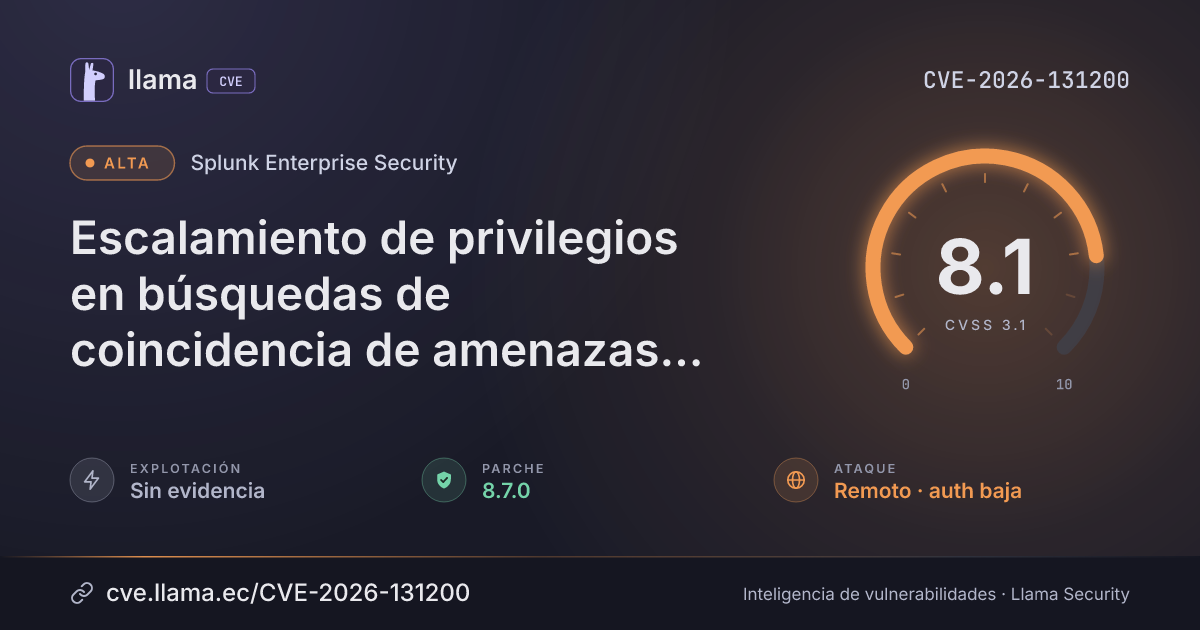
CVE-2026-131200
Splunk Enterprise Security privilege escalation in threat matching searches
A user with the ess_analyst role can run arbitrary SPL commands with elevated privileges remotely.
Texto original en inglés · Ver en español
CVSS:3.1/AV:N/AC:L/PR:L/UI:N/S:U/C:H/I:H/A:N
Fuente: CNA
Ciclo de vida de la vulnerabilidad
| Fecha | Fase | Evento | Detalle |
|---|---|---|---|
| Divulgación | Publicada | CVE-2026-131200 divulgada · CVSS 8.1 (CNA) | |
| Monitoreo | Detectada | Ingresó al índice | |
| Monitoreo | Fuente: NIST NVD | Registro visto por primera vez en NIST NVD | |
| Divulgación | Evaluación SSVC | CISA-ADP · explotación ninguna | |
| Monitoreo | Fuente: ENISA EUVD | Registro visto por primera vez en ENISA EUVD | |
| Divulgación | Modificada | Última actualización del registro | |
| Monitoreo | Verificada | Última verificación contra las fuentes |
Splunk Enterprise Security has a privilege escalation flaw in its threat matching searches. A user with the ess_analyst role can create a saved search that threat intelligence lookup generation later runs with elevated permissions. An attacker with such a low-privileged account can reach this remotely over the network and run arbitrary Search Processing Language (SPL) commands with those elevated permissions.
Affects Splunk Enterprise Security versions below 8.7.0 where users hold the ess_analyst role. Fixed in 8.7.0.
Descripción original del registro (cisco)
In Splunk Enterprise Security versions below 8.7.0, a user who holds the "ess_analyst" Splunk Enterprise Security role could create an attacker-controlled saved search. Threat intelligence lookup generation could later run the saved search with elevated permissions, which could let the user who created the saved search run arbitrary Search Processing Language (SPL) commands with those permissions. The vulnerability is possible because Splunk Enterprise Security does not restrict threat intelligence lookup generation to the intended saved searches. For more information see Users and roles for Splunk Enterprise Security (https://help.splunk.com/en/splunk-enterprise-security-8/install/8.7/installation/users-and-roles-for-splunk-enterprise-security) and Turn on threat matching searches in Splunk Enterprise Security (https://help.splunk.com/en/splunk-enterprise-security-8/administer/8.0/threat-intelligence/turn-on-threat-matching-searches-in-splunk-enterprise-security) in the Splunk documentation.
Condiciones y alcance
Desglose de métricas
Rangos afectados
Estado del parche por paquete
| Paquete / producto | Estado | Corregida en | Desde divulgación | Última versión |
|---|---|---|---|---|
Splunk Enterprise Security |
Corregida | 8.7.0 | — | — |
8.7.0Arsenal público
Sin exploits, módulos ni PoC públicos conocidos a la fecha de verificación.
https://advisory.splunk.com/advisories/SVD-2026-1106Las referencias externas se muestran para copiar: cve.llama.ec no lo redirige a otros sitios.