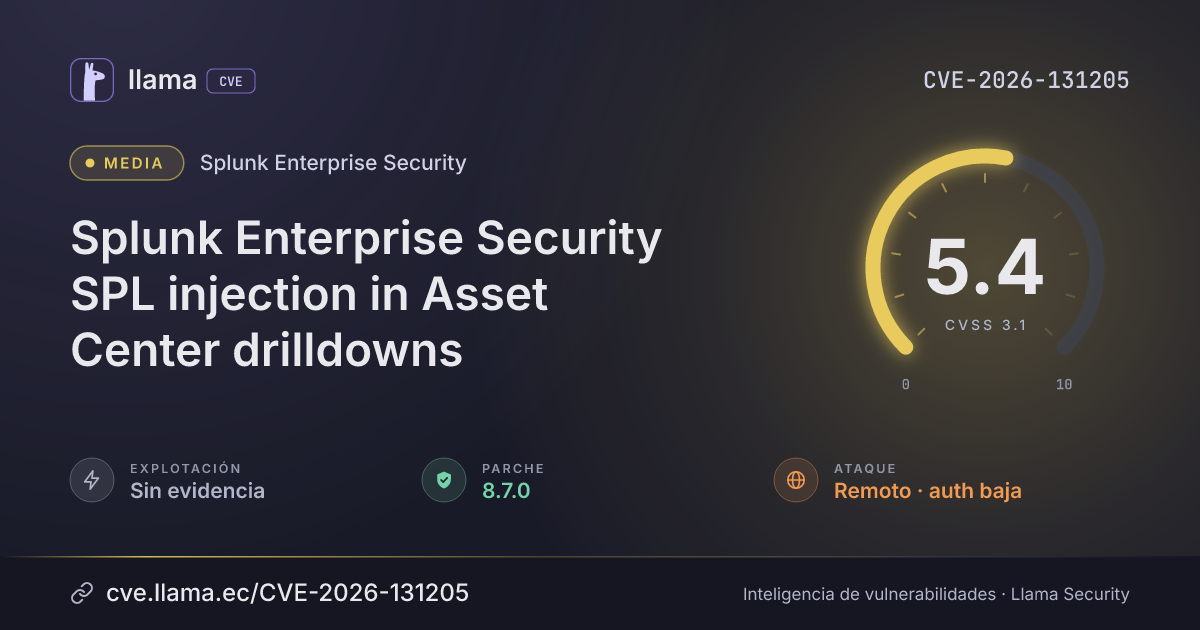
CVE-2026-131205
Splunk Enterprise Security SPL injection in Asset Center drilldowns
An attacker can run search commands as another user, exposing or modifying data that user can access.
CVSS:3.1/AV:N/AC:H/PR:L/UI:R/S:U/C:H/I:L/A:N
Fuente: CNA
Ciclo de vida de la vulnerabilidad
| Fecha | Fase | Evento | Detalle |
|---|---|---|---|
| Divulgación | Publicada | CVE-2026-131205 divulgada · CVSS 5.4 (CNA) | |
| Monitoreo | Detectada | Ingresó al índice | |
| Monitoreo | Fuente: NIST NVD | Registro visto por primera vez en NIST NVD | |
| Divulgación | Evaluación SSVC | CISA-ADP · explotación ninguna | |
| Divulgación | Modificada | Última actualización del registro | |
| Monitoreo | Verificada | Última verificación contra las fuentes |
Splunk Enterprise Security has an injection flaw in Asset Center, where asset values are not escaped before they are used in drilldown searches. A low-privileged user on the network can exploit it by storing crafted asset data, but the attack only runs when another user selects that value in the Asset Information table. Once triggered, the attacker's Search Processing Language (SPL) commands run with the selected user's permissions, which could expose or modify data that user can access.
Descripción original del registro (cisco)
In Splunk Enterprise Security versions below 8.7.0, a user who holds the "ess_user" Splunk Enterprise Security role could store attacker-controlled asset data in an asset source lookup. A user that holds a role with the mc_assets_read capability could later open the Asset Center dashboard and select that value in the Asset Information table. Splunk Enterprise Security could then run attacker-controlled Search Processing Language (SPL) commands using the permissions of that user. With this access, the user who stored the asset data could expose or modify data available to the user who selected the value. The vulnerability is possible because Asset Center does not escape asset values before adding them to drilldown searches. The vulnerability requires Asset Center to process the asset data and another user to select the value. The user who stored the data should not be able to exploit the vulnerability at will. For more information see Users and roles for Splunk Enterprise Security (https://help.splunk.com/en/splunk-enterprise-security-8/install/8.7/installation/users-and-roles-for-splunk-enterprise-security), Add asset and identity data to Splunk Enterprise Security (https://help.splunk.com/en/splunk-enterprise-security-8/administer/8.7/asset-and-identity-management/add-asset-and-identity-data-to-splunk-enterprise-security), and Asset and identity dashboards (https://help.splunk.com/en/splunk-enterprise-security-8/user-guide/8.7/analytics/asset-and-identity-dashboards) in the Splunk documentation.
Desglose de métricas
Rangos afectados
Estado del parche por paquete
| Paquete / producto | Estado | Corregida en | Desde divulgación | Última versión |
|---|---|---|---|---|
Splunk Enterprise Security |
Corregida | 8.7.0 | — | — |
8.7.0Arsenal público
Sin exploits, módulos ni PoC públicos conocidos a la fecha de verificación.
https://advisory.splunk.com/advisories/SVD-2026-1106Las referencias externas se muestran para copiar: cve.llama.ec no lo redirige a otros sitios.