llamaCVEVulnerability Intelligence
/
Splunk Enterprise Security

CVE-2026-131215

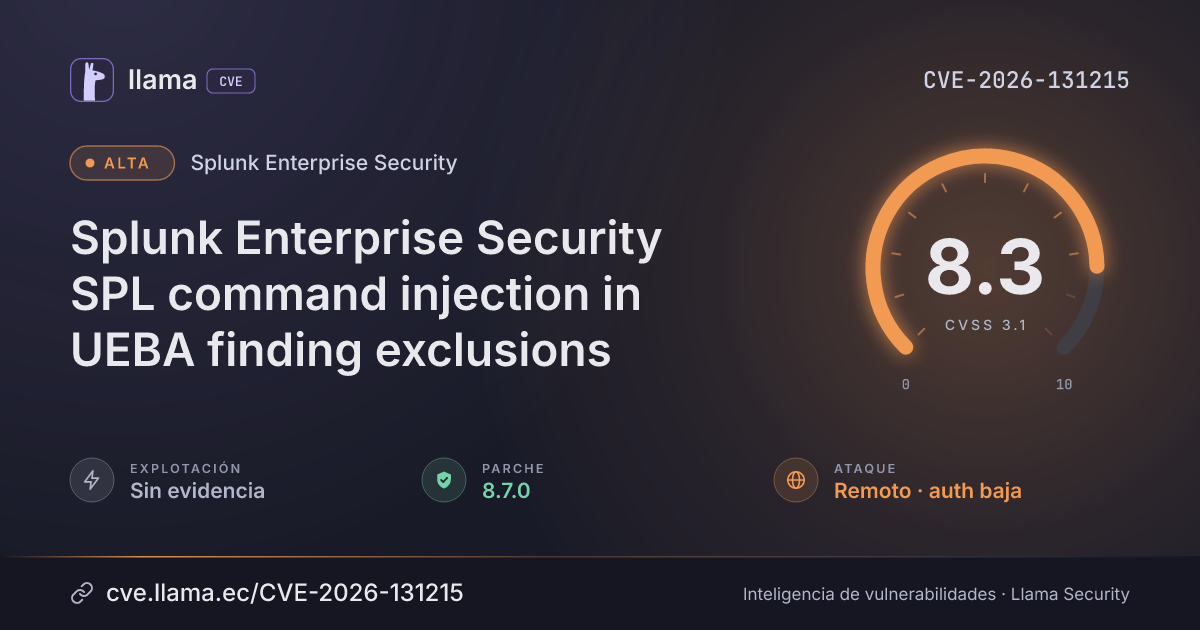
Splunk Enterprise Security SPL command injection in UEBA finding exclusions

A user with rule-editing access can run their own search commands with elevated rights to read stored credentials.

Solo en configuraciones específicasParche disponibleinjection
Descargar PNG JSON
CVSS 3.1
8.3
Alta
CVSS:3.1/AV:N/AC:L/PR:L/UI:N/S:U/C:H/I:H/A:L Fuente: CNA
ExplotaciónSin evidenciaSSVC: ninguna · no figura en CISA KEV
Exploits públicos0Ninguno conocido
Parche1 versión8.7.0
Exposición1 dDesde la divulgación, 19 nov 2026, 2:55 p. m.
Detección10 minDesde la divulgación hasta su ingreso al índice
Decisión SSVCSeguir de cerca
Monitorear y programar la remediación
Sin explotación conocida, no automatizable e impacto técnico total. Hay versiones corregidas disponibles.
Timeline

Ciclo de vida de la vulnerabilidad

Hoy
Divulgación
Publicada
Evaluación SSVC +1
Explotación
Remediación
Monitoreo
Detectada +1
Verificada
02:55 p. m.
03:05 p. m.
07:29 a. m.
03:32 a. m.
02:55 p. m.
12:05 a. m.
09:14 a. m.
06:23 p. m.
03:32 a. m.
FechaFaseEventoDetalle
Divulgación Publicada CVE-2026-131215 divulgada · CVSS 8.3 (CNA)
Monitoreo Detectada Ingresó al índice
Monitoreo Fuente: NIST NVD Registro visto por primera vez en NIST NVD
Divulgación Evaluación SSVC CISA-ADP · explotación ninguna
Divulgación Modificada Última actualización del registro
Monitoreo Verificada Última verificación contra las fuentes
Resumen

In Splunk Enterprise Security versions below 8.7.0, a user that holds a role with the ueba_finding_exclusion_edit capability could store attacker-controlled values in a User and Entity Behavior Analytics (UEBA) finding exclusion rule. Splunk Enterprise Security could later run attacker-controlled Search Processing Language (SPL) commands from the rule with elevated permissions. With this access, the user could cause Splunk Enterprise Security to read stored credentials and modify lookups and knowledge objects. The vulnerability is possible because the UEBA finding exclusion workflow does not escape user-controlled rule values before using them in generated SPL. For more information see Create a finding exclusion rule using UEBA configuration page (https://help.splunk.com/en/splunk-enterprise-security-8/administer/8.7/user-and-entity-behavior-analytics/finding-exclusions-in-splunk-enterprise-security/create-a-finding-exclusion-rule-using-ueba-configuration-page) and Users and roles for Splunk Enterprise Security (https://help.splunk.com/en/splunk-enterprise-security-8/install/8.7/installation/users-and-roles-for-splunk-enterprise-security) in the Splunk documentation.

Affects Splunk Enterprise Security below 8.7.0, where users with the ueba_finding_exclusion_edit capability can inject SPL through UEBA finding exclusion rule values. Fixed in 8.7.0.

¿Qué significa?The UEBA finding exclusion workflow does not escape user-controlled rule values before placing them in generated SPL. A user with the right capability can therefore run attacker-controlled SPL commands with elevated permissions, read stored credentials, and modify lookups and knowledge objects.
¿Quién está afectado?Splunk Enterprise Security versions below 8.7.0 are affected, but only where a role holds the ueba_finding_exclusion_edit capability. To check, look at the installed Splunk Enterprise Security version and at which roles hold that capability.
¿Qué hacer?Upgrade Splunk Enterprise Security to version 8.7.0 or later, which is the fixed version listed for this vulnerability.
Contexto

Condiciones y alcance

Condiciones necesarias para que el fallo sea explotable
01
Splunk Enterprise Security versions below 8.7.0“In Splunk Enterprise Security versions below 8.7.0”
02
The attacker holds a role with the ueba_finding_exclusion_edit capability“a user that holds a role with the ueba_finding_exclusion_edit capability”
03
The UEBA finding exclusion workflow generates SPL from user-controlled rule values“the UEBA finding exclusion workflow does not escape user-controlled rule values before using them in generated SPL”
¿Quién debe revisar?Teams running Splunk Enterprise Security below 8.7.0 that use UEBA finding exclusion rules, and anyone granting the ueba_finding_exclusion_edit capability
Vector CVSS 3.1

Desglose de métricas

Opción resaltada = valor del vector · izquierda = peor caso · CNA
Vector de ataqueAV:N
RedAdyacenteLocalFísica
ComplejidadAC:L
BajaAlta
PrivilegiosPR:L
NingunoBajosAltos
InteracciónUI:N
NingunaRequerida
AlcanceS:U
CambiadoSin cambio
ConfidencialidadC:H
AltoBajoNinguno
IntegridadI:H
AltoBajoNinguno
DisponibilidadA:L
AltoBajoNinguno
Score de explotaciónQué tan fácil y probable es que la exploten
8.3/ 10Alto
Vector 8.3 (muy fácil) · sin evidencia de explotación.
Versiones

Rangos afectados

Afectada Corregida
Splunk Enterprise Security< 8.7.0
8.7.0
Remediación

Estado del parche por paquete

Paquete / productoEstadoCorregida enDesde divulgaciónÚltima versión
Splunk Enterprise Security
Corregida 8.7.0 — —
Versiones corregidas8.7.0
Explotación

Arsenal público

Sin exploits, módulos ni PoC públicos conocidos a la fecha de verificación.

Registro
EscenarioGENERALcisco
solutionUpgrade Splunk Enterprise Security and Splunk App for PCI Compliance to version 8.7.0 or higher.cisco
Referencias
Fabricantehttps://advisory.splunk.com/advisories/SVD-2026-1106

Las referencias externas se muestran para copiar: cve.llama.ec no lo redirige a otros sitios.