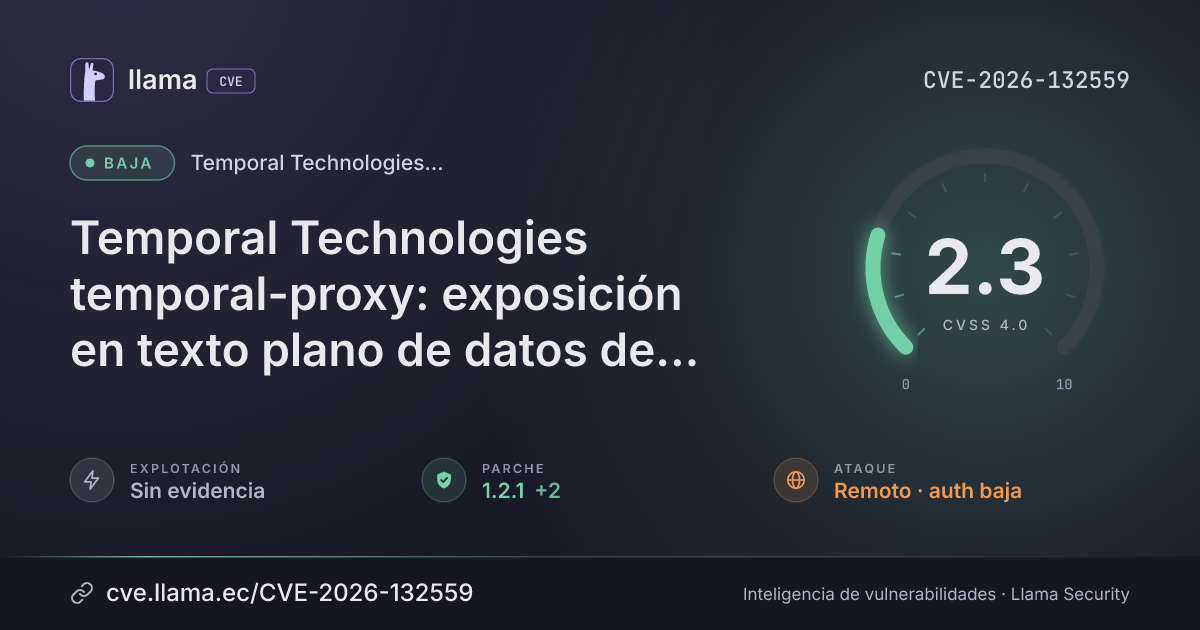
CVE-2026-132559
Temporal Technologies temporal-proxy plaintext exposure of failure data in workflow history
A low-privilege attacker can expose decrypted failure messages and stack traces to anyone reading workflow history.
Texto original en inglés · Ver en español
CVSS:4.0/AV:N/AC:L/AT:P/PR:L/UI:N/VC:L/VI:N/VA:N/SC:N/SI:N/SA:N
Fuente: CNA
Ciclo de vida de la vulnerabilidad
| Fecha | Fase | Evento | Detalle |
|---|---|---|---|
| Divulgación | Publicada | CVE-2026-132559 divulgada · CVSS 2.3 (CNA) | |
| Monitoreo | Detectada | Ingresó al índice | |
| Divulgación | Evaluación SSVC | CISA-ADP · explotación ninguna | |
| Monitoreo | Fuente: NIST NVD | Registro visto por primera vez en NIST NVD | |
| Monitoreo | Fuente: ENISA EUVD | Registro visto por primera vez en ENISA EUVD | |
| Divulgación | Modificada | Última actualización del registro | |
| Monitoreo | Verificada | Última verificación contra las fuentes |
Temporal Technologies' temporal-proxy can store decrypted failure messages and stack traces in plaintext at the upstream Temporal service, where anyone who can read the Workflow's history can see them. A remote attacker with low-privilege access can trigger this by sending a failure back through the proxy, which forwards the restored text unchanged.
Descripción original del registro (Temporal)
When payload encryption is enabled, failure messages and stack traces that temporal-proxy is configured to keep from the upstream Temporal service can reach it in plaintext, where anyone who can read the Workflow's history at the upstream can read them. When the proxy returns a failure to a Worker, it decrypts the failure's encoded attributes and copies the message and stack trace back onto the failure, keeping the attributes. A Worker that sends that failure back through the proxy, as SDKs do when an Activity failure becomes the cause of a Workflow failure, sends the restored text with it, and the proxy forwards the text unchanged because the failure already has encoded attributes. The upstream then stores the text in plaintext beside its encrypted copy. This affects deployments that enable failure encryption in the proxy, and deployments that leave it off while the SDK encodes failure attributes itself. Payloads are not affected. temporal-proxy versions 0.9.0 through 1.2.0 are affected. The issue is fixed in 1.0.2, 1.1.2, and 1.2.1, and releases before 1.0.0 receive no fix. Upgrade to the fixed release for the deployed minor release line.
Desglose de métricas
Rangos afectados
Estado del parche por paquete
| Paquete / producto | Estado | Corregida en | Desde divulgación | Última versión |
|---|---|---|---|---|
gogithub.com/temporalio/temporal-proxy |
Sin parche | — | — | v0.9.1 afectada |
1.0.21.1.21.2.1Arsenal público
Sin exploits, módulos ni PoC públicos conocidos a la fecha de verificación.
https://github.com/temporalio/temporal-proxy/pull/296https://github.com/temporalio/temporal-proxy/commit/68dea481cdd8112432d5efb495b0963e03fff14dhttps://github.com/temporalio/temporal-proxy/pull/305https://github.com/temporalio/temporal-proxy/commit/53710919feb8af12e2f4b789e2d997a412cdd33fhttps://github.com/temporalio/temporal-proxy/pull/304https://github.com/temporalio/temporal-proxy/commit/95b99dceaa1a19c666b1661e2edef4090acda119https://github.com/temporalio/temporal-proxy/pull/308https://github.com/temporalio/temporal-proxy/commit/85492b5728362d8fd082e5cff9290a23c016ae30https://github.com/temporalio/temporal-proxy/pull/303https://github.com/temporalio/temporal-proxy/commit/8bd1045ccfaaa54580444dd9855fd87f3b1b252bhttps://github.com/temporalio/temporal-proxy/pull/307https://github.com/temporalio/temporal-proxy/commit/7742a645c526dde4b6a182e6e55e2f9d9ea2b43bVer 9 referencias más
https://github.com/temporalio/temporal-proxy/pull/302https://github.com/temporalio/temporal-proxy/commit/c5d211cda68a7c07ec691b3b47f1c0ab6fc495fbhttps://github.com/temporalio/temporal-proxy/pull/306https://github.com/temporalio/temporal-proxy/commit/ea541ae21fbfda65bd867a88020ddfce0b92c907https://github.com/temporalio/temporal-proxy/blob/v1.2.0/pkg/codec/failure.go#L26-L29https://github.com/temporalio/temporal-proxy/blob/v1.2.0/pkg/codec/failure.go#L55-L70https://github.com/temporalio/temporal-proxy/releases/tag/v1.0.2https://github.com/temporalio/temporal-proxy/releases/tag/v1.1.2https://github.com/temporalio/temporal-proxy/releases/tag/v1.2.1Las referencias externas se muestran para copiar: cve.llama.ec no lo redirige a otros sitios.