CVE-2026-132663
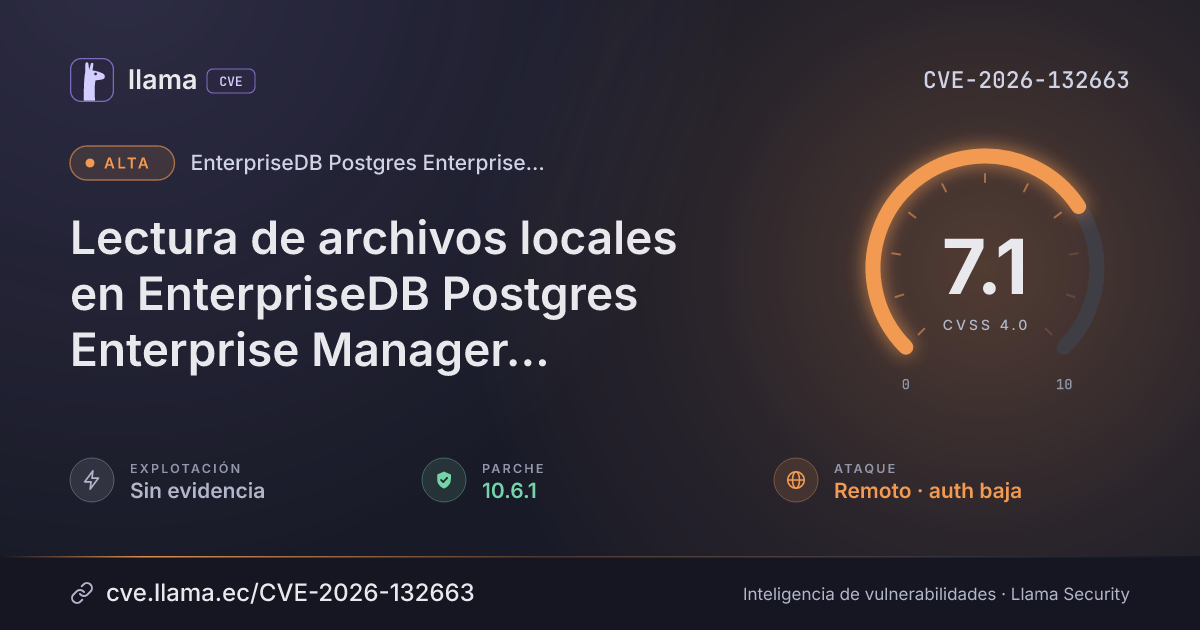
EnterpriseDB Postgres Enterprise Manager local file read via alert webhook URLs
A low-privilege user can read local files on the server through alert webhooks and view their contents.
CVSS:4.0/AV:N/AC:L/AT:N/PR:L/UI:N/VC:H/VI:N/VA:N/SC:N/SI:N/SA:N
Fuente: CNA
Ciclo de vida de la vulnerabilidad
| Fecha | Fase | Evento | Detalle |
|---|---|---|---|
| Divulgación | Publicada | CVE-2026-132663 divulgada · CVSS 7.1 (CNA) | |
| Monitoreo | Detectada | Ingresó al índice | |
| Monitoreo | Verificada | Última verificación contra las fuentes |
Users with the alert configuration role in Postgres Enterprise Manager (PEM) can set a webhook to a file:// URL, which makes the PEM agent on the server read a local file and store its contents in a database record that any PEM user can read. The attack is carried out over the network by a user who has a low-privilege login to PEM.
Descripción original del registro (EDB)
In Postgres Enterprise Manager (PEM), webhook URLs are not validated, and the PEM agent does not restrict the URL schemes it uses to deliver webhooks. A user with the alert configuration role (pem_config_alert) can set up a webhook with a file:// URL. When the webhook is sent, the agent on the PEM server, which runs as root by default, reads the local file and stores its contents in the webhook error record in the PEM database, where any PEM user can read it. From PEM 10.6.1, PEM accepts and sends only http and https webhook URLs.
Desglose de métricas
Rangos afectados
Estado del parche por paquete
| Paquete / producto | Estado | Corregida en | Desde divulgación | Última versión |
|---|---|---|---|---|
Postgres Enterprise Manager |
Corregida | 10.6.1 | — | — |
10.6.1Arsenal público
Sin exploits, módulos ni PoC públicos conocidos a la fecha de verificación.
https://www.enterprisedb.com/docs/security/advisories/cve2026132663/Las referencias externas se muestran para copiar: cve.llama.ec no lo redirige a otros sitios.